Certification of Normal Category Rotorcraft — Changes 1–9
Normal category rotorcraft guidance with Changes 1–9 incorporated. Search the complete AC or start with the system safety, flight controls and instrument-flight guidance.
This source includes guidance for different amendments of Part 27. Match the guidance to the aircraft’s agreed certification basis: the 27.1309 entries for Amendments 27-21, 27-46 and 27-51 are separate. The base AC was issued on 30 September 1999; Change 9 is dated 23 June 2023. The FAA catalogue’s 30 September 2008 date is not the date of the latest change.
The source, within reach.
Search within this AC, jump to a source page, or download the complete saved publication.
This extraction supports search. Read the original page for complete notation and layout.
9/30/2008                                       AC 27-1B, Chg 3

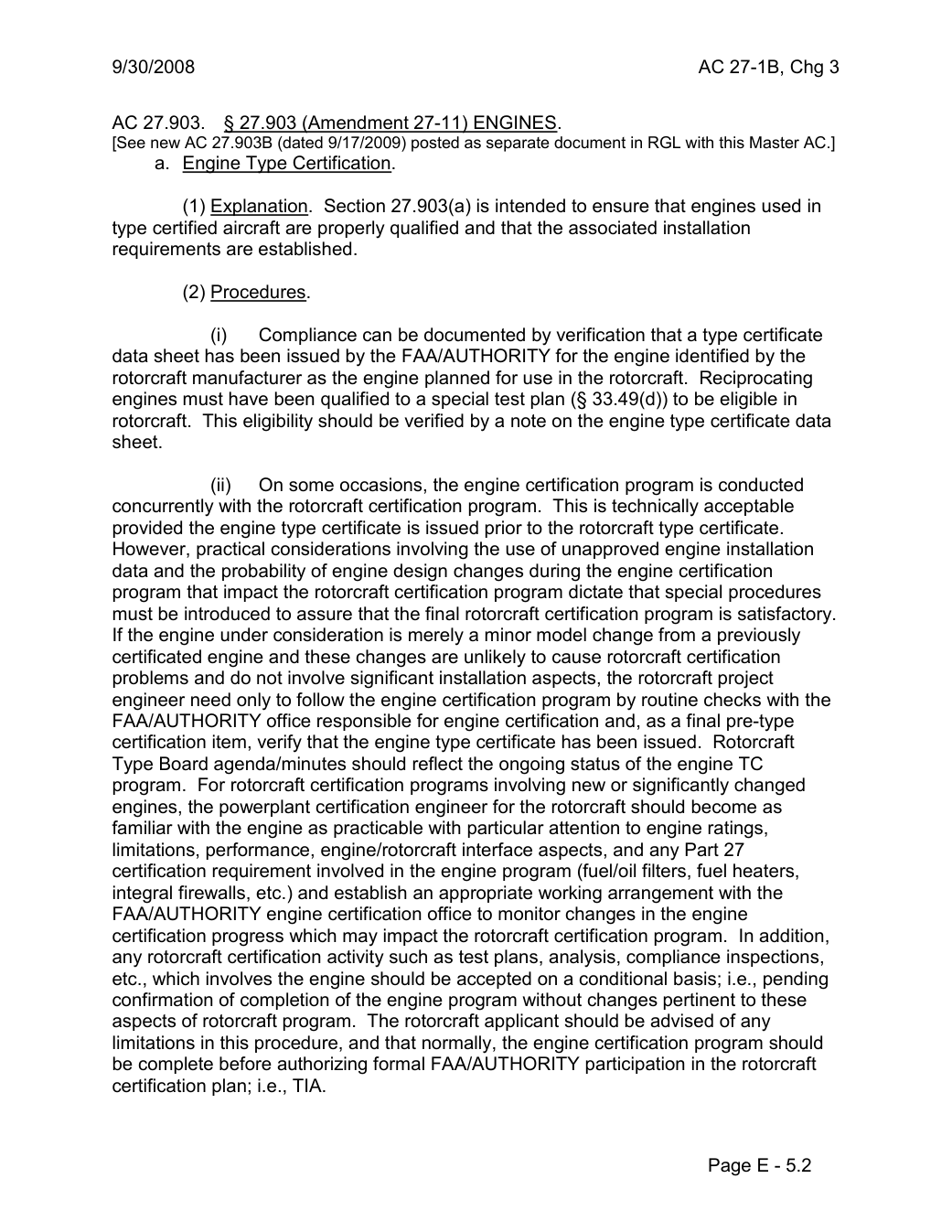
AC 27.903.  § 27.903 (Amendment 27-11) ENGINES.
[See new AC 27.903B (dated 9/17/2009) posted as separate document in RGL with this Master AC.]
     a. Engine Type Certification.

         (1) Explanation. Section 27.903(a) is intended to ensure that engines used in
type certified aircraft are properly qualified and that the associated installation
requirements are established.

         (2) Procedures.

                  (i)   Compliance can be documented by verification that a type certificate
data sheet has been issued by the FAA/AUTHORITY for the engine identified by the
rotorcraft manufacturer as the engine planned for use in the rotorcraft. Reciprocating
engines must have been qualified to a special test plan (§ 33.49(d)) to be eligible in
rotorcraft. This eligibility should be verified by a note on the engine type certificate data
sheet.

                   (ii)  On some occasions, the engine certification program is conducted
concurrently with the rotorcraft certification program. This is technically acceptable
provided the engine type certificate is issued prior to the rotorcraft type certificate.
However, practical considerations involving the use of unapproved engine installation
data and the probability of engine design changes during the engine certification
program that impact the rotorcraft certification program dictate that special procedures
must be introduced to assure that the final rotorcraft certification program is satisfactory.
If the engine under consideration is merely a minor model change from a previously
certificated engine and these changes are unlikely to cause rotorcraft certification
problems and do not involve significant installation aspects, the rotorcraft project
engineer need only to follow the engine certification program by routine checks with the
FAA/AUTHORITY office responsible for engine certification and, as a final pre-type
certification item, verify that the engine type certificate has been issued. Rotorcraft
Type Board agenda/minutes should reflect the ongoing status of the engine TC
program. For rotorcraft certification programs involving new or significantly changed
engines, the powerplant certification engineer for the rotorcraft should become as
familiar with the engine as practicable with particular attention to engine ratings,
limitations, performance, engine/rotorcraft interface aspects, and any Part 27
certification requirement involved in the engine program (fuel/oil filters, fuel heaters,
integral firewalls, etc.) and establish an appropriate working arrangement with the
FAA/AUTHORITY engine certification office to monitor changes in the engine
certification progress which may impact the rotorcraft certification program. In addition,
any rotorcraft certification activity such as test plans, analysis, compliance inspections,
etc., which involves the engine should be accepted on a conditional basis; i.e., pending
confirmation of completion of the engine program without changes pertinent to these
aspects of rotorcraft program. The rotorcraft applicant should be advised of any
limitations in this procedure, and that normally, the engine certification program should
be complete before authorizing formal FAA/AUTHORITY participation in the rotorcraft
certification plan; i.e., TIA.


                                                       Page E - 5.2
Saved from the FAA on November 17, 2026. All original pages are retained. Engineering explanations are presented separately below.
Aerospace Consulting / Engineering perspective
Start with the certification basis and the function.
Identify the applicable amendment before selecting the safety guidance. Connect intended functions and operating conditions to failure conditions, architecture decisions, common-cause considerations, verification and limitations. For flight controls and IFR work, carry the relevant 27.672, 27.1329 and Appendix B assumptions into the system safety and compliance evidence.
1196 original pages. 0 pages have reviewed text reflows. Original-first pages retain the source layout, with extracted text available for finding words.
A focused review, an agreed assessment package or ongoing support alongside your team. We can agree the relevant inputs and scope in the initial conversation.
This opens your email application.
Start a conversation
Tell us about your programme, the system you are developing and the support you need.
We can agree a focused use-case review, a defined evidence package or ongoing programme support.
This opens your email application.
Specialist aerospace expertise
Aerospace Consulting is led by Hussein Khimji, an FAA Designated Engineering Representative in systems and equipment, with a focus on system safety, flight controls and avionics.
We work with aircraft developers and systems suppliers to connect technical decisions, safety assessments and certification evidence.
This is the proposed introduction. The full About page will add your approved biography and associate expertise.
Systems engineering & development assurance
Tell us about the aircraft or system, its intended function, stage of development and the support you need.