Certification of Normal Category Rotorcraft — Changes 1–9
Normal category rotorcraft guidance with Changes 1–9 incorporated. Search the complete AC or start with the system safety, flight controls and instrument-flight guidance.
This source includes guidance for different amendments of Part 27. Match the guidance to the aircraft’s agreed certification basis: the 27.1309 entries for Amendments 27-21, 27-46 and 27-51 are separate. The base AC was issued on 30 September 1999; Change 9 is dated 23 June 2023. The FAA catalogue’s 30 September 2008 date is not the date of the latest change.
The source, within reach.
Search within this AC, jump to a source page, or download the complete saved publication.
This extraction supports search. Read the original page for complete notation and layout.
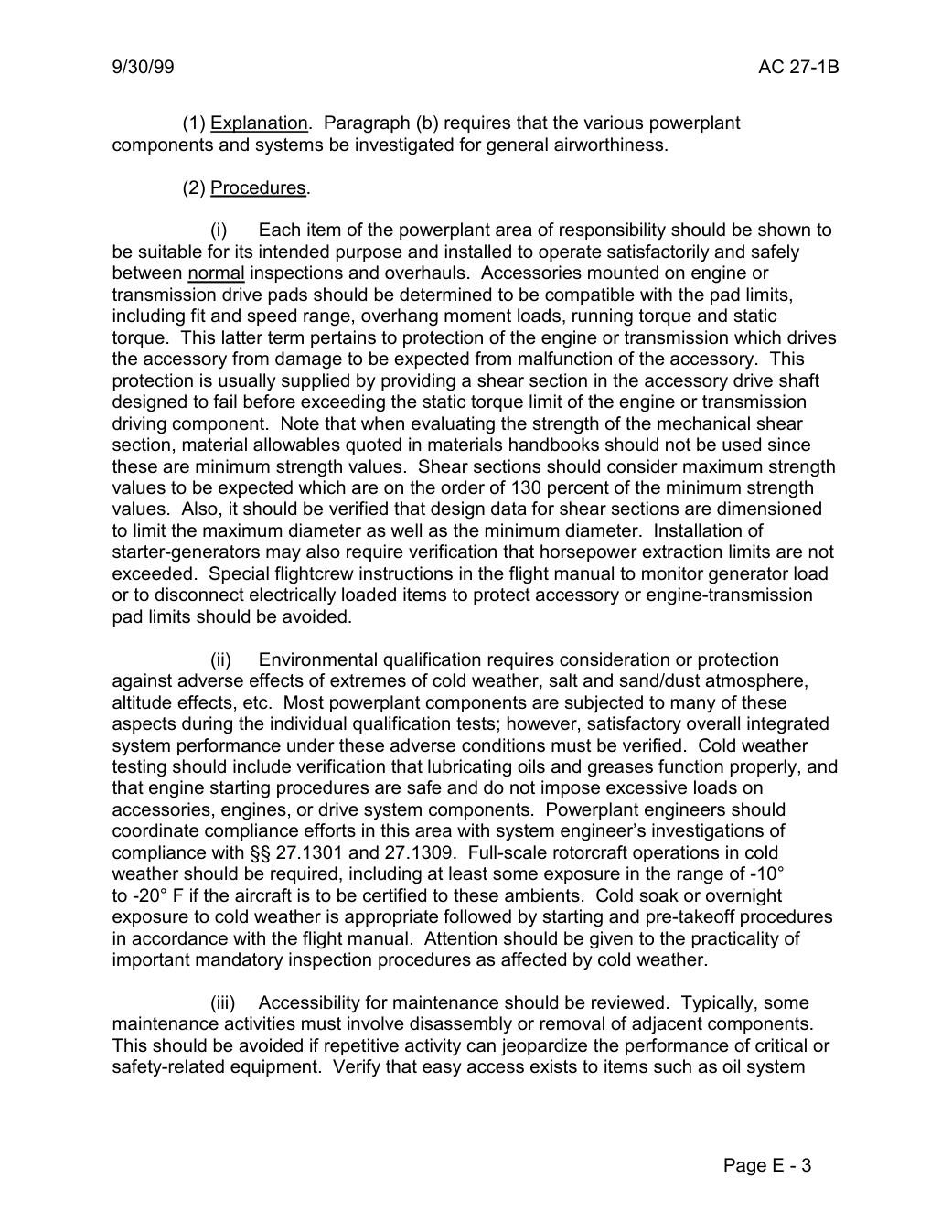
9/30/99                                             AC 27-1B

         (1) Explanation. Paragraph (b) requires that the various powerplant
components and systems be investigated for general airworthiness.

         (2) Procedures.

                  (i)   Each item of the powerplant area of responsibility should be shown to
be suitable for its intended purpose and installed to operate satisfactorily and safely
between normal inspections and overhauls. Accessories mounted on engine or
transmission drive pads should be determined to be compatible with the pad limits,
including fit and speed range, overhang moment loads, running torque and static
torque. This latter term pertains to protection of the engine or transmission which drives
the accessory from damage to be expected from malfunction of the accessory. This
protection is usually supplied by providing a shear section in the accessory drive shaft
designed to fail before exceeding the static torque limit of the engine or transmission
driving component. Note that when evaluating the strength of the mechanical shear
section, material allowables quoted in materials handbooks should not be used since
these are minimum strength values. Shear sections should consider maximum strength
values to be expected which are on the order of 130 percent of the minimum strength
values. Also, it should be verified that design data for shear sections are dimensioned
to limit the maximum diameter as well as the minimum diameter. Installation of
starter-generators may also require verification that horsepower extraction limits are not
exceeded. Special flightcrew instructions in the flight manual to monitor generator load
or to disconnect electrically loaded items to protect accessory or engine-transmission
pad limits should be avoided.

                   (ii)   Environmental qualification requires consideration or protection
against adverse effects of extremes of cold weather, salt and sand/dust atmosphere,
altitude effects, etc. Most powerplant components are subjected to many of these
aspects during the individual qualification tests; however, satisfactory overall integrated
system performance under these adverse conditions must be verified. Cold weather
testing should include verification that lubricating oils and greases function properly, and
that engine starting procedures are safe and do not impose excessive loads on
accessories, engines, or drive system components. Powerplant engineers should
coordinate compliance efforts in this area with system engineer’s investigations of
compliance with §§ 27.1301 and 27.1309. Full-scale rotorcraft operations in cold
weather should be required, including at least some exposure in the range of -10°
to -20° F if the aircraft is to be certified to these ambients. Cold soak or overnight
exposure to cold weather is appropriate followed by starting and pre-takeoff procedures
in accordance with the flight manual. Attention should be given to the practicality of
important mandatory inspection procedures as affected by cold weather.

                    (iii)   Accessibility for maintenance should be reviewed. Typically, some
maintenance activities must involve disassembly or removal of adjacent components.
This should be avoided if repetitive activity can jeopardize the performance of critical or
safety-related equipment. Verify that easy access exists to items such as oil system


                                                        Page E - 3
Saved from the FAA on November 17, 2026. All original pages are retained. Engineering explanations are presented separately below.
Aerospace Consulting / Engineering perspective
Start with the certification basis and the function.
Identify the applicable amendment before selecting the safety guidance. Connect intended functions and operating conditions to failure conditions, architecture decisions, common-cause considerations, verification and limitations. For flight controls and IFR work, carry the relevant 27.672, 27.1329 and Appendix B assumptions into the system safety and compliance evidence.
1196 original pages. 0 pages have reviewed text reflows. Original-first pages retain the source layout, with extracted text available for finding words.
A focused review, an agreed assessment package or ongoing support alongside your team. We can agree the relevant inputs and scope in the initial conversation.
This opens your email application.
Start a conversation
Tell us about your programme, the system you are developing and the support you need.
We can agree a focused use-case review, a defined evidence package or ongoing programme support.
This opens your email application.
Specialist aerospace expertise
Aerospace Consulting is led by Hussein Khimji, an FAA Designated Engineering Representative in systems and equipment, with a focus on system safety, flight controls and avionics.
We work with aircraft developers and systems suppliers to connect technical decisions, safety assessments and certification evidence.
This is the proposed introduction. The full About page will add your approved biography and associate expertise.
Systems engineering & development assurance
Tell us about the aircraft or system, its intended function, stage of development and the support you need.