Certification of Normal Category Rotorcraft — Changes 1–9
Normal category rotorcraft guidance with Changes 1–9 incorporated. Search the complete AC or start with the system safety, flight controls and instrument-flight guidance.
This source includes guidance for different amendments of Part 27. Match the guidance to the aircraft’s agreed certification basis: the 27.1309 entries for Amendments 27-21, 27-46 and 27-51 are separate. The base AC was issued on 30 September 1999; Change 9 is dated 23 June 2023. The FAA catalogue’s 30 September 2008 date is not the date of the latest change.
The source, within reach.
Search within this AC, jump to a source page, or download the complete saved publication.
This extraction supports search. Read the original page for complete notation and layout.
9/30/99                                             AC 27-1B

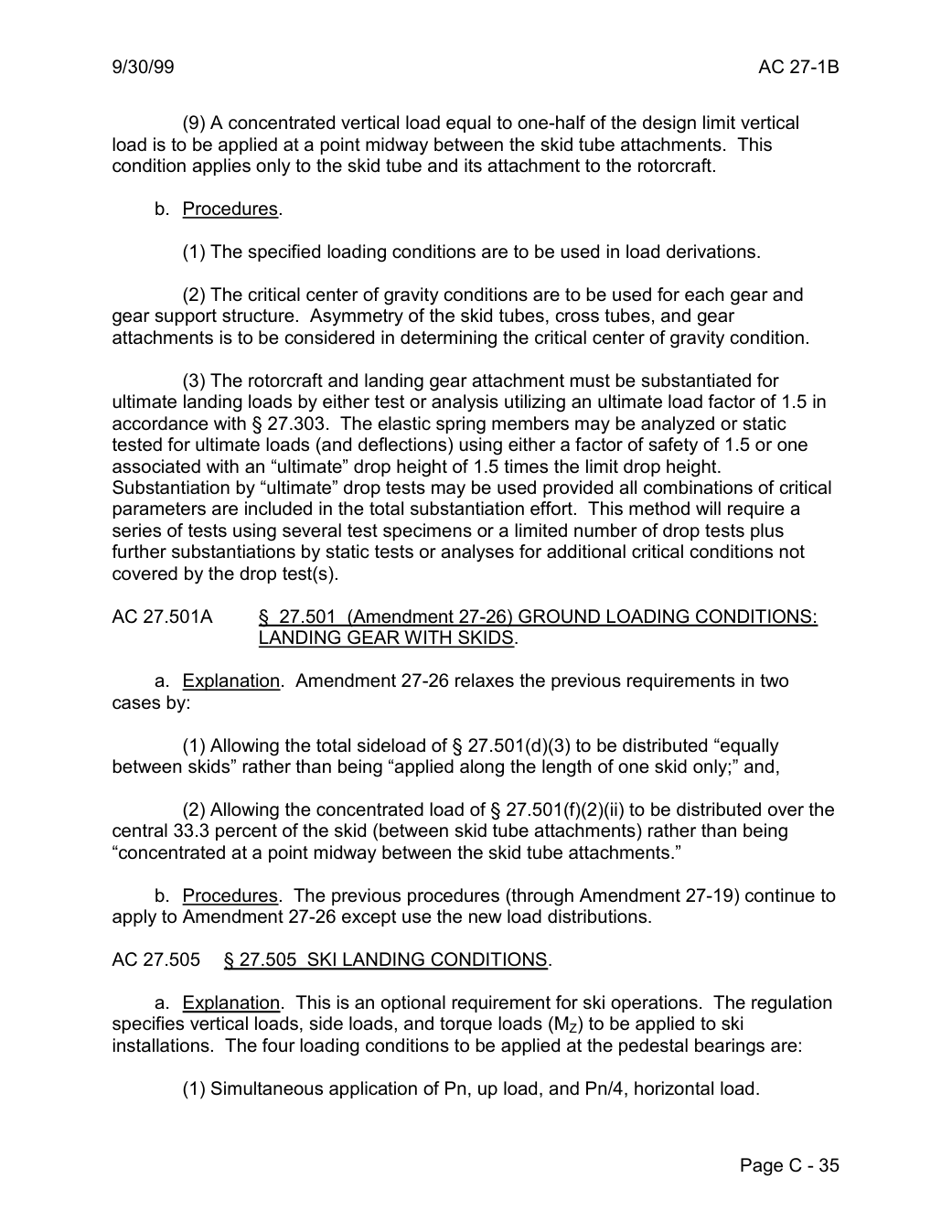
         (9) A concentrated vertical load equal to one-half of the design limit vertical
load is to be applied at a point midway between the skid tube attachments. This
condition applies only to the skid tube and its attachment to the rotorcraft.

     b. Procedures.

         (1) The specified loading conditions are to be used in load derivations.

         (2) The critical center of gravity conditions are to be used for each gear and
gear support structure. Asymmetry of the skid tubes, cross tubes, and gear
attachments is to be considered in determining the critical center of gravity condition.

         (3) The rotorcraft and landing gear attachment must be substantiated for
ultimate landing loads by either test or analysis utilizing an ultimate load factor of 1.5 in
accordance with § 27.303. The elastic spring members may be analyzed or static
tested for ultimate loads (and deflections) using either a factor of safety of 1.5 or one
associated with an “ultimate” drop height of 1.5 times the limit drop height.
Substantiation by “ultimate” drop tests may be used provided all combinations of critical
parameters are included in the total substantiation effort. This method will require a
series of tests using several test specimens or a limited number of drop tests plus
further substantiations by static tests or analyses for additional critical conditions not
covered by the drop test(s).

AC 27.501A    § 27.501 (Amendment 27-26) GROUND LOADING CONDITIONS:
            LANDING GEAR WITH SKIDS.

     a. Explanation. Amendment 27-26 relaxes the previous requirements in two
cases by:

         (1) Allowing the total sideload of § 27.501(d)(3) to be distributed “equally
between skids” rather than being “applied along the length of one skid only;” and,

         (2) Allowing the concentrated load of § 27.501(f)(2)(ii) to be distributed over the
central 33.3 percent of the skid (between skid tube attachments) rather than being
“concentrated at a point midway between the skid tube attachments.”

     b. Procedures. The previous procedures (through Amendment 27-19) continue to
apply to Amendment 27-26 except use the new load distributions.

AC 27.505  § 27.505 SKI LANDING CONDITIONS.

     a. Explanation. This is an optional requirement for ski operations. The regulation
specifies vertical loads, side loads, and torque loads (MZ) to be applied to ski
installations. The four loading conditions to be applied at the pedestal bearings are:

         (1) Simultaneous application of Pn, up load, and Pn/4, horizontal load.


                                                          Page C - 35
Saved from the FAA on November 17, 2026. All original pages are retained. Engineering explanations are presented separately below.
Aerospace Consulting / Engineering perspective
Start with the certification basis and the function.
Identify the applicable amendment before selecting the safety guidance. Connect intended functions and operating conditions to failure conditions, architecture decisions, common-cause considerations, verification and limitations. For flight controls and IFR work, carry the relevant 27.672, 27.1329 and Appendix B assumptions into the system safety and compliance evidence.
1196 original pages. 0 pages have reviewed text reflows. Original-first pages retain the source layout, with extracted text available for finding words.
A focused review, an agreed assessment package or ongoing support alongside your team. We can agree the relevant inputs and scope in the initial conversation.
This opens your email application.
Start a conversation
Tell us about your programme, the system you are developing and the support you need.
We can agree a focused use-case review, a defined evidence package or ongoing programme support.
This opens your email application.
Specialist aerospace expertise
Aerospace Consulting is led by Hussein Khimji, an FAA Designated Engineering Representative in systems and equipment, with a focus on system safety, flight controls and avionics.
We work with aircraft developers and systems suppliers to connect technical decisions, safety assessments and certification evidence.
This is the proposed introduction. The full About page will add your approved biography and associate expertise.
Systems engineering & development assurance
Tell us about the aircraft or system, its intended function, stage of development and the support you need.