
Original FAA page, including its printed amendment and change markings. Extracted words support search; text reflow has not been reviewed.
AC 27-1B · Apdx B-9Open saved PDF here ↗
Extracted text for finding words
This extraction supports search. Read the original page for complete notation and layout.
2/4/2016 AC 27-1B, Chg 7
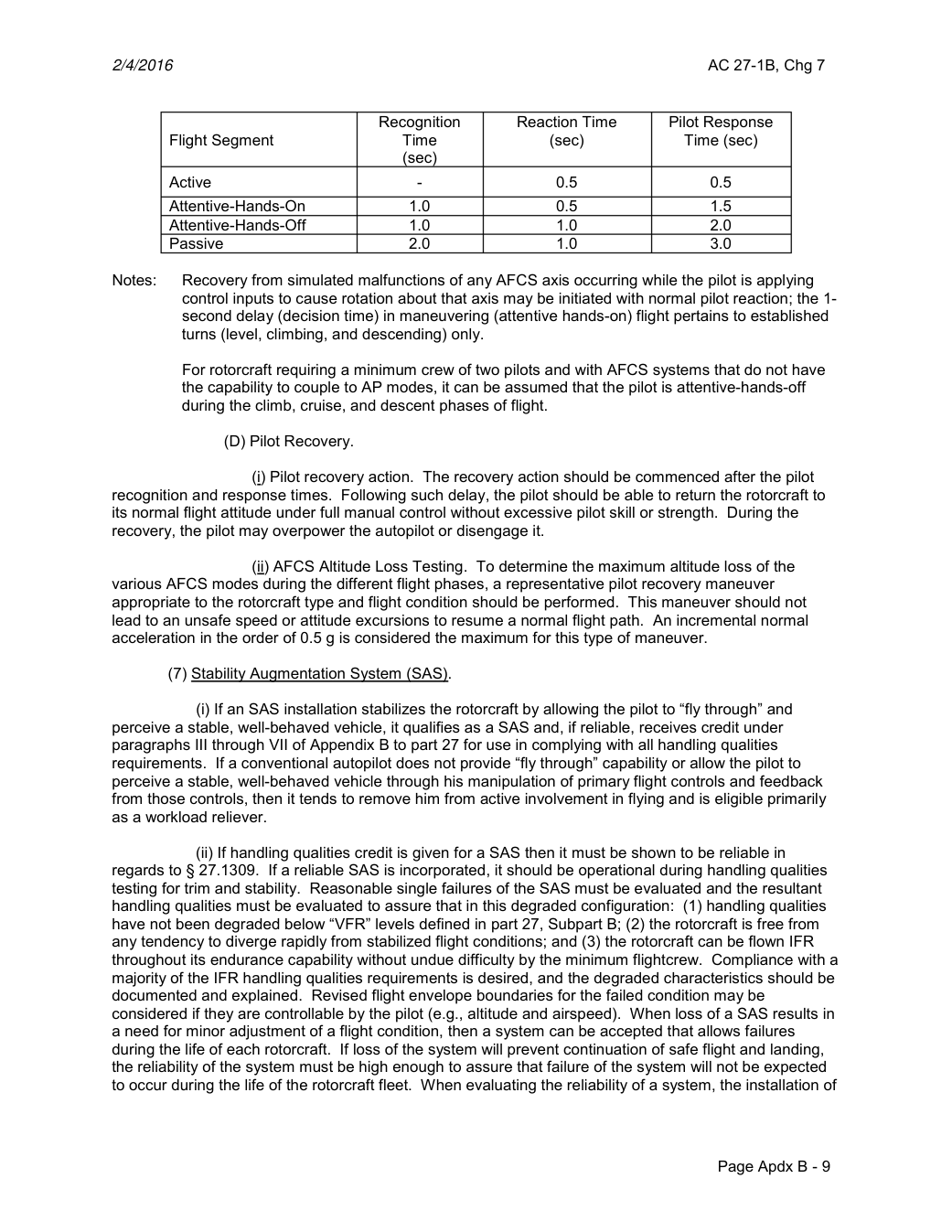
Recognition Reaction Time Pilot Response
Flight Segment Time (sec) Time (sec)
(sec)
Active - 0.5 0.5
Attentive-Hands-On 1.0 0.5 1.5
Attentive-Hands-Off 1.0 1.0 2.0
Passive 2.0 1.0 3.0
Notes: Recovery from simulated malfunctions of any AFCS axis occurring while the pilot is applying
control inputs to cause rotation about that axis may be initiated with normal pilot reaction; the 1
second delay (decision time) in maneuvering (attentive hands-on) flight pertains to established
turns (level, climbing, and descending) only.
For rotorcraft requiring a minimum crew of two pilots and with AFCS systems that do not have
the capability to couple to AP modes, it can be assumed that the pilot is attentive-hands-off
during the climb, cruise, and descent phases of flight.
(D) Pilot Recovery.
(i) Pilot recovery action. The recovery action should be commenced after the pilot
recognition and response times. Following such delay, the pilot should be able to return the rotorcraft to
its normal flight attitude under full manual control without excessive pilot skill or strength. During the
recovery, the pilot may overpower the autopilot or disengage it.
(ii) AFCS Altitude Loss Testing. To determine the maximum altitude loss of the
various AFCS modes during the different flight phases, a representative pilot recovery maneuver
appropriate to the rotorcraft type and flight condition should be performed. This maneuver should not
lead to an unsafe speed or attitude excursions to resume a normal flight path. An incremental normal
acceleration in the order of 0.5 g is considered the maximum for this type of maneuver.
(7) Stability Augmentation System (SAS).
(i) If an SAS installation stabilizes the rotorcraft by allowing the pilot to “fly through” and
perceive a stable, well-behaved vehicle, it qualifies as a SAS and, if reliable, receives credit under
paragraphs III through VII of Appendix B to part 27 for use in complying with all handling qualities
requirements. If a conventional autopilot does not provide “fly through” capability or allow the pilot to
perceive a stable, well-behaved vehicle through his manipulation of primary flight controls and feedback
from those controls, then it tends to remove him from active involvement in flying and is eligible primarily
as a workload reliever.
(ii) If handling qualities credit is given for a SAS then it must be shown to be reliable in
regards to § 27.1309. If a reliable SAS is incorporated, it should be operational during handling qualities
testing for trim and stability. Reasonable single failures of the SAS must be evaluated and the resultant
handling qualities must be evaluated to assure that in this degraded configuration: (1) handling qualities
have not been degraded below “VFR” levels defined in part 27, Subpart B; (2) the rotorcraft is free from
any tendency to diverge rapidly from stabilized flight conditions; and (3) the rotorcraft can be flown IFR
throughout its endurance capability without undue difficulty by the minimum flightcrew. Compliance with a
majority of the IFR handling qualities requirements is desired, and the degraded characteristics should be
documented and explained. Revised flight envelope boundaries for the failed condition may be
considered if they are controllable by the pilot (e.g., altitude and airspeed). When loss of a SAS results in
a need for minor adjustment of a flight condition, then a system can be accepted that allows failures
during the life of each rotorcraft. If loss of the system will prevent continuation of safe flight and landing,
the reliability of the system must be high enough to assure that failure of the system will not be expected
to occur during the life of the rotorcraft fleet. When evaluating the reliability of a system, the installation of
Page Apdx B - 9