
Original FAA page, including its printed amendment and change markings. Extracted words support search; text reflow has not been reviewed.
AC 27-1B · Apdx A-26Open saved PDF here ↗
Extracted text for finding words
This extraction supports search. Read the original page for complete notation and layout.
AC 27-1B, Chg 1 2/12/03
(MANUAL IDENTIFICATION)
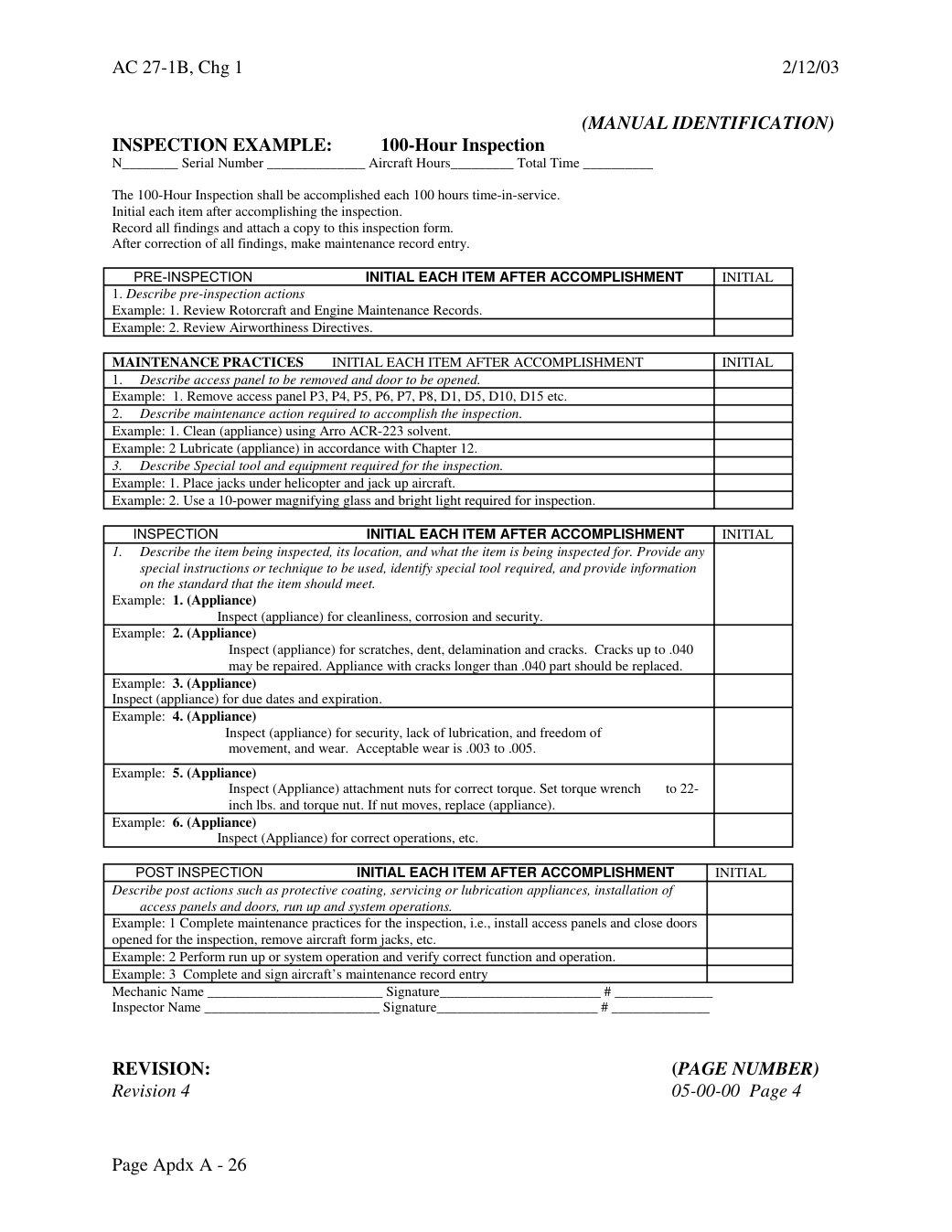
INSPECTION EXAMPLE: 100-Hour Inspection
N________ Serial Number ______________ Aircraft Hours_________ Total Time __________
The 100-Hour Inspection shall be accomplished each 100 hours time-in-service.
Initial each item after accomplishing the inspection.
Record all findings and attach a copy to this inspection form.
After correction of all findings, make maintenance record entry.
PRE-INSPECTION INITIAL EACH ITEM AFTER ACCOMPLISHMENT INITIAL
1. Describe pre-inspection actions
Example: 1. Review Rotorcraft and Engine Maintenance Records.
Example: 2. Review Airworthiness Directives.
MAINTENANCE PRACTICES INITIAL EACH ITEM AFTER ACCOMPLISHMENT INITIAL
1. Describe access panel to be removed and door to be opened.
Example: 1. Remove access panel P3, P4, P5, P6, P7, P8, D1, D5, D10, D15 etc.
2. Describe maintenance action required to accomplish the inspection.
Example: 1. Clean (appliance) using Arro ACR-223 solvent.
Example: 2 Lubricate (appliance) in accordance with Chapter 12.
3. Describe Special tool and equipment required for the inspection.
Example: 1. Place jacks under helicopter and jack up aircraft.
Example: 2. Use a 10-power magnifying glass and bright light required for inspection.
INSPECTION INITIAL EACH ITEM AFTER ACCOMPLISHMENT INITIAL
1. Describe the item being inspected, its location, and what the item is being inspected for. Provide any
special instructions or technique to be used, identify special tool required, and provide information
on the standard that the item should meet.
Example: 1. (Appliance)
Inspect (appliance) for cleanliness, corrosion and security.
Example: 2. (Appliance)
Inspect (appliance) for scratches, dent, delamination and cracks. Cracks up to .040
may be repaired. Appliance with cracks longer than .040 part should be replaced.
Example: 3. (Appliance)
Inspect (appliance) for due dates and expiration.
Example: 4. (Appliance)
Inspect (appliance) for security, lack of lubrication, and freedom of
movement, and wear. Acceptable wear is .003 to .005.
Example: 5. (Appliance)
Inspect (Appliance) attachment nuts for correct torque. Set torque wrench to 22
inch lbs. and torque nut. If nut moves, replace (appliance).
Example: 6. (Appliance)
Inspect (Appliance) for correct operations, etc.
POST INSPECTION INITIAL EACH ITEM AFTER ACCOMPLISHMENT INITIAL
Describe post actions such as protective coating, servicing or lubrication appliances, installation of
access panels and doors, run up and system operations.
Example: 1 Complete maintenance practices for the inspection, i.e., install access panels and close doors
opened for the inspection, remove aircraft form jacks, etc.
Example: 2 Perform run up or system operation and verify correct function and operation.
Example: 3 Complete and sign aircraft’s maintenance record entry
Mechanic Name _________________________ Signature_______________________ # ______________
Inspector Name _________________________ Signature_______________________ # ______________
REVISION: (PAGE NUMBER)
Revision 4 05-00-00 Page 4
Page Apdx A - 26