Certification of Normal Category Rotorcraft — Changes 1–9
Normal category rotorcraft guidance with Changes 1–9 incorporated. Search the complete AC or start with the system safety, flight controls and instrument-flight guidance.
This source includes guidance for different amendments of Part 27. Match the guidance to the aircraft’s agreed certification basis: the 27.1309 entries for Amendments 27-21, 27-46 and 27-51 are separate. The base AC was issued on 30 September 1999; Change 9 is dated 23 June 2023. The FAA catalogue’s 30 September 2008 date is not the date of the latest change.
The source, within reach.
Search within this AC, jump to a source page, or download the complete saved publication.
This extraction supports search. Read the original page for complete notation and layout.
AC 27-1B, Chg 7                                                                       2/4/2016


                             Vertical Fields of View

                                     Secondary                 Primary

                                                                                                       Horiz

                                                                                                                                            0
                                                                                    15

                                                               NOM
                                                       DN
                           Vertical Field  of View


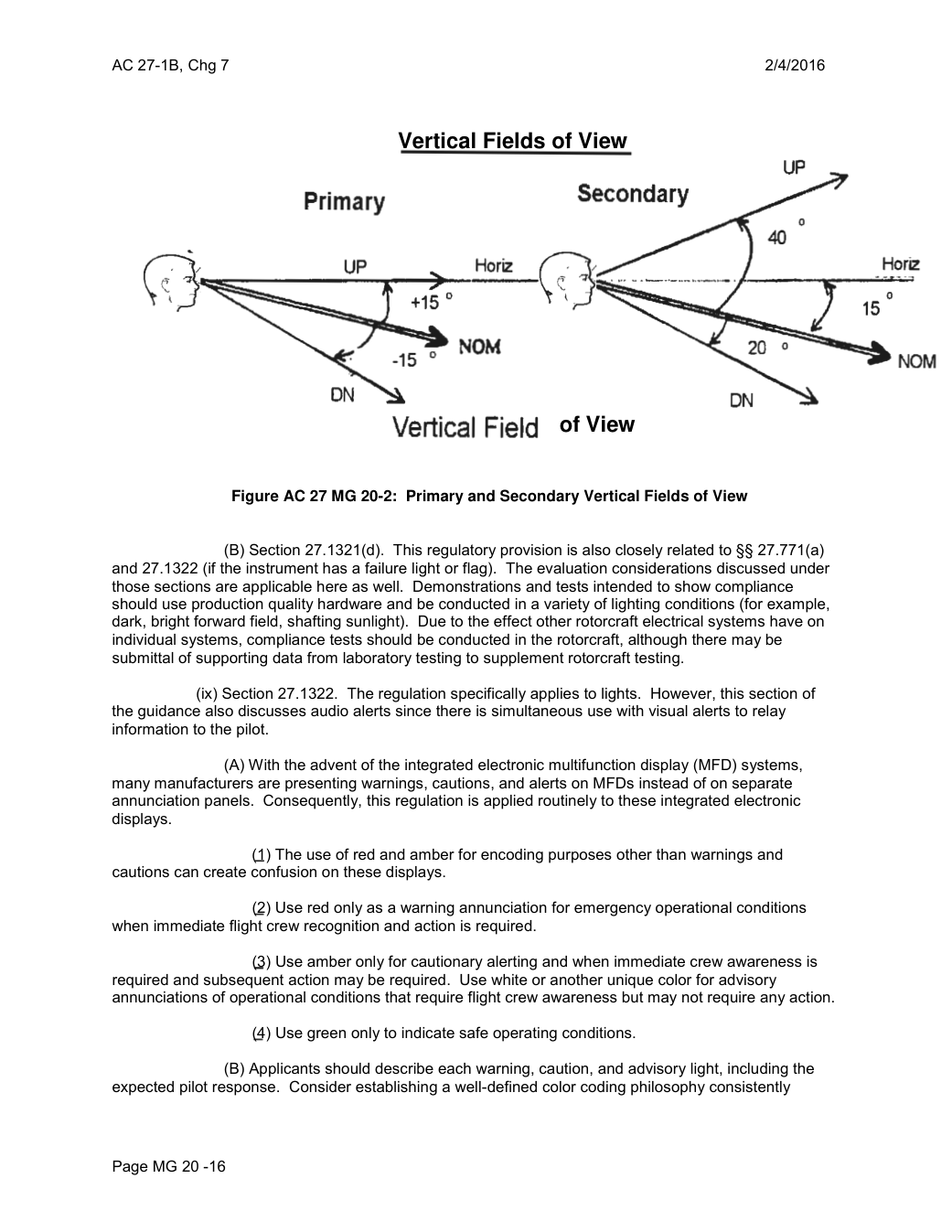
               Figure AC 27 MG 20-2: Primary and Secondary Vertical Fields of View


                (B) Section 27.1321(d). This regulatory provision is also closely related to §§ 27.771(a)
and 27.1322 (if the instrument has a failure light or flag). The evaluation considerations discussed under
those sections are applicable here as well. Demonstrations and tests intended to show compliance
should use production quality hardware and be conducted in a variety of lighting conditions (for example,
dark, bright forward field, shafting sunlight). Due to the effect other rotorcraft electrical systems have on
individual systems, compliance tests should be conducted in the rotorcraft, although there may be
submittal of supporting data from laboratory testing to supplement rotorcraft testing.

                (ix) Section 27.1322. The regulation specifically applies to lights. However, this section of
the guidance also discusses audio alerts since there is simultaneous use with visual alerts to relay
information to the pilot.

                (A) With the advent of the integrated electronic multifunction display (MFD) systems,
many manufacturers are presenting warnings, cautions, and alerts on MFDs instead of on separate
annunciation panels. Consequently, this regulation is applied routinely to these integrated electronic
displays.

                      (1) The use of red and amber for encoding purposes other than warnings and
cautions can create confusion on these displays.

                      (2) Use red only as a warning annunciation for emergency operational conditions
when immediate flight crew recognition and action is required.

                      (3) Use amber only for cautionary alerting and when immediate crew awareness is
required and subsequent action may be required. Use white or another unique color for advisory
annunciations of operational conditions that require flight crew awareness but may not require any action.

                      (4) Use green only to indicate safe operating conditions.

                (B) Applicants should describe each warning, caution, and advisory light, including the
expected pilot response. Consider establishing a well-defined color coding philosophy consistently


Page MG 20 -16
Saved from the FAA on November 17, 2026. All original pages are retained. Engineering explanations are presented separately below.
Aerospace Consulting / Engineering perspective
Start with the certification basis and the function.
Identify the applicable amendment before selecting the safety guidance. Connect intended functions and operating conditions to failure conditions, architecture decisions, common-cause considerations, verification and limitations. For flight controls and IFR work, carry the relevant 27.672, 27.1329 and Appendix B assumptions into the system safety and compliance evidence.
1196 original pages. 0 pages have reviewed text reflows. Original-first pages retain the source layout, with extracted text available for finding words.
A focused review, an agreed assessment package or ongoing support alongside your team. We can agree the relevant inputs and scope in the initial conversation.
This opens your email application.
Start a conversation
Tell us about your programme, the system you are developing and the support you need.
We can agree a focused use-case review, a defined evidence package or ongoing programme support.
This opens your email application.
Specialist aerospace expertise
Aerospace Consulting is led by Hussein Khimji, an FAA Designated Engineering Representative in systems and equipment, with a focus on system safety, flight controls and avionics.
We work with aircraft developers and systems suppliers to connect technical decisions, safety assessments and certification evidence.
This is the proposed introduction. The full About page will add your approved biography and associate expertise.
Systems engineering & development assurance
Tell us about the aircraft or system, its intended function, stage of development and the support you need.