Certification of Normal Category Rotorcraft — Changes 1–9
Normal category rotorcraft guidance with Changes 1–9 incorporated. Search the complete AC or start with the system safety, flight controls and instrument-flight guidance.
This source includes guidance for different amendments of Part 27. Match the guidance to the aircraft’s agreed certification basis: the 27.1309 entries for Amendments 27-21, 27-46 and 27-51 are separate. The base AC was issued on 30 September 1999; Change 9 is dated 23 June 2023. The FAA catalogue’s 30 September 2008 date is not the date of the latest change.
The source, within reach.
Search within this AC, jump to a source page, or download the complete saved publication.
This extraction supports search. Read the original page for complete notation and layout.
AC 27-1B, Chg 7                                                                       2/4/2016


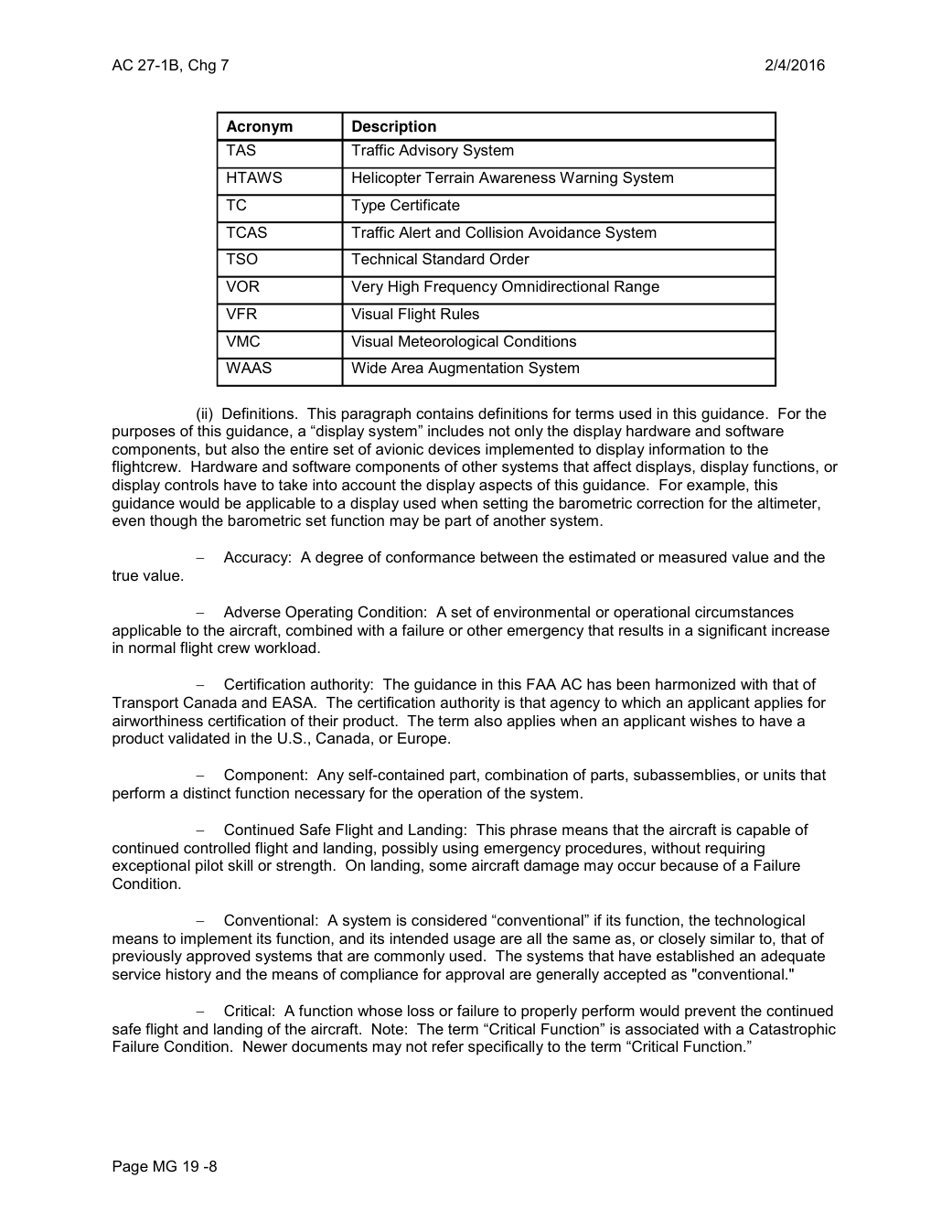
            Acronym       Description
           TAS               Traffic Advisory System
          HTAWS          Helicopter Terrain Awareness Warning System
           TC            Type Certificate
           TCAS              Traffic Alert and Collision Avoidance System
           TSO             Technical Standard Order
          VOR           Very High Frequency Omnidirectional Range
           VFR             Visual Flight Rules
          VMC             Visual Meteorological Conditions
          WAAS         Wide Area Augmentation System

                    (ii) Definitions. This paragraph contains definitions for terms used in this guidance. For the
purposes of this guidance, a “display system” includes not only the display hardware and software
components, but also the entire set of avionic devices implemented to display information to the
flightcrew. Hardware and software components of other systems that affect displays, display functions, or
display controls have to take into account the display aspects of this guidance. For example, this
guidance would be applicable to a display used when setting the barometric correction for the altimeter,
even though the barometric set function may be part of another system.

          −   Accuracy: A degree of conformance between the estimated or measured value and the
true value.

          −  Adverse Operating Condition: A set of environmental or operational circumstances
applicable to the aircraft, combined with a failure or other emergency that results in a significant increase
in normal flight crew workload.

          −   Certification authority: The guidance in this FAA AC has been harmonized with that of
Transport Canada and EASA. The certification authority is that agency to which an applicant applies for
airworthiness certification of their product. The term also applies when an applicant wishes to have a
product validated in the U.S., Canada, or Europe.

          −  Component: Any self-contained part, combination of parts, subassemblies, or units that
perform a distinct function necessary for the operation of the system.

          −  Continued Safe Flight and Landing: This phrase means that the aircraft is capable of
continued controlled flight and landing, possibly using emergency procedures, without requiring
exceptional pilot skill or strength. On landing, some aircraft damage may occur because of a Failure
Condition.

          −   Conventional: A system is considered “conventional” if its function, the technological
means to implement its function, and its intended usage are all the same as, or closely similar to, that of
previously approved systems that are commonly used. The systems that have established an adequate
service history and the means of compliance for approval are generally accepted as "conventional."

          −   Critical: A function whose loss or failure to properly perform would prevent the continued
safe flight and landing of the aircraft. Note: The term “Critical Function” is associated with a Catastrophic
Failure Condition. Newer documents may not refer specifically to the term “Critical Function.”


Page MG 19 -8
Saved from the FAA on November 17, 2026. All original pages are retained. Engineering explanations are presented separately below.
Aerospace Consulting / Engineering perspective
Start with the certification basis and the function.
Identify the applicable amendment before selecting the safety guidance. Connect intended functions and operating conditions to failure conditions, architecture decisions, common-cause considerations, verification and limitations. For flight controls and IFR work, carry the relevant 27.672, 27.1329 and Appendix B assumptions into the system safety and compliance evidence.
1196 original pages. 0 pages have reviewed text reflows. Original-first pages retain the source layout, with extracted text available for finding words.
A focused review, an agreed assessment package or ongoing support alongside your team. We can agree the relevant inputs and scope in the initial conversation.
This opens your email application.
Start a conversation
Tell us about your programme, the system you are developing and the support you need.
We can agree a focused use-case review, a defined evidence package or ongoing programme support.
This opens your email application.
Specialist aerospace expertise
Aerospace Consulting is led by Hussein Khimji, an FAA Designated Engineering Representative in systems and equipment, with a focus on system safety, flight controls and avionics.
We work with aircraft developers and systems suppliers to connect technical decisions, safety assessments and certification evidence.
This is the proposed introduction. The full About page will add your approved biography and associate expertise.
Systems engineering & development assurance
Tell us about the aircraft or system, its intended function, stage of development and the support you need.