
AC 27-1B
Certification of Normal Category Rotorcraft — Changes 1–9
27-1B · Changes 1–9 incorporated Source checked 2026-11-28
Scope, source and reading notes
This source includes guidance for different amendments of Part 27. Match the guidance to the aircraft’s agreed certification basis: the 27.1309 entries for Amendments 27-21, 27-46 and 27-51 are separate. The base AC was issued on 30 September 1999; Change 9 is dated 23 June 2023. The FAA catalogue’s 30 September 2008 date is not the date of the latest change.
Aerospace Consulting reference note: Complete normal-category rotorcraft guidance, including system safety, equipment, flight guidance and IFR certification.
The complete selected publication is available in reading text and as the original PDF. Reading text is extracted from the official PDF; page layout is simplified, and figures and tables should be checked in the original page view.
Search covers extracted text. Words contained only in graphics may not be searchable. The original publication is available below.
Official source recordOriginal PDF on this siteSource: FAA. Reproduced with source acknowledgment; source edition and status are shown above. SHA-256: 2dfac16a3644dc18997069cca78746c10726e4b70d3aba996fc87843ffe68a2b
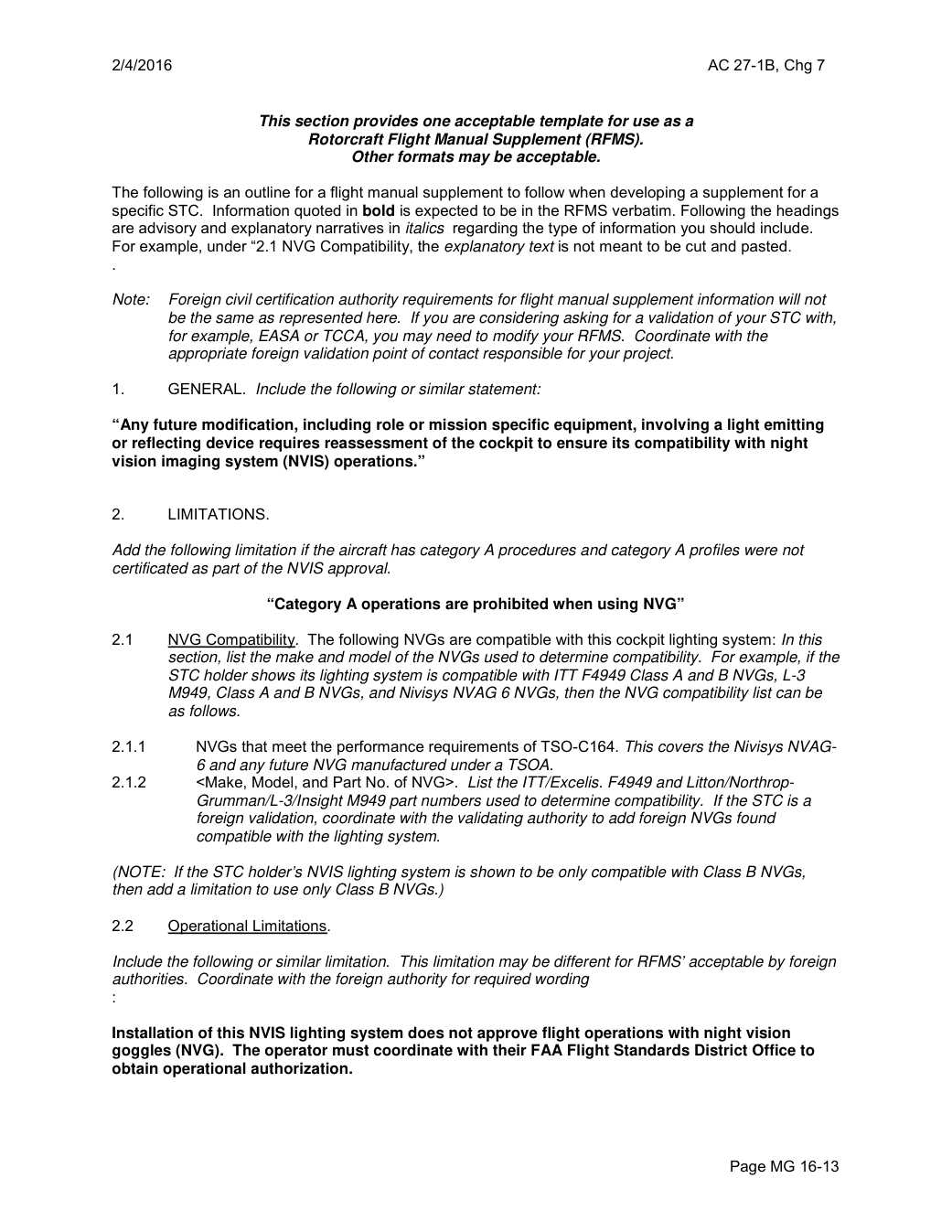
This section provides one acceptable template for use as a Rotorcraft Flight Manual Supplement (RFMS). Other formats may be acceptable.
The following is an outline for a flight manual supplement to follow when developing a supplement for a specific STC. Information quoted in bold is expected to be in the RFMS verbatim. Following the headings are advisory and explanatory narratives in italics regarding the type of information you should include. For example, under “2.1 NVG Compatibility, the explanatory text is not meant to be cut and pasted. .
Note: Foreign civil certification authority requirements for flight manual supplement information will not be the same as represented here. If you are considering asking for a validation of your STC with, for example, EASA or TCCA, you may need to modify your RFMS. Coordinate with the appropriate foreign validation point of contact responsible for your project.
1. GENERAL. Include the following or similar statement:
“Any future modification, including role or mission specific equipment, involving a light emitting or reflecting device requires reassessment of the cockpit to ensure its compatibility with night vision imaging system (NVIS) operations.”
2. LIMITATIONS.
Add the following limitation if the aircraft has category A procedures and category A profiles were not certificated as part of the NVIS approval.
“Category A operations are prohibited when using NVG”
2.1 NVG Compatibility. The following NVGs are compatible with this cockpit lighting system: In this section, list the make and model of the NVGs used to determine compatibility. For example, if the STC holder shows its lighting system is compatible with ITT F4949 Class A and B NVGs, L-3 M949, Class A and B NVGs, and Nivisys NVAG 6 NVGs, then the NVG compatibility list can be as follows.
2.1.1 NVGs that meet the performance requirements of TSO-C164. This covers the Nivisys NVAG 6 and any future NVG manufactured under a TSOA. 2.1.2 <Make, Model, and Part No. of NVG>. List the ITT/Excelis. F4949 and Litton/Northrop- Grumman/L-3/Insight M949 part numbers used to determine compatibility. If the STC is a foreign validation, coordinate with the validating authority to add foreign NVGs found compatible with the lighting system.
(NOTE: If the STC holder’s NVIS lighting system is shown to be only compatible with Class B NVGs, then add a limitation to use only Class B NVGs.)
2.2 Operational Limitations.
Include the following or similar limitation. This limitation may be different for RFMS’ acceptable by foreign authorities. Coordinate with the foreign authority for required wording :
Installation of this NVIS lighting system does not approve flight operations with night vision goggles (NVG). The operator must coordinate with their FAA Flight Standards District Office to obtain operational authorization.
View figures, tables and original page layout
Connected references
Source-backed citations and subject-based engineering context are labelled separately. These links do not establish equivalence or project acceptance.
Related technical context
Engineering contextEvidence and scope
AC 27-1B and AC 29-2C — published scope
Aerospace Consulting navigation suggestion based on the subject and stated scope of the two publications.
This connection does not establish regulatory equivalence, acceptance of a newer edition, or applicability of a project-specific precedent to another programme.
Supporting sourceRelated technical context
Engineering contextEvidence and scope
CS-27 and AC 27-1B — published scope
Aerospace Consulting navigation suggestion based on the subject and stated scope of the two publications.
This connection does not establish regulatory equivalence, acceptance of a newer edition, or applicability of a project-specific precedent to another programme.
Supporting source