
AC 27-1B
Certification of Normal Category Rotorcraft — Changes 1–9
27-1B · Changes 1–9 incorporated Source checked 2026-11-28
Scope, source and reading notes
This source includes guidance for different amendments of Part 27. Match the guidance to the aircraft’s agreed certification basis: the 27.1309 entries for Amendments 27-21, 27-46 and 27-51 are separate. The base AC was issued on 30 September 1999; Change 9 is dated 23 June 2023. The FAA catalogue’s 30 September 2008 date is not the date of the latest change.
Aerospace Consulting reference note: Complete normal-category rotorcraft guidance, including system safety, equipment, flight guidance and IFR certification.
The complete selected publication is available in reading text and as the original PDF. Reading text is extracted from the official PDF; page layout is simplified, and figures and tables should be checked in the original page view.
Search covers extracted text. Words contained only in graphics may not be searchable. The original publication is available below.
Official source recordOriginal PDF on this siteSource: FAA. Reproduced with source acknowledgment; source edition and status are shown above. SHA-256: 2dfac16a3644dc18997069cca78746c10726e4b70d3aba996fc87843ffe68a2b
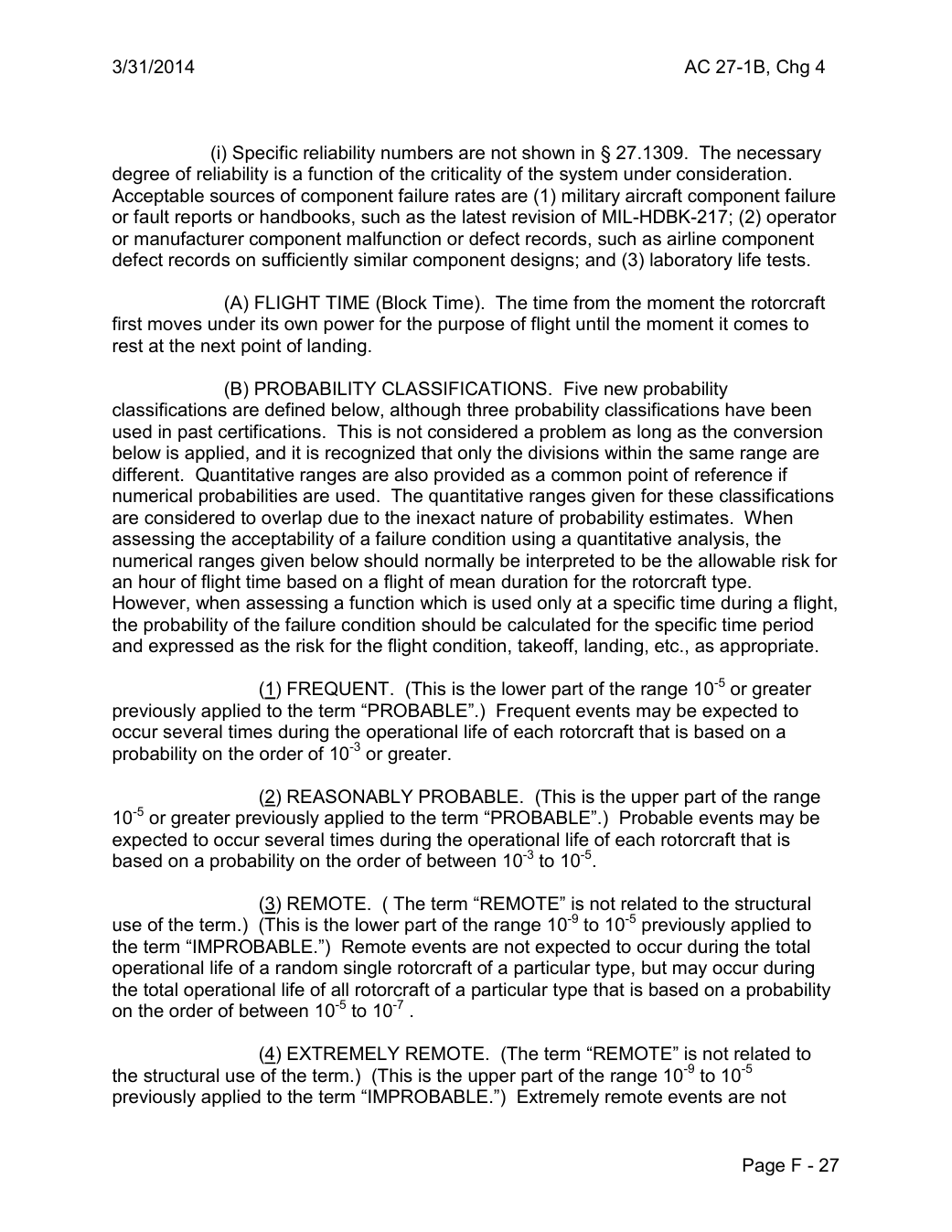
(i) Specific reliability numbers are not shown in § 27.1309. The necessary degree of reliability is a function of the criticality of the system under consideration. Acceptable sources of component failure rates are (1) military aircraft component failure or fault reports or handbooks, such as the latest revision of MIL-HDBK-217; (2) operator or manufacturer component malfunction or defect records, such as airline component defect records on sufficiently similar component designs; and (3) laboratory life tests.
(A) FLIGHT TIME (Block Time). The time from the moment the rotorcraft first moves under its own power for the purpose of flight until the moment it comes to rest at the next point of landing.
(B) PROBABILITY CLASSIFICATIONS. Five new probability classifications are defined below, although three probability classifications have been used in past certifications. This is not considered a problem as long as the conversion below is applied, and it is recognized that only the divisions within the same range are different. Quantitative ranges are also provided as a common point of reference if numerical probabilities are used. The quantitative ranges given for these classifications are considered to overlap due to the inexact nature of probability estimates. When assessing the acceptability of a failure condition using a quantitative analysis, the numerical ranges given below should normally be interpreted to be the allowable risk for an hour of flight time based on a flight of mean duration for the rotorcraft type. However, when assessing a function which is used only at a specific time during a flight, the probability of the failure condition should be calculated for the specific time period and expressed as the risk for the flight condition, takeoff, landing, etc., as appropriate.
(1) FREQUENT. (This is the lower part of the range 10-5 or greater previously applied to the term “PROBABLE”.) Frequent events may be expected to occur several times during the operational life of each rotorcraft that is based on a probability on the order of 10-3 or greater.
(2) REASONABLY PROBABLE. (This is the upper part of the range 10-5 or greater previously applied to the term “PROBABLE”.) Probable events may be expected to occur several times during the operational life of each rotorcraft that is based on a probability on the order of between 10-3 to 10-5 .
(3) REMOTE. ( The term “REMOTE” is not related to the structural use of the term.) (This is the lower part of the range 10-9 to 10-5
previously applied to the term “IMPROBABLE.”) Remote events are not expected to occur during the total operational life of a random single rotorcraft of a particular type, but may occur during the total operational life of all rotorcraft of a particular type that is based on a probability on the order of between 10 to 10-7
-5 .
-9 -5
(4) EXTREMELY REMOTE. (The term “REMOTE” is not related to the structural use of the term.) (This is the upper part of the range 10 to 10 previously applied to the term “IMPROBABLE.”) Extremely remote events are not
View figures, tables and original page layout
Connected references
Source-backed citations and subject-based engineering context are labelled separately. These links do not establish equivalence or project acceptance.
Related technical context
Engineering contextEvidence and scope
AC 27-1B and AC 29-2C — published scope
Aerospace Consulting navigation suggestion based on the subject and stated scope of the two publications.
This connection does not establish regulatory equivalence, acceptance of a newer edition, or applicability of a project-specific precedent to another programme.
Supporting sourceRelated technical context
Engineering contextEvidence and scope
CS-27 and AC 27-1B — published scope
Aerospace Consulting navigation suggestion based on the subject and stated scope of the two publications.
This connection does not establish regulatory equivalence, acceptance of a newer edition, or applicability of a project-specific precedent to another programme.
Supporting source