
AC 27-1B
Certification of Normal Category Rotorcraft — Changes 1–9
27-1B · Changes 1–9 incorporated Source checked 2026-11-28
Scope, source and reading notes
This source includes guidance for different amendments of Part 27. Match the guidance to the aircraft’s agreed certification basis: the 27.1309 entries for Amendments 27-21, 27-46 and 27-51 are separate. The base AC was issued on 30 September 1999; Change 9 is dated 23 June 2023. The FAA catalogue’s 30 September 2008 date is not the date of the latest change.
Aerospace Consulting reference note: Complete normal-category rotorcraft guidance, including system safety, equipment, flight guidance and IFR certification.
The complete selected publication is available in reading text and as the original PDF. Reading text is extracted from the official PDF; page layout is simplified, and figures and tables should be checked in the original page view.
Search covers extracted text. Words contained only in graphics may not be searchable. The original publication is available below.
Official source recordOriginal PDF on this siteSource: FAA. Reproduced with source acknowledgment; source edition and status are shown above. SHA-256: 2dfac16a3644dc18997069cca78746c10726e4b70d3aba996fc87843ffe68a2b
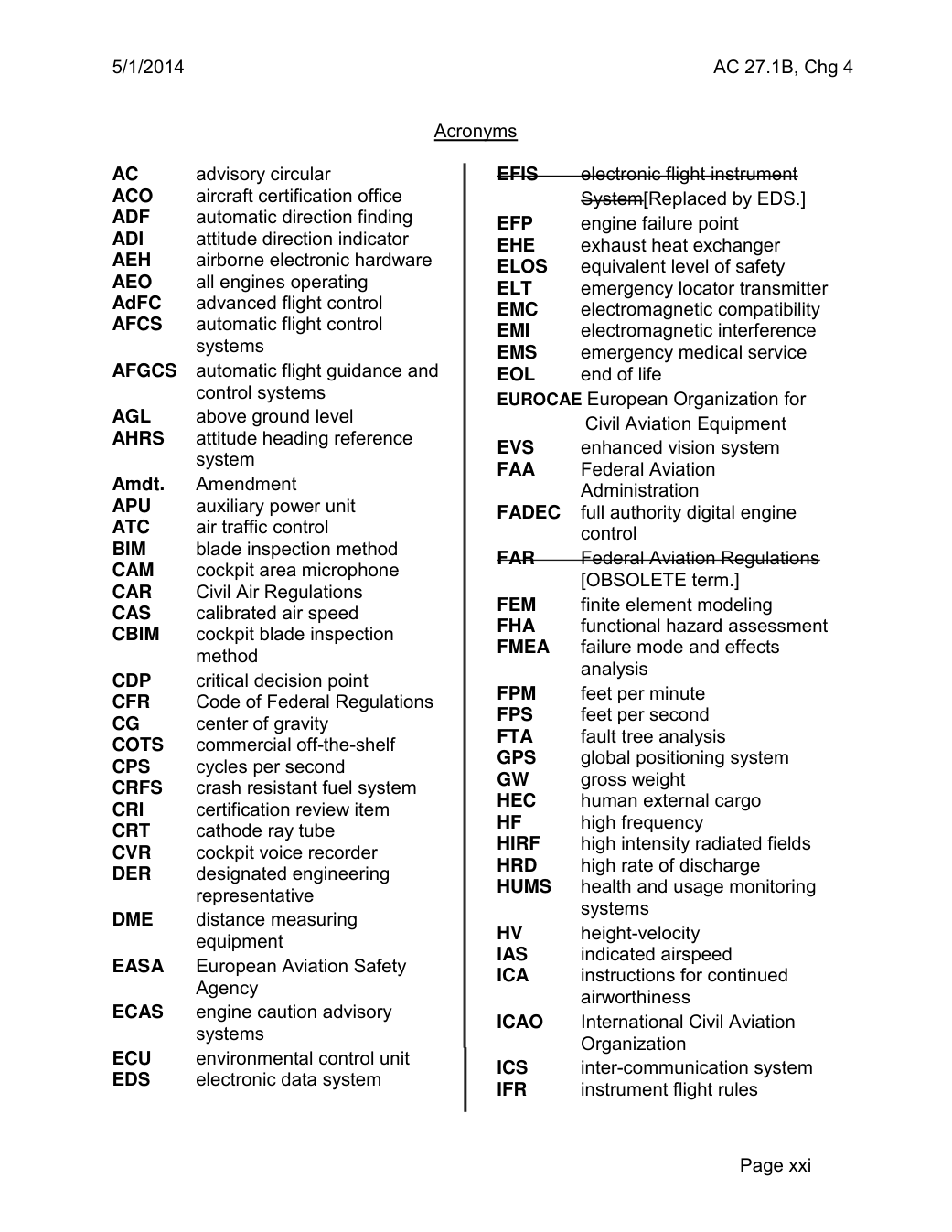
Acronyms
AC ACO ADF ADI AEH AEO AdFC AFCS
AFGCS
AGL AHRS
Amdt. APU ATC BIM CAM CAR CAS CBIM
CDP CFR CG COTS CPS CRFS CRI CRT CVR DER
DME
EASA
ECAS
advisory circular aircraft certification office automatic direction finding attitude direction indicator airborne electronic hardware all engines operating advanced flight control automatic flight control systems automatic flight guidance and control systems above ground level attitude heading reference system Amendment auxiliary power unit air traffic control blade inspection method cockpit area microphone Civil Air Regulations calibrated air speed cockpit blade inspection method critical decision point Code of Federal Regulations center of gravity commercial off-the-shelf cycles per second crash resistant fuel system certification review item cathode ray tube cockpit voice recorder designated engineering representative distance measuring equipment European Aviation Safety Agency engine caution advisory systems environmental control unit electronic data system
ECU EDS
EFIS electronic flight instrument System[Replaced by EDS.] EFP engine failure point EHE exhaust heat exchanger ELOS equivalent level of safety ELT emergency locator transmitter EMC electromagnetic compatibility EMI electromagnetic interference EMS emergency medical service EOL end of life EUROCAE European Organization for Civil Aviation Equipment EVS enhanced vision system FAA Federal Aviation Administration FADEC full authority digital engine control FAR Federal Aviation Regulations [OBSOLETE term.] FEM finite element modeling FHA functional hazard assessment FMEA failure mode and effects analysis FPM feet per minute FPS feet per second FTA fault tree analysis GPS global positioning system GW gross weight HEC human external cargo HF high frequency HIRF high intensity radiated fields HRD high rate of discharge HUMS health and usage monitoring systems HV height-velocity IAS indicated airspeed ICA instructions for continued airworthiness ICAO International Civil Aviation Organization ICS inter-communication system IFR instrument flight rules
View figures, tables and original page layout
Connected references
Source-backed citations and subject-based engineering context are labelled separately. These links do not establish equivalence or project acceptance.
Related technical context
Engineering contextEvidence and scope
AC 27-1B and AC 29-2C — published scope
Aerospace Consulting navigation suggestion based on the subject and stated scope of the two publications.
This connection does not establish regulatory equivalence, acceptance of a newer edition, or applicability of a project-specific precedent to another programme.
Supporting sourceRelated technical context
Engineering contextEvidence and scope
CS-27 and AC 27-1B — published scope
Aerospace Consulting navigation suggestion based on the subject and stated scope of the two publications.
This connection does not establish regulatory equivalence, acceptance of a newer edition, or applicability of a project-specific precedent to another programme.
Supporting source