
AC 27-1B
Certification of Normal Category Rotorcraft — Changes 1–9
27-1B · Changes 1–9 incorporated Source checked 2026-11-28
Scope, source and reading notes
This source includes guidance for different amendments of Part 27. Match the guidance to the aircraft’s agreed certification basis: the 27.1309 entries for Amendments 27-21, 27-46 and 27-51 are separate. The base AC was issued on 30 September 1999; Change 9 is dated 23 June 2023. The FAA catalogue’s 30 September 2008 date is not the date of the latest change.
Aerospace Consulting reference note: Complete normal-category rotorcraft guidance, including system safety, equipment, flight guidance and IFR certification.
The complete selected publication is available in reading text and as the original PDF. Reading text is extracted from the official PDF; page layout is simplified, and figures and tables should be checked in the original page view.
Search covers extracted text. Words contained only in graphics may not be searchable. The original publication is available below.
Official source recordOriginal PDF on this siteSource: FAA. Reproduced with source acknowledgment; source edition and status are shown above. SHA-256: 2dfac16a3644dc18997069cca78746c10726e4b70d3aba996fc87843ffe68a2b
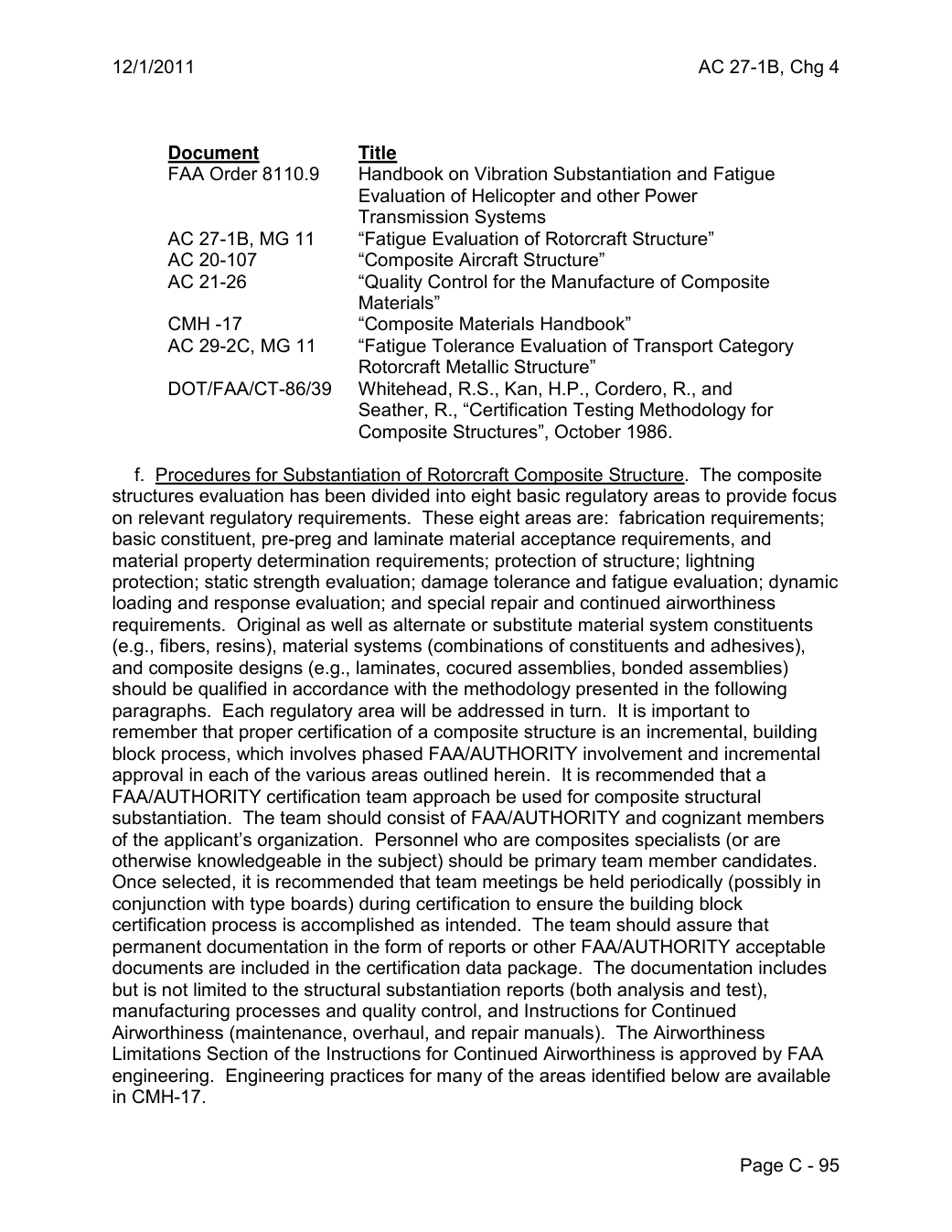
Document Title FAA Order 8110.9 Handbook on Vibration Substantiation and Fatigue Evaluation of Helicopter and other Power Transmission Systems AC 27-1B, MG 11 “Fatigue Evaluation of Rotorcraft Structure” AC 20-107 “Composite Aircraft Structure” AC 21-26 “Quality Control for the Manufacture of Composite Materials” CMH -17 “Composite Materials Handbook” AC 29-2C, MG 11 “Fatigue Tolerance Evaluation of Transport Category Rotorcraft Metallic Structure” DOT/FAA/CT-86/39 Whitehead, R.S., Kan, H.P., Cordero, R., and Seather, R., “Certification Testing Methodology for Composite Structures”, October 1986.
f. Procedures for Substantiation of Rotorcraft Composite Structure. The composite structures evaluation has been divided into eight basic regulatory areas to provide focus on relevant regulatory requirements. These eight areas are: fabrication requirements; basic constituent, pre-preg and laminate material acceptance requirements, and material property determination requirements; protection of structure; lightning protection; static strength evaluation; damage tolerance and fatigue evaluation; dynamic loading and response evaluation; and special repair and continued airworthiness requirements. Original as well as alternate or substitute material system constituents (e.g., fibers, resins), material systems (combinations of constituents and adhesives), and composite designs (e.g., laminates, cocured assemblies, bonded assemblies) should be qualified in accordance with the methodology presented in the following paragraphs. Each regulatory area will be addressed in turn. It is important to remember that proper certification of a composite structure is an incremental, building block process, which involves phased FAA/AUTHORITY involvement and incremental approval in each of the various areas outlined herein. It is recommended that a FAA/AUTHORITY certification team approach be used for composite structural substantiation. The team should consist of FAA/AUTHORITY and cognizant members of the applicant’s organization. Personnel who are composites specialists (or are otherwise knowledgeable in the subject) should be primary team member candidates. Once selected, it is recommended that team meetings be held periodically (possibly in conjunction with type boards) during certification to ensure the building block certification process is accomplished as intended. The team should assure that permanent documentation in the form of reports or other FAA/AUTHORITY acceptable documents are included in the certification data package. The documentation includes but is not limited to the structural substantiation reports (both analysis and test), manufacturing processes and quality control, and Instructions for Continued Airworthiness (maintenance, overhaul, and repair manuals). The Airworthiness Limitations Section of the Instructions for Continued Airworthiness is approved by FAA engineering. Engineering practices for many of the areas identified below are available in CMH-17.
View figures, tables and original page layout
Connected references
Source-backed citations and subject-based engineering context are labelled separately. These links do not establish equivalence or project acceptance.
Related technical context
Engineering contextEvidence and scope
AC 27-1B and AC 29-2C — published scope
Aerospace Consulting navigation suggestion based on the subject and stated scope of the two publications.
This connection does not establish regulatory equivalence, acceptance of a newer edition, or applicability of a project-specific precedent to another programme.
Supporting sourceRelated technical context
Engineering contextEvidence and scope
CS-27 and AC 27-1B — published scope
Aerospace Consulting navigation suggestion based on the subject and stated scope of the two publications.
This connection does not establish regulatory equivalence, acceptance of a newer edition, or applicability of a project-specific precedent to another programme.
Supporting source