
AC 27-1B
Certification of Normal Category Rotorcraft — Changes 1–9
27-1B · Changes 1–9 incorporated Source checked 2026-11-28
Scope, source and reading notes
This source includes guidance for different amendments of Part 27. Match the guidance to the aircraft’s agreed certification basis: the 27.1309 entries for Amendments 27-21, 27-46 and 27-51 are separate. The base AC was issued on 30 September 1999; Change 9 is dated 23 June 2023. The FAA catalogue’s 30 September 2008 date is not the date of the latest change.
Aerospace Consulting reference note: Complete normal-category rotorcraft guidance, including system safety, equipment, flight guidance and IFR certification.
The complete selected publication is available in reading text and as the original PDF. Reading text is extracted from the official PDF; page layout is simplified, and figures and tables should be checked in the original page view.
Search covers extracted text. Words contained only in graphics may not be searchable. The original publication is available below.
Official source recordOriginal PDF on this siteSource: FAA. Reproduced with source acknowledgment; source edition and status are shown above. SHA-256: 2dfac16a3644dc18997069cca78746c10726e4b70d3aba996fc87843ffe68a2b
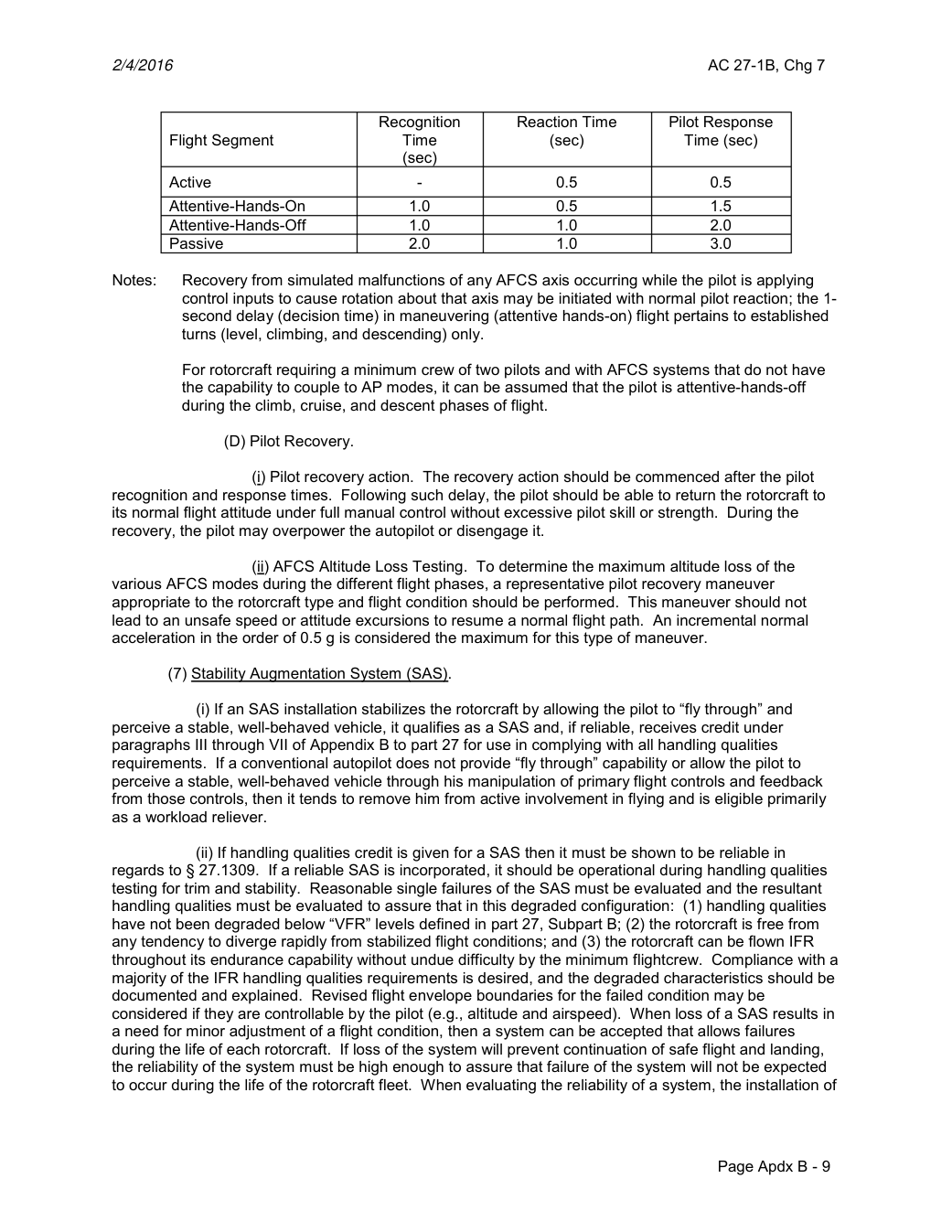
Recognition Reaction Time Pilot Response Flight Segment Time (sec) Time (sec) (sec)
Active - 0.5 0.5
Attentive-Hands-On 1.0 0.5 1.5 Attentive-Hands-Off 1.0 1.0 2.0 Passive 2.0 1.0 3.0
Notes: Recovery from simulated malfunctions of any AFCS axis occurring while the pilot is applying control inputs to cause rotation about that axis may be initiated with normal pilot reaction; the 1 second delay (decision time) in maneuvering (attentive hands-on) flight pertains to established turns (level, climbing, and descending) only.
For rotorcraft requiring a minimum crew of two pilots and with AFCS systems that do not have the capability to couple to AP modes, it can be assumed that the pilot is attentive-hands-off during the climb, cruise, and descent phases of flight.
(D) Pilot Recovery.
(i) Pilot recovery action. The recovery action should be commenced after the pilot recognition and response times. Following such delay, the pilot should be able to return the rotorcraft to its normal flight attitude under full manual control without excessive pilot skill or strength. During the recovery, the pilot may overpower the autopilot or disengage it.
(ii) AFCS Altitude Loss Testing. To determine the maximum altitude loss of the various AFCS modes during the different flight phases, a representative pilot recovery maneuver appropriate to the rotorcraft type and flight condition should be performed. This maneuver should not lead to an unsafe speed or attitude excursions to resume a normal flight path. An incremental normal acceleration in the order of 0.5 g is considered the maximum for this type of maneuver.
(7) Stability Augmentation System (SAS).
(i) If an SAS installation stabilizes the rotorcraft by allowing the pilot to “fly through” and perceive a stable, well-behaved vehicle, it qualifies as a SAS and, if reliable, receives credit under paragraphs III through VII of Appendix B to part 27 for use in complying with all handling qualities requirements. If a conventional autopilot does not provide “fly through” capability or allow the pilot to perceive a stable, well-behaved vehicle through his manipulation of primary flight controls and feedback from those controls, then it tends to remove him from active involvement in flying and is eligible primarily as a workload reliever.
(ii) If handling qualities credit is given for a SAS then it must be shown to be reliable in regards to § 27.1309. If a reliable SAS is incorporated, it should be operational during handling qualities testing for trim and stability. Reasonable single failures of the SAS must be evaluated and the resultant handling qualities must be evaluated to assure that in this degraded configuration: (1) handling qualities have not been degraded below “VFR” levels defined in part 27, Subpart B; (2) the rotorcraft is free from any tendency to diverge rapidly from stabilized flight conditions; and (3) the rotorcraft can be flown IFR throughout its endurance capability without undue difficulty by the minimum flightcrew. Compliance with a majority of the IFR handling qualities requirements is desired, and the degraded characteristics should be documented and explained. Revised flight envelope boundaries for the failed condition may be considered if they are controllable by the pilot (e.g., altitude and airspeed). When loss of a SAS results in a need for minor adjustment of a flight condition, then a system can be accepted that allows failures during the life of each rotorcraft. If loss of the system will prevent continuation of safe flight and landing, the reliability of the system must be high enough to assure that failure of the system will not be expected to occur during the life of the rotorcraft fleet. When evaluating the reliability of a system, the installation of
View figures, tables and original page layout
Connected references
Source-backed citations and subject-based engineering context are labelled separately. These links do not establish equivalence or project acceptance.
Related technical context
Engineering contextEvidence and scope
AC 27-1B and AC 29-2C — published scope
Aerospace Consulting navigation suggestion based on the subject and stated scope of the two publications.
This connection does not establish regulatory equivalence, acceptance of a newer edition, or applicability of a project-specific precedent to another programme.
Supporting sourceRelated technical context
Engineering contextEvidence and scope
CS-27 and AC 27-1B — published scope
Aerospace Consulting navigation suggestion based on the subject and stated scope of the two publications.
This connection does not establish regulatory equivalence, acceptance of a newer edition, or applicability of a project-specific precedent to another programme.
Supporting source