
AC 27-1B
Certification of Normal Category Rotorcraft — Changes 1–9
27-1B · Changes 1–9 incorporated Source checked 2026-11-28
Scope, source and reading notes
This source includes guidance for different amendments of Part 27. Match the guidance to the aircraft’s agreed certification basis: the 27.1309 entries for Amendments 27-21, 27-46 and 27-51 are separate. The base AC was issued on 30 September 1999; Change 9 is dated 23 June 2023. The FAA catalogue’s 30 September 2008 date is not the date of the latest change.
Aerospace Consulting reference note: Complete normal-category rotorcraft guidance, including system safety, equipment, flight guidance and IFR certification.
The complete selected publication is available in reading text and as the original PDF. Reading text is extracted from the official PDF; page layout is simplified, and figures and tables should be checked in the original page view.
Search covers extracted text. Words contained only in graphics may not be searchable. The original publication is available below.
Official source recordOriginal PDF on this siteSource: FAA. Reproduced with source acknowledgment; source edition and status are shown above. SHA-256: 2dfac16a3644dc18997069cca78746c10726e4b70d3aba996fc87843ffe68a2b
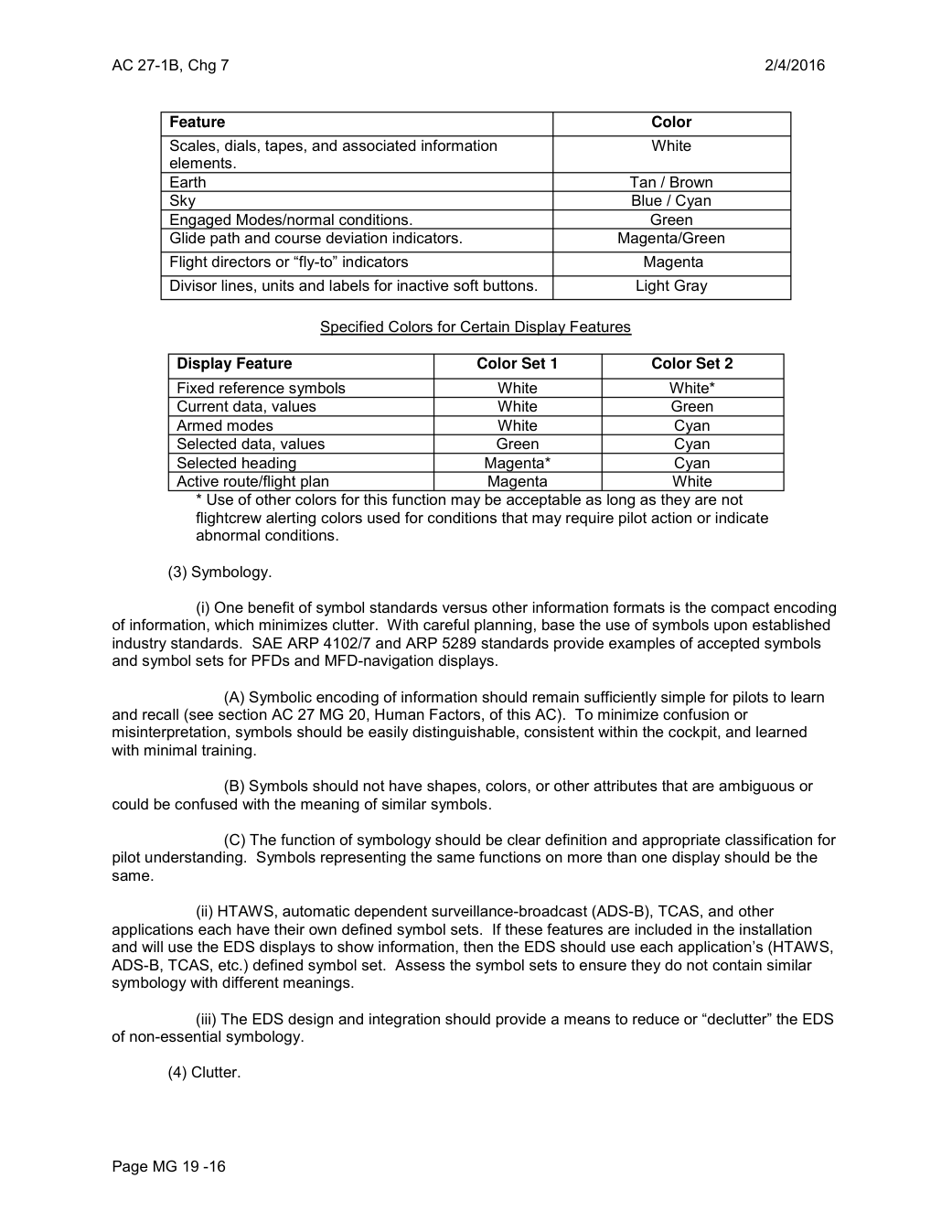
Feature Color
Scales, dials, tapes, and associated information White elements. Earth Tan / Brown Sky Blue / Cyan Engaged Modes/normal conditions. Green Glide path and course deviation indicators. Magenta/Green
Flight directors or “fly-to” indicators Magenta
Divisor lines, units and labels for inactive soft buttons. Light Gray
Specified Colors for Certain Display Features
Display Feature Color Set 1 Color Set 2
Fixed reference symbols White White* Current data, values White Green Armed modes White Cyan Selected data, values Green Cyan Selected heading Magenta* Cyan Active route/flight plan Magenta White * Use of other colors for this function may be acceptable as long as they are not flightcrew alerting colors used for conditions that may require pilot action or indicate abnormal conditions.
(3) Symbology.
(i) One benefit of symbol standards versus other information formats is the compact encoding of information, which minimizes clutter. With careful planning, base the use of symbols upon established industry standards. SAE ARP 4102/7 and ARP 5289 standards provide examples of accepted symbols and symbol sets for PFDs and MFD-navigation displays.
(A) Symbolic encoding of information should remain sufficiently simple for pilots to learn and recall (see section AC 27 MG 20, Human Factors, of this AC). To minimize confusion or misinterpretation, symbols should be easily distinguishable, consistent within the cockpit, and learned with minimal training.
(B) Symbols should not have shapes, colors, or other attributes that are ambiguous or could be confused with the meaning of similar symbols.
(C) The function of symbology should be clear definition and appropriate classification for pilot understanding. Symbols representing the same functions on more than one display should be the same.
(ii) HTAWS, automatic dependent surveillance-broadcast (ADS-B), TCAS, and other applications each have their own defined symbol sets. If these features are included in the installation and will use the EDS displays to show information, then the EDS should use each application’s (HTAWS, ADS-B, TCAS, etc.) defined symbol set. Assess the symbol sets to ensure they do not contain similar symbology with different meanings.
(iii) The EDS design and integration should provide a means to reduce or “declutter” the EDS of non-essential symbology.
(4) Clutter.
View figures, tables and original page layout
Connected references
Source-backed citations and subject-based engineering context are labelled separately. These links do not establish equivalence or project acceptance.
Related technical context
Engineering contextEvidence and scope
AC 27-1B and AC 29-2C — published scope
Aerospace Consulting navigation suggestion based on the subject and stated scope of the two publications.
This connection does not establish regulatory equivalence, acceptance of a newer edition, or applicability of a project-specific precedent to another programme.
Supporting sourceRelated technical context
Engineering contextEvidence and scope
CS-27 and AC 27-1B — published scope
Aerospace Consulting navigation suggestion based on the subject and stated scope of the two publications.
This connection does not establish regulatory equivalence, acceptance of a newer edition, or applicability of a project-specific precedent to another programme.
Supporting source