
AC 27-1B
Certification of Normal Category Rotorcraft — Changes 1–9
27-1B · Changes 1–9 incorporated Source checked 2026-11-28
Scope, source and reading notes
This source includes guidance for different amendments of Part 27. Match the guidance to the aircraft’s agreed certification basis: the 27.1309 entries for Amendments 27-21, 27-46 and 27-51 are separate. The base AC was issued on 30 September 1999; Change 9 is dated 23 June 2023. The FAA catalogue’s 30 September 2008 date is not the date of the latest change.
Aerospace Consulting reference note: Complete normal-category rotorcraft guidance, including system safety, equipment, flight guidance and IFR certification.
The complete selected publication is available in reading text and as the original PDF. Reading text is extracted from the official PDF; page layout is simplified, and figures and tables should be checked in the original page view.
Search covers extracted text. Words contained only in graphics may not be searchable. The original publication is available below.
Official source recordOriginal PDF on this siteSource: FAA. Reproduced with source acknowledgment; source edition and status are shown above. SHA-256: 2dfac16a3644dc18997069cca78746c10726e4b70d3aba996fc87843ffe68a2b
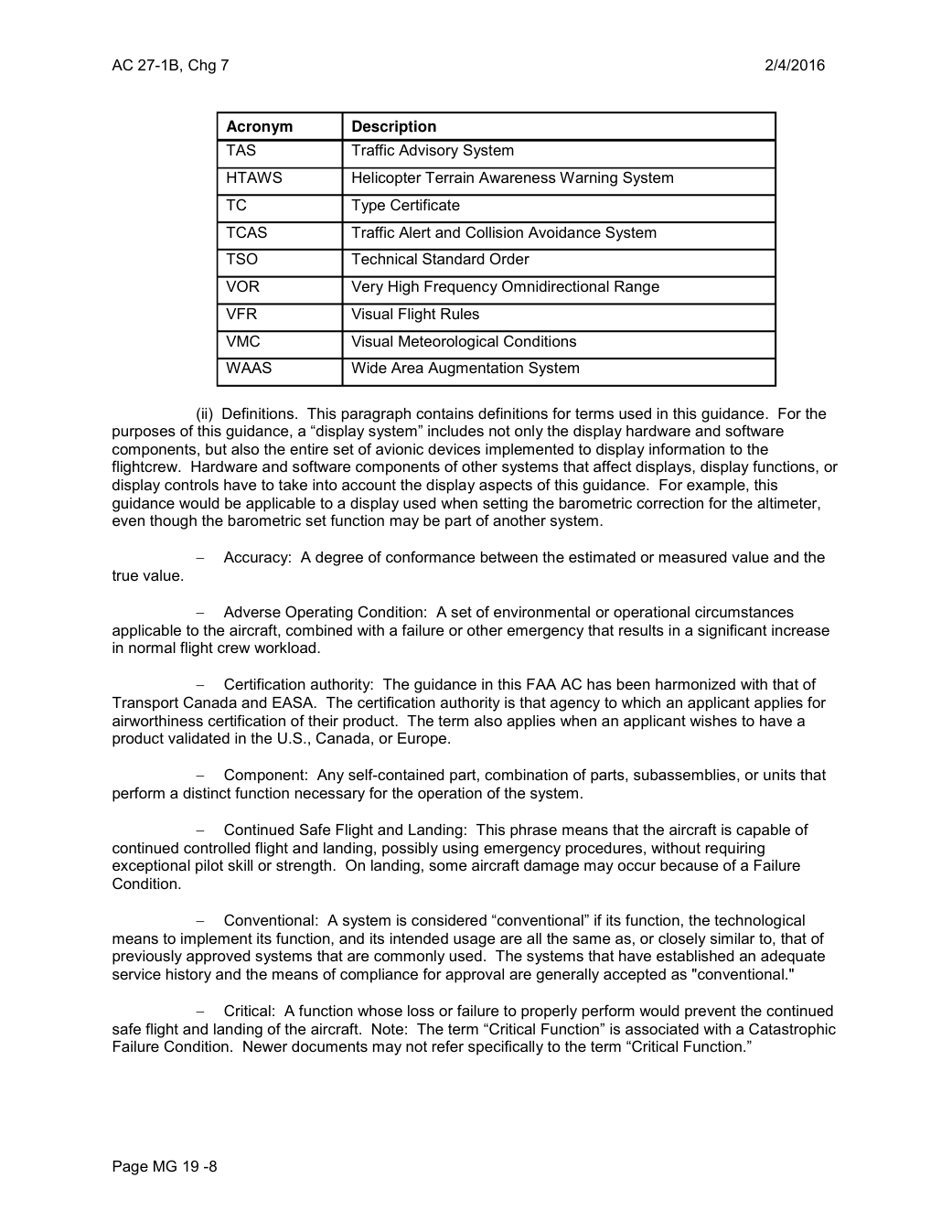
Acronym Description
TAS Traffic Advisory System
HTAWS Helicopter Terrain Awareness Warning System
TC Type Certificate
TCAS Traffic Alert and Collision Avoidance System
TSO Technical Standard Order
VOR Very High Frequency Omnidirectional Range
VFR Visual Flight Rules
VMC Visual Meteorological Conditions
WAAS Wide Area Augmentation System
(ii) Definitions. This paragraph contains definitions for terms used in this guidance. For the purposes of this guidance, a “display system” includes not only the display hardware and software components, but also the entire set of avionic devices implemented to display information to the flightcrew. Hardware and software components of other systems that affect displays, display functions, or display controls have to take into account the display aspects of this guidance. For example, this guidance would be applicable to a display used when setting the barometric correction for the altimeter, even though the barometric set function may be part of another system.
− Accuracy: A degree of conformance between the estimated or measured value and the true value.
− Adverse Operating Condition: A set of environmental or operational circumstances applicable to the aircraft, combined with a failure or other emergency that results in a significant increase in normal flight crew workload.
− Certification authority: The guidance in this FAA AC has been harmonized with that of Transport Canada and EASA. The certification authority is that agency to which an applicant applies for airworthiness certification of their product. The term also applies when an applicant wishes to have a product validated in the U.S., Canada, or Europe.
− Component: Any self-contained part, combination of parts, subassemblies, or units that perform a distinct function necessary for the operation of the system.
− Continued Safe Flight and Landing: This phrase means that the aircraft is capable of continued controlled flight and landing, possibly using emergency procedures, without requiring exceptional pilot skill or strength. On landing, some aircraft damage may occur because of a Failure Condition.
− Conventional: A system is considered “conventional” if its function, the technological means to implement its function, and its intended usage are all the same as, or closely similar to, that of previously approved systems that are commonly used. The systems that have established an adequate service history and the means of compliance for approval are generally accepted as "conventional."
− Critical: A function whose loss or failure to properly perform would prevent the continued safe flight and landing of the aircraft. Note: The term “Critical Function” is associated with a Catastrophic Failure Condition. Newer documents may not refer specifically to the term “Critical Function.”
View figures, tables and original page layout
Connected references
Source-backed citations and subject-based engineering context are labelled separately. These links do not establish equivalence or project acceptance.
Related technical context
Engineering contextEvidence and scope
AC 27-1B and AC 29-2C — published scope
Aerospace Consulting navigation suggestion based on the subject and stated scope of the two publications.
This connection does not establish regulatory equivalence, acceptance of a newer edition, or applicability of a project-specific precedent to another programme.
Supporting sourceRelated technical context
Engineering contextEvidence and scope
CS-27 and AC 27-1B — published scope
Aerospace Consulting navigation suggestion based on the subject and stated scope of the two publications.
This connection does not establish regulatory equivalence, acceptance of a newer edition, or applicability of a project-specific precedent to another programme.
Supporting source