Certification of Normal Category Rotorcraft — Changes 1–9
Normal category rotorcraft guidance with Changes 1–9 incorporated. Search the complete AC or start with the system safety, flight controls and instrument-flight guidance.
This source includes guidance for different amendments of Part 27. Match the guidance to the aircraft’s agreed certification basis: the 27.1309 entries for Amendments 27-21, 27-46 and 27-51 are separate. The base AC was issued on 30 September 1999; Change 9 is dated 23 June 2023. The FAA catalogue’s 30 September 2008 date is not the date of the latest change.
The source, within reach.
Search within this AC, jump to a source page, or download the complete saved publication.
This extraction supports search. Read the original page for complete notation and layout.
AC 27-1B, Chg 7                                                       2/4/2016


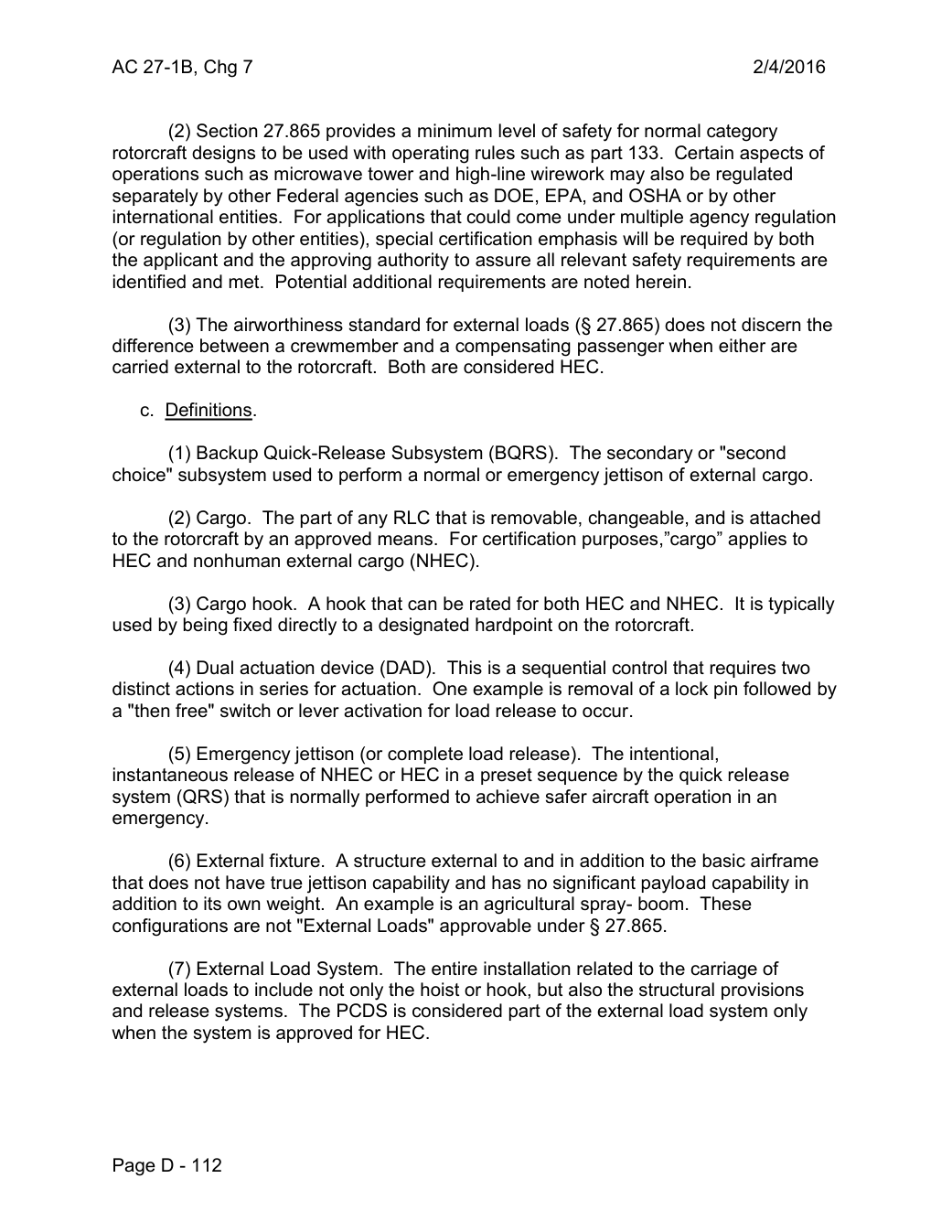
       (2) Section 27.865 provides a minimum level of safety for normal category
rotorcraft designs to be used with operating rules such as part 133. Certain aspects of
operations such as microwave tower and high-line wirework may also be regulated
separately by other Federal agencies such as DOE, EPA, and OSHA or by other
international entities. For applications that could come under multiple agency regulation
(or regulation by other entities), special certification emphasis will be required by both
the applicant and the approving authority to assure all relevant safety requirements are
identified and met. Potential additional requirements are noted herein.

       (3) The airworthiness standard for external loads (§ 27.865) does not discern the
difference between a crewmember and a compensating passenger when either are
carried external to the rotorcraft. Both are considered HEC.

    c. Definitions.

       (1) Backup Quick-Release Subsystem (BQRS). The secondary or "second
choice" subsystem used to perform a normal or emergency jettison of external cargo.

       (2) Cargo. The part of any RLC that is removable, changeable, and is attached
to the rotorcraft by an approved means. For certification purposes,”cargo” applies to
HEC and nonhuman external cargo (NHEC).

       (3) Cargo hook. A hook that can be rated for both HEC and NHEC.  It is typically
used by being fixed directly to a designated hardpoint on the rotorcraft.

       (4) Dual actuation device (DAD). This is a sequential control that requires two
distinct actions in series for actuation. One example is removal of a lock pin followed by
a "then free" switch or lever activation for load release to occur.

       (5) Emergency jettison (or complete load release). The intentional,
instantaneous release of NHEC or HEC in a preset sequence by the quick release
system (QRS) that is normally performed to achieve safer aircraft operation in an
emergency.

       (6) External fixture. A structure external to and in addition to the basic airframe
that does not have true jettison capability and has no significant payload capability in
addition to its own weight. An example is an agricultural spray- boom. These
configurations are not "External Loads" approvable under § 27.865.

       (7) External Load System. The entire installation related to the carriage of
external loads to include not only the hoist or hook, but also the structural provisions
and release systems. The PCDS is considered part of the external load system only
when the system is approved for HEC.


Page D - 112
Saved from the FAA on November 17, 2026. All original pages are retained. Engineering explanations are presented separately below.
Aerospace Consulting / Engineering perspective
Start with the certification basis and the function.
Identify the applicable amendment before selecting the safety guidance. Connect intended functions and operating conditions to failure conditions, architecture decisions, common-cause considerations, verification and limitations. For flight controls and IFR work, carry the relevant 27.672, 27.1329 and Appendix B assumptions into the system safety and compliance evidence.
1196 original pages. 0 pages have reviewed text reflows. Original-first pages retain the source layout, with extracted text available for finding words.
A focused review, an agreed assessment package or ongoing support alongside your team. We can agree the relevant inputs and scope in the initial conversation.
This opens your email application.
Start a conversation
Tell us about your programme, the system you are developing and the support you need.
We can agree a focused use-case review, a defined evidence package or ongoing programme support.
This opens your email application.
Specialist aerospace expertise
Aerospace Consulting is led by Hussein Khimji, an FAA Designated Engineering Representative in systems and equipment, with a focus on system safety, flight controls and avionics.
We work with aircraft developers and systems suppliers to connect technical decisions, safety assessments and certification evidence.
This is the proposed introduction. The full About page will add your approved biography and associate expertise.
Systems engineering & development assurance
Tell us about the aircraft or system, its intended function, stage of development and the support you need.