
Original FAA page, including its printed amendment and change markings. Extracted words support search; text reflow has not been reviewed.
AC 27-1B · 1058Open saved PDF here ↗
Extracted text for finding words
This extraction supports search. Read the original page for complete notation and layout.
2/4/2016                                                            AC 27-1B, Chg 7

 Note: Not all ATA chapters or subchapters have been included. Also, the italicized entries are not usually included in the
                       failure condition description but in the systems description or assumptions section.

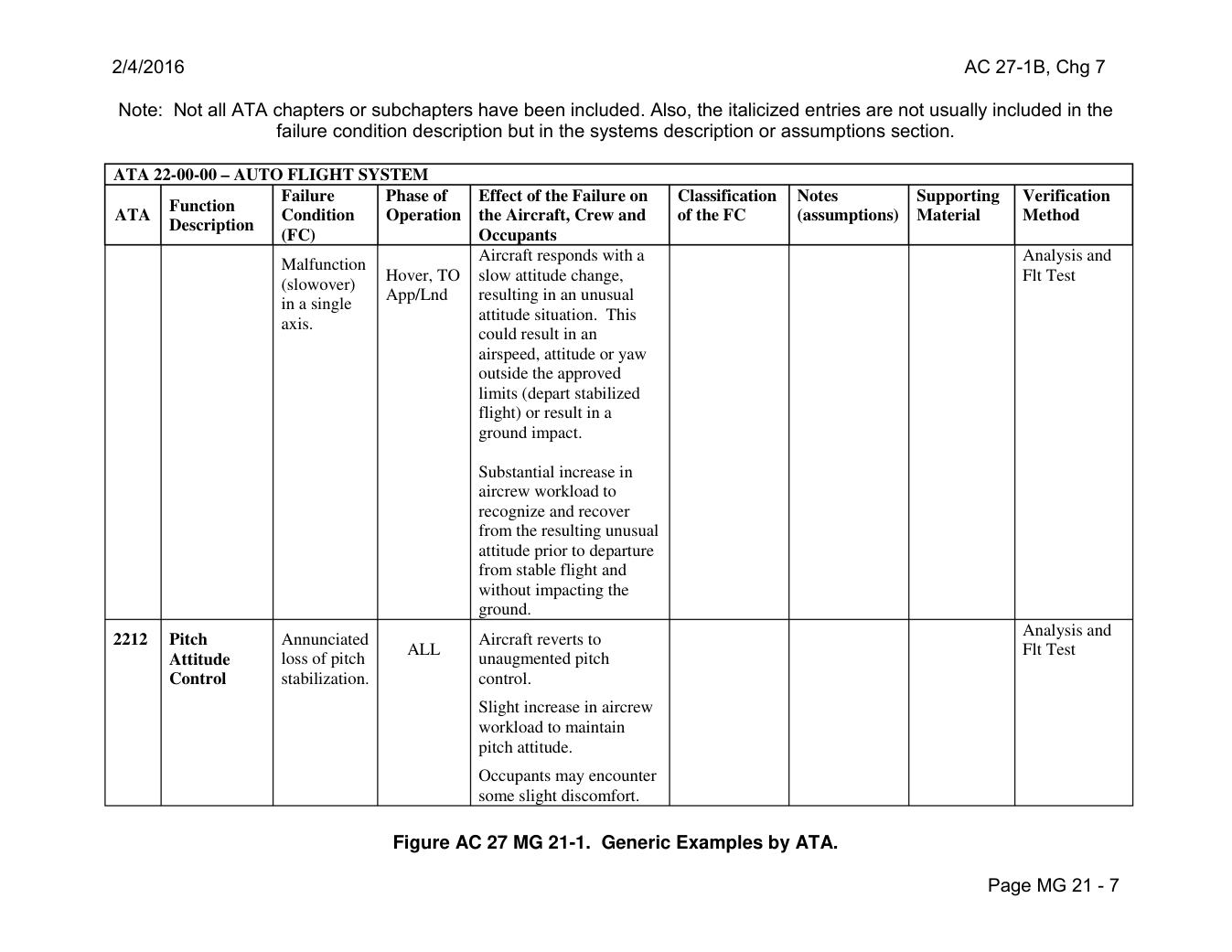
ATA 22-00-00 – AUTO FLIGHT SYSTEM
                      Failure      Phase of    Effect of the Failure on    Classification  Notes         Supporting   Verification       FunctionATA                Condition    Operation  the Aircraft, Crew and    of the FC       (assumptions)  Material    Method       Description                    (FC)                   Occupants
                                                      Aircraft responds with a                                                  Analysis and                      Malfunction                                   Hover, TO  slow attitude change,                                                               Flt Test                       (slowover)                               App/Lnd     resulting in an unusual                         in a single                                                         attitude situation. This                          axis.                                                could result in an
                                                      airspeed, attitude or yaw
                                                    outside the approved
                                                        limits (depart stabilized
                                                            flight) or result in a
                                             ground impact.

                                                     Substantial increase in
                                                  aircrew workload to
                                                  recognize and recover
                                            from the resulting unusual
                                                         attitude prior to departure
                                            from stable flight and
                                                 without impacting the
                                                 ground.
                                                                                                                         Analysis and2212   Pitch         Annunciated                Aircraft reverts to                           ALL                                                                                           Flt Test        Attitude        loss of pitch              unaugmented pitch
       Control         stabilization.                 control.
                                                      Slight increase in aircrew
                                             workload to maintain
                                                     pitch attitude.
                                              Occupants may encounter
                                         some slight discomfort.

                              Figure AC 27 MG 21-1. Generic Examples by ATA.

                                                                                Page MG 21 - 7