Certification of Normal Category Rotorcraft — Changes 1–9
Normal category rotorcraft guidance with Changes 1–9 incorporated. Search the complete AC or start with the system safety, flight controls and instrument-flight guidance.
This source includes guidance for different amendments of Part 27. Match the guidance to the aircraft’s agreed certification basis: the 27.1309 entries for Amendments 27-21, 27-46 and 27-51 are separate. The base AC was issued on 30 September 1999; Change 9 is dated 23 June 2023. The FAA catalogue’s 30 September 2008 date is not the date of the latest change.
The source, within reach.
Search within this AC, jump to a source page, or download the complete saved publication.
This extraction supports search. Read the original page for complete notation and layout.
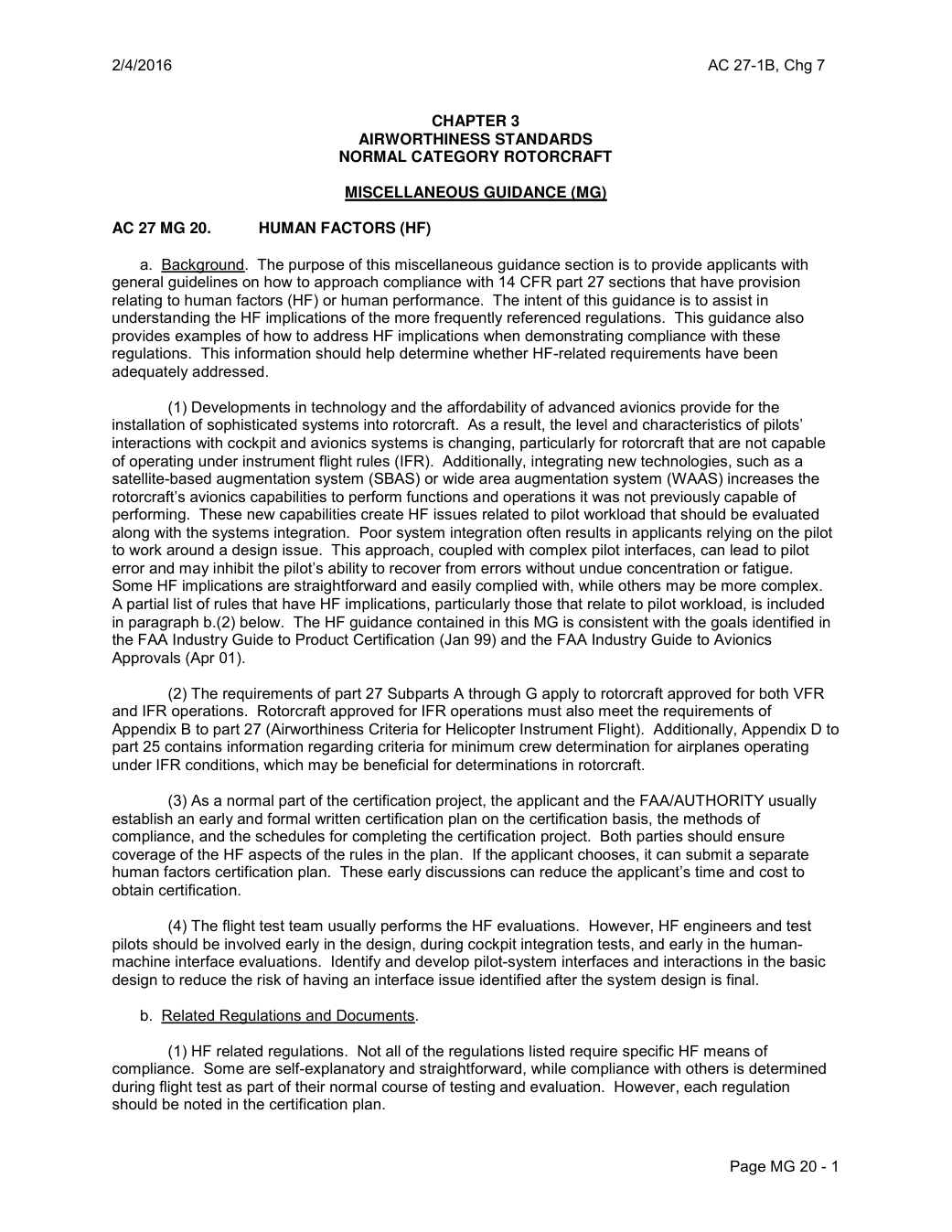
2/4/2016                                                  AC 27-1B, Chg 7


                              CHAPTER 3
                        AIRWORTHINESS STANDARDS
                    NORMAL CATEGORY ROTORCRAFT

                      MISCELLANEOUS GUIDANCE (MG)

AC 27 MG 20.    HUMAN FACTORS (HF)

    a. Background. The purpose of this miscellaneous guidance section is to provide applicants with
general guidelines on how to approach compliance with 14 CFR part 27 sections that have provision
relating to human factors (HF) or human performance. The intent of this guidance is to assist in
understanding the HF implications of the more frequently referenced regulations. This guidance also
provides examples of how to address HF implications when demonstrating compliance with these
regulations. This information should help determine whether HF-related requirements have been
adequately addressed.

         (1) Developments in technology and the affordability of advanced avionics provide for the
installation of sophisticated systems into rotorcraft. As a result, the level and characteristics of pilots’
interactions with cockpit and avionics systems is changing, particularly for rotorcraft that are not capable
of operating under instrument flight rules (IFR). Additionally, integrating new technologies, such as a
satellite-based augmentation system (SBAS) or wide area augmentation system (WAAS) increases the
rotorcraft’s avionics capabilities to perform functions and operations it was not previously capable of
performing. These new capabilities create HF issues related to pilot workload that should be evaluated
along with the systems integration. Poor system integration often results in applicants relying on the pilot
to work around a design issue. This approach, coupled with complex pilot interfaces, can lead to pilot
error and may inhibit the pilot’s ability to recover from errors without undue concentration or fatigue.
Some HF implications are straightforward and easily complied with, while others may be more complex.
A partial list of rules that have HF implications, particularly those that relate to pilot workload, is included
in paragraph b.(2) below. The HF guidance contained in this MG is consistent with the goals identified in
the FAA Industry Guide to Product Certification (Jan 99) and the FAA Industry Guide to Avionics
Approvals (Apr 01).

         (2) The requirements of part 27 Subparts A through G apply to rotorcraft approved for both VFR
and IFR operations. Rotorcraft approved for IFR operations must also meet the requirements of
Appendix B to part 27 (Airworthiness Criteria for Helicopter Instrument Flight). Additionally, Appendix D to
part 25 contains information regarding criteria for minimum crew determination for airplanes operating
under IFR conditions, which may be beneficial for determinations in rotorcraft.

         (3) As a normal part of the certification project, the applicant and the FAA/AUTHORITY usually
establish an early and formal written certification plan on the certification basis, the methods of
compliance, and the schedules for completing the certification project. Both parties should ensure
coverage of the HF aspects of the rules in the plan.  If the applicant chooses, it can submit a separate
human factors certification plan. These early discussions can reduce the applicant’s time and cost to
obtain certification.

         (4) The flight test team usually performs the HF evaluations. However, HF engineers and test
pilots should be involved early in the design, during cockpit integration tests, and early in the human-
machine interface evaluations. Identify and develop pilot-system interfaces and interactions in the basic
design to reduce the risk of having an interface issue identified after the system design is final.

    b. Related Regulations and Documents.

         (1) HF related regulations. Not all of the regulations listed require specific HF means of
compliance. Some are self-explanatory and straightforward, while compliance with others is determined
during flight test as part of their normal course of testing and evaluation. However, each regulation
should be noted in the certification plan.


                                                                    Page MG 20 - 1
Saved from the FAA on November 17, 2026. All original pages are retained. Engineering explanations are presented separately below.
Aerospace Consulting / Engineering perspective
Start with the certification basis and the function.
Identify the applicable amendment before selecting the safety guidance. Connect intended functions and operating conditions to failure conditions, architecture decisions, common-cause considerations, verification and limitations. For flight controls and IFR work, carry the relevant 27.672, 27.1329 and Appendix B assumptions into the system safety and compliance evidence.
1196 original pages. 0 pages have reviewed text reflows. Original-first pages retain the source layout, with extracted text available for finding words.
A focused review, an agreed assessment package or ongoing support alongside your team. We can agree the relevant inputs and scope in the initial conversation.
This opens your email application.
Start a conversation
Tell us about your programme, the system you are developing and the support you need.
We can agree a focused use-case review, a defined evidence package or ongoing programme support.
This opens your email application.
Specialist aerospace expertise
Aerospace Consulting is led by Hussein Khimji, an FAA Designated Engineering Representative in systems and equipment, with a focus on system safety, flight controls and avionics.
We work with aircraft developers and systems suppliers to connect technical decisions, safety assessments and certification evidence.
This is the proposed introduction. The full About page will add your approved biography and associate expertise.
Systems engineering & development assurance
Tell us about the aircraft or system, its intended function, stage of development and the support you need.