Certification of Normal Category Rotorcraft — Changes 1–9
Normal category rotorcraft guidance with Changes 1–9 incorporated. Search the complete AC or start with the system safety, flight controls and instrument-flight guidance.
This source includes guidance for different amendments of Part 27. Match the guidance to the aircraft’s agreed certification basis: the 27.1309 entries for Amendments 27-21, 27-46 and 27-51 are separate. The base AC was issued on 30 September 1999; Change 9 is dated 23 June 2023. The FAA catalogue’s 30 September 2008 date is not the date of the latest change.
The source, within reach.
Search within this AC, jump to a source page, or download the complete saved publication.
This extraction supports search. Read the original page for complete notation and layout.
AC 27-1B, Chg 7                                                                       2/4/2016


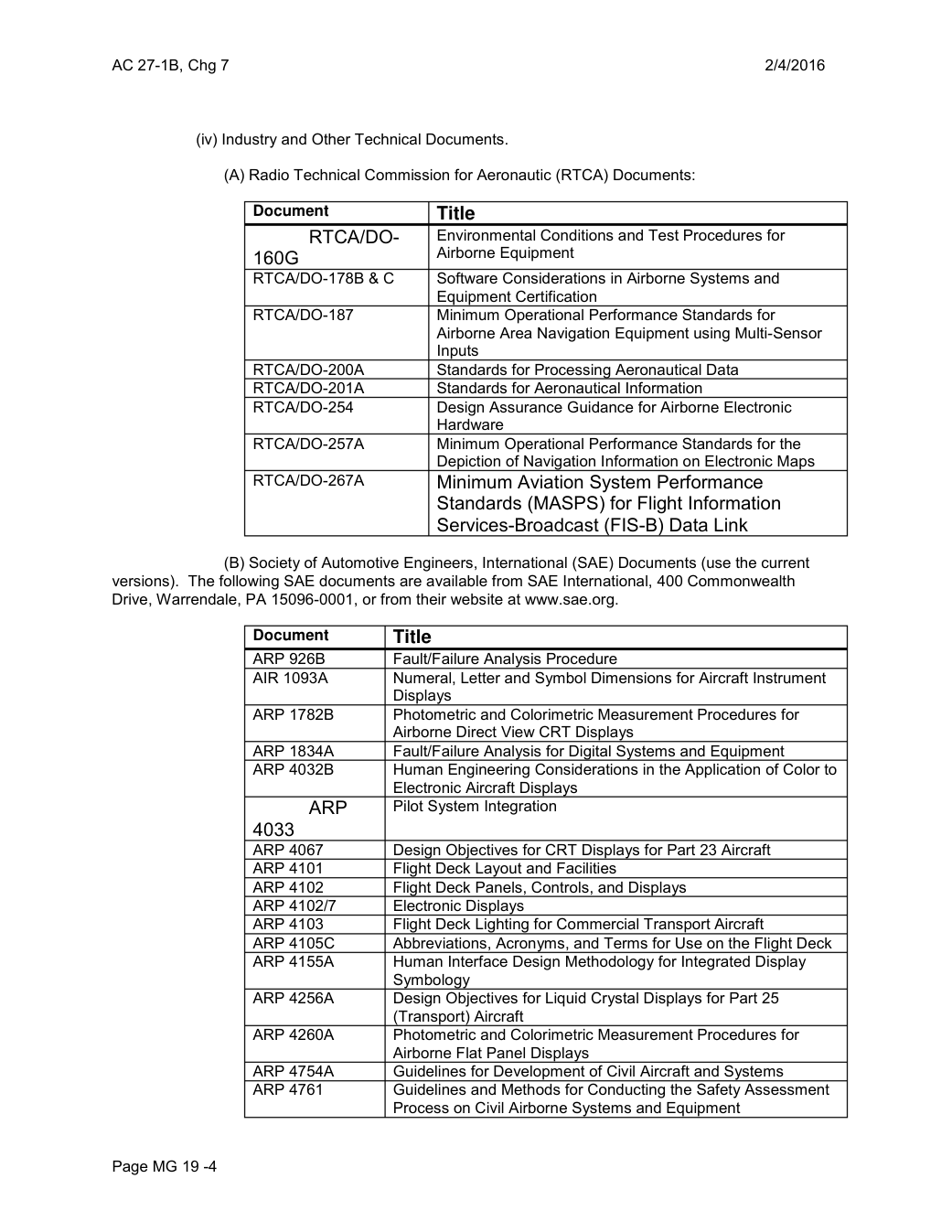
                (iv) Industry and Other Technical Documents.

                (A) Radio Technical Commission for Aeronautic (RTCA) Documents:

               Document              Title
                 RTCA/DO-     Environmental Conditions and Test Procedures for
            160G                   Airborne Equipment
               RTCA/DO-178B & C      Software Considerations in Airborne Systems and
                                       Equipment Certification
               RTCA/DO-187         Minimum Operational Performance Standards for
                                            Airborne Area Navigation Equipment using Multi-Sensor
                                              Inputs
               RTCA/DO-200A         Standards for Processing Aeronautical Data
               RTCA/DO-201A         Standards for Aeronautical Information
               RTCA/DO-254          Design Assurance Guidance for Airborne Electronic
                                       Hardware
               RTCA/DO-257A        Minimum Operational Performance Standards for the
                                             Depiction of Navigation Information on Electronic Maps
               RTCA/DO-267A       Minimum Aviation System Performance
                                  Standards (MASPS) for Flight Information
                                    Services-Broadcast (FIS-B) Data Link

                (B) Society of Automotive Engineers, International (SAE) Documents (use the current
versions). The following SAE documents are available from SAE International, 400 Commonwealth
Drive, Warrendale, PA 15096-0001, or from their website at www.sae.org.

               Document        Title
             ARP 926B          Fault/Failure Analysis Procedure
                AIR 1093A        Numeral, Letter and Symbol Dimensions for Aircraft Instrument
                                      Displays
             ARP 1782B        Photometric and Colorimetric Measurement Procedures for
                                      Airborne Direct View CRT Displays
             ARP 1834A         Fault/Failure Analysis for Digital Systems and Equipment
             ARP 4032B      Human Engineering Considerations in the Application of Color to
                                         Electronic Aircraft Displays
               ARP        Pilot System Integration
              4033
             ARP 4067         Design Objectives for CRT Displays for Part 23 Aircraft
             ARP 4101           Flight Deck Layout and Facilities
             ARP 4102           Flight Deck Panels, Controls, and Displays
             ARP 4102/7        Electronic Displays
             ARP 4103           Flight Deck Lighting for Commercial Transport Aircraft
             ARP 4105C        Abbreviations, Acronyms, and Terms for Use on the Flight Deck
             ARP 4155A      Human Interface Design Methodology for Integrated Display
                                 Symbology
             ARP 4256A       Design Objectives for Liquid Crystal Displays for Part 25
                                        (Transport) Aircraft
             ARP 4260A        Photometric and Colorimetric Measurement Procedures for
                                      Airborne Flat Panel Displays
             ARP 4754A        Guidelines for Development of Civil Aircraft and Systems
             ARP 4761         Guidelines and Methods for Conducting the Safety Assessment
                                   Process on Civil Airborne Systems and Equipment


Page MG 19 -4
Saved from the FAA on November 17, 2026. All original pages are retained. Engineering explanations are presented separately below.
Aerospace Consulting / Engineering perspective
Start with the certification basis and the function.
Identify the applicable amendment before selecting the safety guidance. Connect intended functions and operating conditions to failure conditions, architecture decisions, common-cause considerations, verification and limitations. For flight controls and IFR work, carry the relevant 27.672, 27.1329 and Appendix B assumptions into the system safety and compliance evidence.
1196 original pages. 0 pages have reviewed text reflows. Original-first pages retain the source layout, with extracted text available for finding words.
A focused review, an agreed assessment package or ongoing support alongside your team. We can agree the relevant inputs and scope in the initial conversation.
This opens your email application.
Start a conversation
Tell us about your programme, the system you are developing and the support you need.
We can agree a focused use-case review, a defined evidence package or ongoing programme support.
This opens your email application.
Specialist aerospace expertise
Aerospace Consulting is led by Hussein Khimji, an FAA Designated Engineering Representative in systems and equipment, with a focus on system safety, flight controls and avionics.
We work with aircraft developers and systems suppliers to connect technical decisions, safety assessments and certification evidence.
This is the proposed introduction. The full About page will add your approved biography and associate expertise.
Systems engineering & development assurance
Tell us about the aircraft or system, its intended function, stage of development and the support you need.