
CS-27
Small Rotorcraft
Amendment 10; corrected 15 September 2025 Source checked 2026-11-28
Scope, source and reading notes
Complete official CS-27 Amendment 10, including AMC, GM and appendices.
Aerospace Consulting reference note: Certification specifications and related compliance guidance for small rotorcraft, using the corrected official publication.
The complete selected publication is available in reading text and as the original PDF. Reading text is extracted from the official PDF; page layout is simplified, and figures and tables should be checked in the original page view.
Search covers extracted text. Words contained only in graphics may not be searchable. The original publication is available below.
Official source recordOriginal PDF on this siteSource: EASA. Reproduced with source acknowledgment; source edition and status are shown above. SHA-256: e762c494818f5badf2cceb0a8dc04e8cf5938efa2552deeadc0f708d1ead92ae
Table 1: Definition of the small rotorcraft classes in the context of the AMC 27.1309
Note: A rotorcraft that is intended to operate under IFR, will need to be certified as a minimum as Class II.
Safety objectives per class and failure condition classification
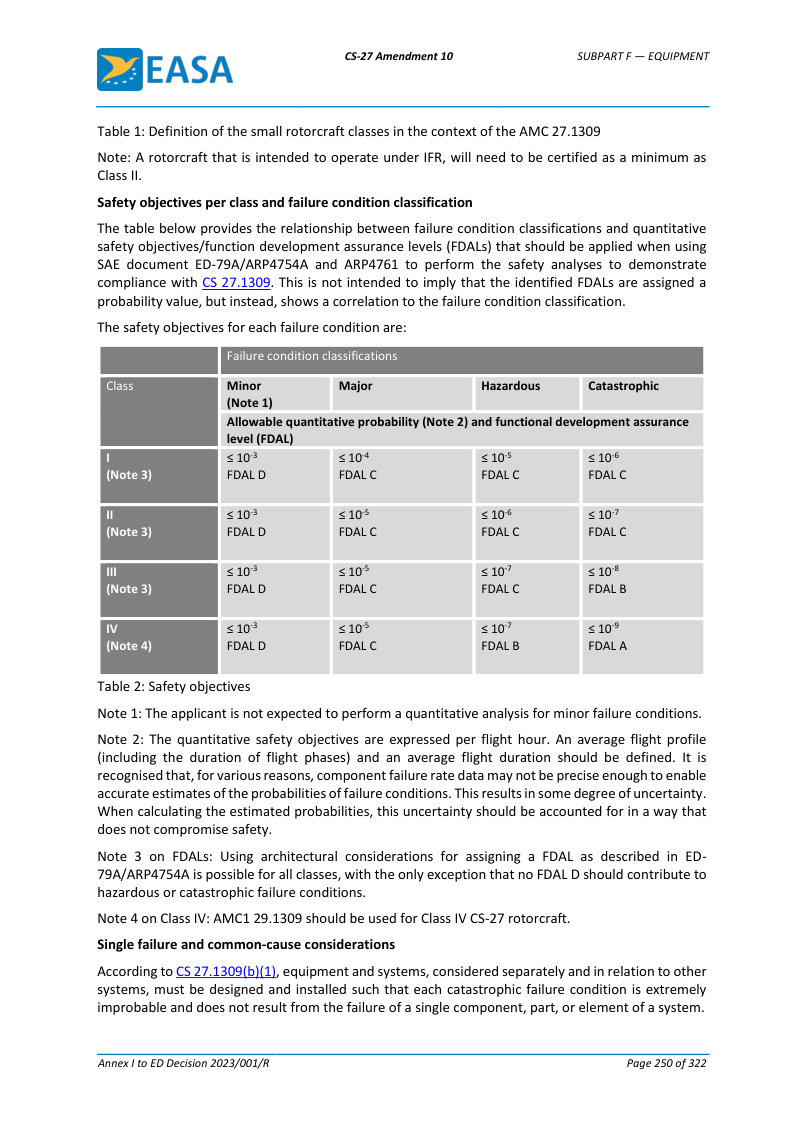
The table below provides the relationship between failure condition classifications and quantitative safety objectives/function development assurance levels (FDALs) that should be applied when using SAE document ED-79A/ARP4754A and ARP4761 to perform the safety analyses to demonstrate compliance with CS 27.1309. This is not intended to imply that the identified FDALs are assigned a probability value, but instead, shows a correlation to the failure condition classification.
The safety objectives for each failure condition are:
Failure condition classifications
Major Hazardous Catastrophic
Class Minor (Note 1)
Allowable quantitative probability (Note 2) and functional development assurance level (FDAL) I (Note 3)
≤ 10-3 FDAL D
≤ 10-4 FDAL C
≤ 10-5 FDAL C
≤ 10-6 FDAL C
II (Note 3)
≤ 10-3 FDAL D
≤ 10-5 FDAL C
≤ 10-6 FDAL C
≤ 10-7 FDAL C
III (Note 3)
≤ 10-3 FDAL D
≤ 10-5 FDAL C
≤ 10-7 FDAL C
≤ 10-8 FDAL B
IV (Note 4)
≤ 10-3 FDAL D
≤ 10-5 FDAL C
≤ 10-7 FDAL B
≤ 10-9 FDAL A
Table 2: Safety objectives
Note 1: The applicant is not expected to perform a quantitative analysis for minor failure conditions.
Note 2: The quantitative safety objectives are expressed per flight hour. An average flight profile (including the duration of flight phases) and an average flight duration should be defined. It is recognised that, for various reasons, component failure rate data may not be precise enough to enable accurate estimates of the probabilities of failure conditions. This results in some degree of uncertainty. When calculating the estimated probabilities, this uncertainty should be accounted for in a way that does not compromise safety.
Note 3 on FDALs: Using architectural considerations for assigning a FDAL as described in ED- 79A/ARP4754A is possible for all classes, with the only exception that no FDAL D should contribute to hazardous or catastrophic failure conditions.
Note 4 on Class IV: AMC1 29.1309 should be used for Class IV CS-27 rotorcraft.
Single failure and common-cause considerations
According to CS 27.1309(b)(1), equipment and systems, considered separately and in relation to other systems, must be designed and installed such that each catastrophic failure condition is extremely improbable and does not result from the failure of a single component, part, or element of a system.
View figures, tables and original page layout
Connected references
Source-backed citations and subject-based engineering context are labelled separately. These links do not establish equivalence or project acceptance.
Related technical context
Engineering contextEvidence and scope
CS-27 and AC 27-1B — published scope
Aerospace Consulting navigation suggestion based on the subject and stated scope of the two publications.
This connection does not establish regulatory equivalence, acceptance of a newer edition, or applicability of a project-specific precedent to another programme.
Supporting source