
CS-27
Small Rotorcraft
Amendment 10; corrected 15 September 2025 Source checked 2026-11-28
Scope, source and reading notes
Complete official CS-27 Amendment 10, including AMC, GM and appendices.
Aerospace Consulting reference note: Certification specifications and related compliance guidance for small rotorcraft, using the corrected official publication.
The complete selected publication is available in reading text and as the original PDF. Reading text is extracted from the official PDF; page layout is simplified, and figures and tables should be checked in the original page view.
Search covers extracted text. Words contained only in graphics may not be searchable. The original publication is available below.
Official source recordOriginal PDF on this siteSource: EASA. Reproduced with source acknowledgment; source edition and status are shown above. SHA-256: e762c494818f5badf2cceb0a8dc04e8cf5938efa2552deeadc0f708d1ead92ae
(d) If cargo compartment lamps are installed, each lamp must be installed so as to prevent contact between lamp bulb and cargo.
AMC1 27.787 Cargo and baggage compartments
PROTECTION OF OCCUPANTS IN THE CABIN
The CS-27 objective is to protect the occupant within the cabin from forces up to those specified in CS 27.561(b)(3).
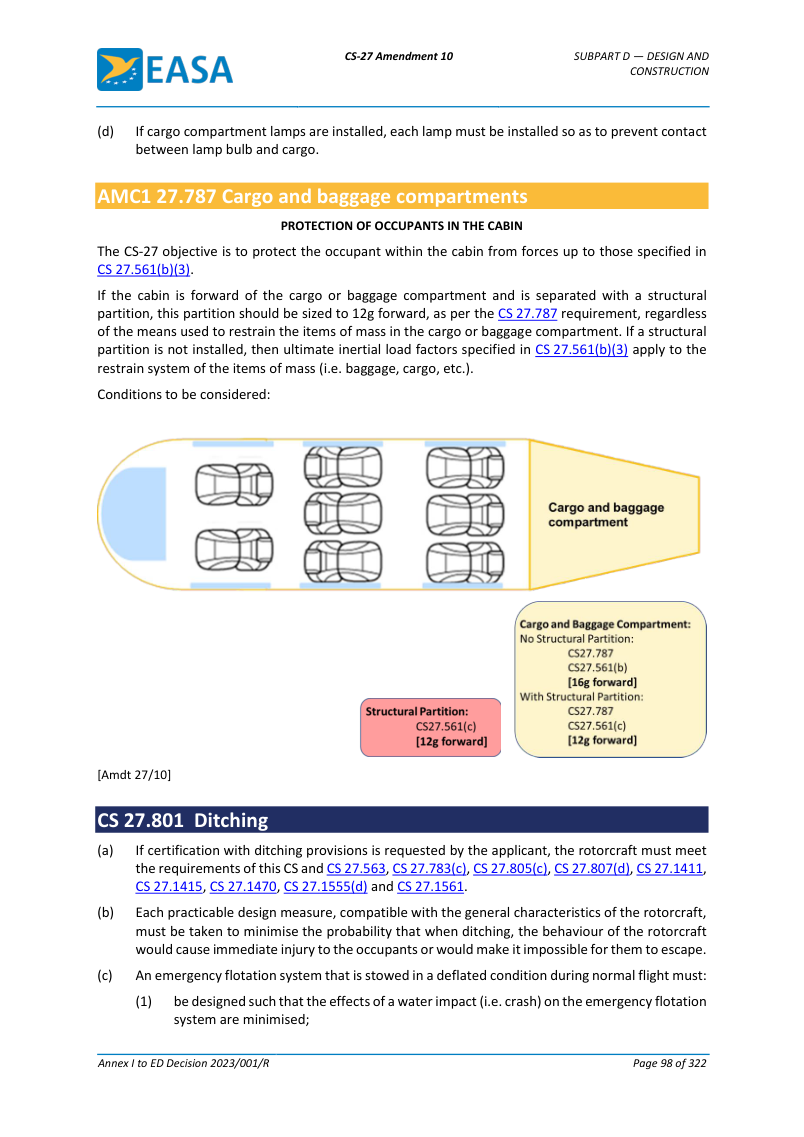
If the cabin is forward of the cargo or baggage compartment and is separated with a structural partition, this partition should be sized to 12g forward, as per the CS 27.787 requirement, regardless of the means used to restrain the items of mass in the cargo or baggage compartment. If a structural partition is not installed, then ultimate inertial load factors specified in CS 27.561(b)(3) apply to the restrain system of the items of mass (i.e. baggage, cargo, etc.).
Conditions to be considered:
[Amdt 27/10]
CS 27.801 Ditching
(a) If certification with ditching provisions is requested by the applicant, the rotorcraft must meet the requirements of this CS and CS 27.563, CS 27.783(c), CS 27.805(c), CS 27.807(d), CS 27.1411, CS 27.1415, CS 27.1470, CS 27.1555(d) and CS 27.1561.
(b) Each practicable design measure, compatible with the general characteristics of the rotorcraft, must be taken to minimise the probability that when ditching, the behaviour of the rotorcraft would cause immediate injury to the occupants or would make it impossible for them to escape.
(c) An emergency flotation system that is stowed in a deflated condition during normal flight must:
(1) be designed such that the effects of a water impact (i.e. crash) on the emergency flotation system are minimised;
View figures, tables and original page layout
Connected references
Source-backed citations and subject-based engineering context are labelled separately. These links do not establish equivalence or project acceptance.
Related technical context
Engineering contextEvidence and scope
CS-27 and AC 27-1B — published scope
Aerospace Consulting navigation suggestion based on the subject and stated scope of the two publications.
This connection does not establish regulatory equivalence, acceptance of a newer edition, or applicability of a project-specific precedent to another programme.
Supporting source