
CS-27
Small Rotorcraft
Amendment 10; corrected 15 September 2025 Source checked 2026-11-28
Scope, source and reading notes
Complete official CS-27 Amendment 10, including AMC, GM and appendices.
Aerospace Consulting reference note: Certification specifications and related compliance guidance for small rotorcraft, using the corrected official publication.
The complete selected publication is available in reading text and as the original PDF. Reading text is extracted from the official PDF; page layout is simplified, and figures and tables should be checked in the original page view.
Search covers extracted text. Words contained only in graphics may not be searchable. The original publication is available below.
Official source recordOriginal PDF on this siteSource: EASA. Reproduced with source acknowledgment; source edition and status are shown above. SHA-256: e762c494818f5badf2cceb0a8dc04e8cf5938efa2552deeadc0f708d1ead92ae
(2) Likely to deteriorate in service before normal replacement; or
(3) Subject to appreciable variability due to:
(i) Uncertainties in manufacturing processes; or
(ii) Uncertainties in inspection methods.
(b) For each part to which CS 27.621 to 27.625 apply, the factor of safety prescribed in CS 27.303 must be multiplied by a special factor equal to:
(1) The applicable special factors prescribed in CS 27.621 to 27.625; or
(2) Any other factor great enough to ensure that the probability of the part being understrength because of the uncertainties specified in sub-paragraph (a) is extremely remote.
CS 27.621 Casting factors
(a) General. The factors, tests, and inspections specified in sub-paragraphs (b) and (c) must be applied in addition to those necessary to establish foundry quality control. The inspections must meet approved specifications. Sub-paragraphs (c) and (d) apply to structural castings except castings that are pressure tested as parts of hydraulic or other fluid systems and do not support structural loads.
(b) Bearing stresses and surfaces. The casting factors specified in sub-paragraphs (c) and (d):
(1) Need not exceed 1.25 with respect to bearing stresses regardless of the method of inspection used; and
(2) Need not be used with respect to the bearing surfaces of a part whose bearing factor is larger than the applicable casting factor.
(c) Critical castings. For each casting whose failure would preclude continued safe flight and landing of the rotorcraft or result in serious injury to any occupant, the following apply:
(1) Each critical casting must –
(i) Have a casting factor of not less than 1.25; and
(ii) Receive 100% inspection by visual, radiographic, and magnetic particle (for ferromagnetic materials) or penetrant (for non-ferromagnetic materials) inspection methods or approved equivalent inspection methods.
(2) For each critical casting with a casting factor less than 1.50, three sample castings must be static tested and shown to meet –
(i) The strength requirements of CS 27.305 at an ultimate load corresponding to a casting factor of 1.25; and
(ii) The deformation requirements of CS 27.305 at a load of 1.15 times the limit load.
(d) Non-critical castings. For each casting other than those specified in sub-paragraph (c), the following apply:
(1) Except as provided in sub-paragraphs (d)(2) and (3), the casting factors and corresponding inspections must meet the following table:
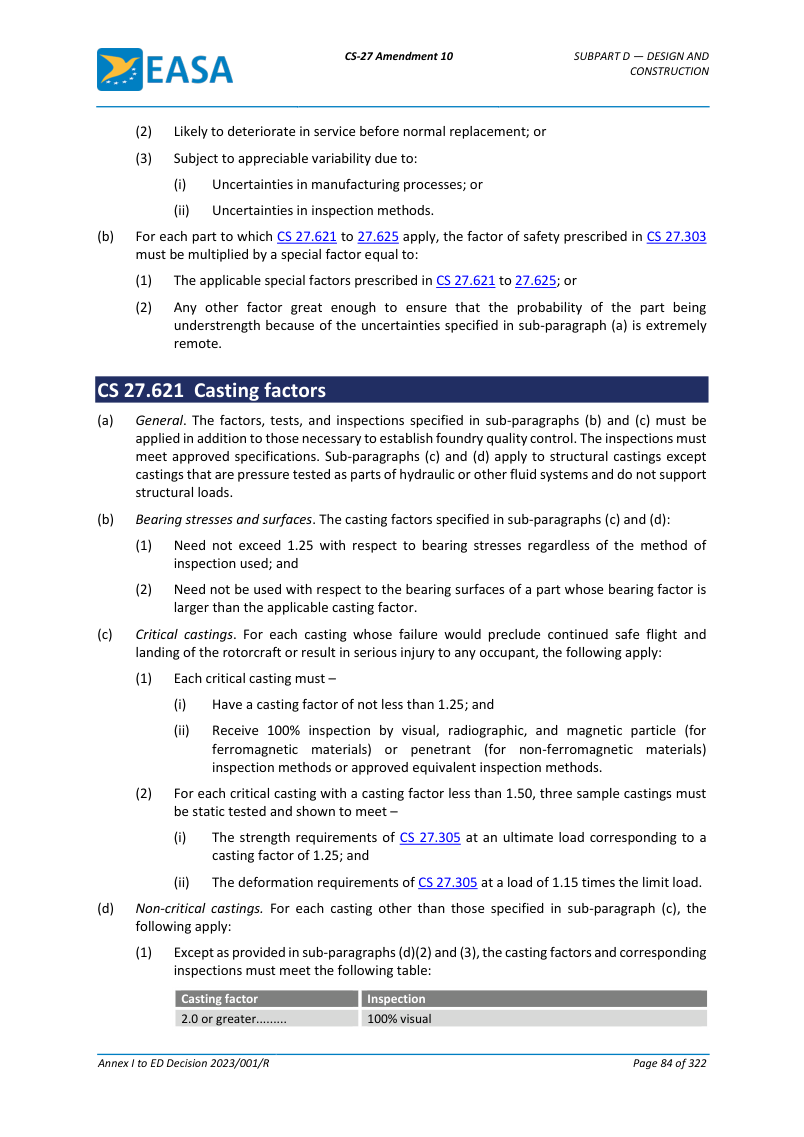
Casting factor Inspection 2.0 or greater......... 100% visual
View figures, tables and original page layout
Connected references
Source-backed citations and subject-based engineering context are labelled separately. These links do not establish equivalence or project acceptance.
Related technical context
Engineering contextEvidence and scope
CS-27 and AC 27-1B — published scope
Aerospace Consulting navigation suggestion based on the subject and stated scope of the two publications.
This connection does not establish regulatory equivalence, acceptance of a newer edition, or applicability of a project-specific precedent to another programme.
Supporting source