
CS-27
Small Rotorcraft
Amendment 10; corrected 15 September 2025 Source checked 2026-11-28
Scope, source and reading notes
Complete official CS-27 Amendment 10, including AMC, GM and appendices.
Aerospace Consulting reference note: Certification specifications and related compliance guidance for small rotorcraft, using the corrected official publication.
The complete selected publication is available in reading text and as the original PDF. Reading text is extracted from the official PDF; page layout is simplified, and figures and tables should be checked in the original page view.
Search covers extracted text. Words contained only in graphics may not be searchable. The original publication is available below.
Official source recordOriginal PDF on this siteSource: EASA. Reproduced with source acknowledgment; source edition and status are shown above. SHA-256: e762c494818f5badf2cceb0a8dc04e8cf5938efa2552deeadc0f708d1ead92ae
power generation, engine displays, transducers, etc.) on the rotorcraft (reference CS 27.901).
(2) CS 27.1309 does not apply to the rotor drive systems. However, it does apply to the equipment/systems associated with the rotor drive systems (e.g. cooling and lubrication systems with their associated monitoring means, chip detection systems, rotor brake actuation and monitoring systems, VHM systems, systems usually including actuator(s) used to engage/disengage the engine(s) to/from the rotor drive systems).
(d) Subpart F
(1) CS 27.1309 does not apply to stowed safety equipment such as life rafts, life preservers, and emergency floatation equipment. It also does not apply to safety belts, rotorcraft seats, and handheld fire extinguishers. However, it does apply to hazards to the rotorcraft, its occupants, and flight crew introduced by the installation/presence of this type of equipment/systems (e.g. electromagnetic-interference considerations, fire hazards, and inadvertent deployment of emergency floatation equipment) approved as part of the type design.
(2) CS 27.1309 does not apply to the functional aspects of aircraft non-safety-related equipment such as entertainment systems, hoists, forward-looking infrared (FLIR) systems, or emergency medical equipment such as defibrillators, etc. However, it does apply to hazards to the rotorcraft, its occupants, and flight crew introduced by the installation/presence of this type of equipment/systems (e.g. electromagnetic- interference considerations, fire hazards, and failure of the electrical system fault protection scheme) approved as part of the type design.
(3) CS 27.1309 does not apply to the lighting characteristics (e.g. light intensity, colour, and coverage) of the position lights, anti-collision lights, and riding lights. However, it does apply to hazards to the rotorcraft, its occupants, and flight crew introduced by the installation/presence of this type of equipment/systems (e.g. electromagnetic- interference considerations, fire hazards, and pilot visibility impairment due to glare) approved as part of the type design.
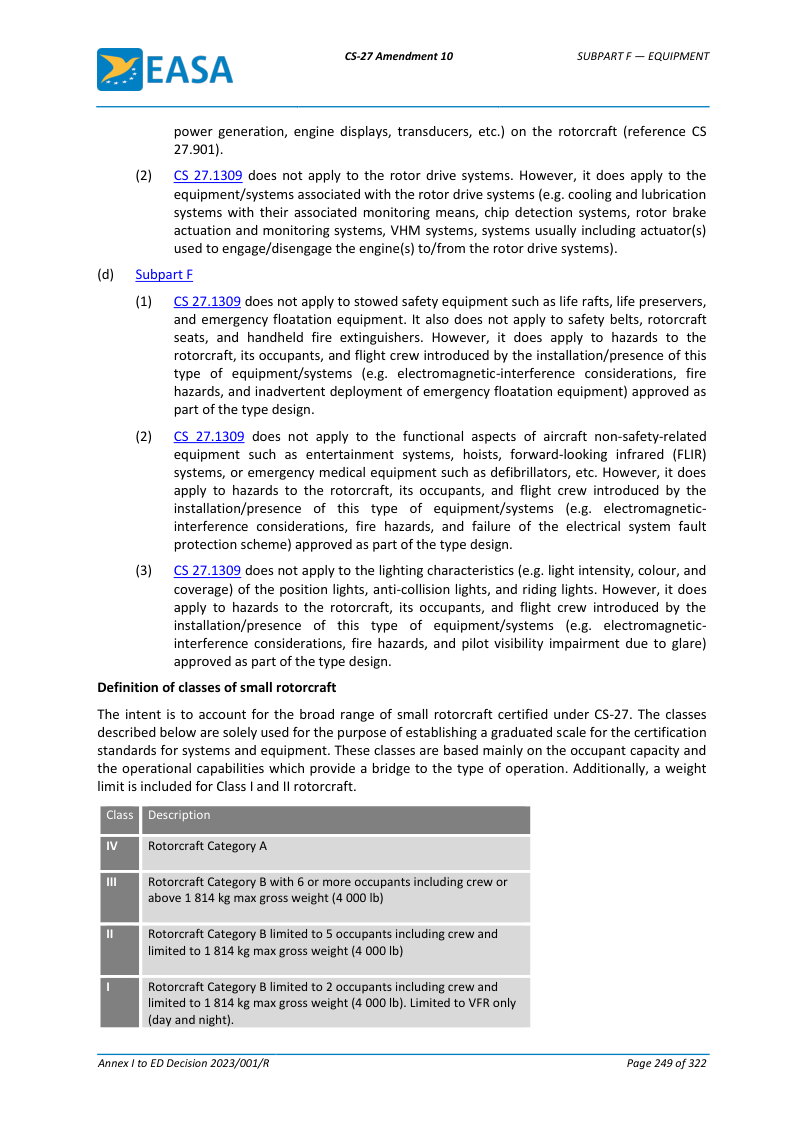
Definition of classes of small rotorcraft
The intent is to account for the broad range of small rotorcraft certified under CS-27. The classes described below are solely used for the purpose of establishing a graduated scale for the certification standards for systems and equipment. These classes are based mainly on the occupant capacity and the operational capabilities which provide a bridge to the type of operation. Additionally, a weight limit is included for Class I and II rotorcraft.
Class Description
IV Rotorcraft Category A III Rotorcraft Category B with 6 or more occupants including crew or above 1 814 kg max gross weight (4 000 lb) II Rotorcraft Category B limited to 5 occupants including crew and limited to 1 814 kg max gross weight (4 000 lb) I Rotorcraft Category B limited to 2 occupants including crew and limited to 1 814 kg max gross weight (4 000 lb). Limited to VFR only (day and night).
View figures, tables and original page layout
Connected references
Source-backed citations and subject-based engineering context are labelled separately. These links do not establish equivalence or project acceptance.
Related technical context
Engineering contextEvidence and scope
CS-27 and AC 27-1B — published scope
Aerospace Consulting navigation suggestion based on the subject and stated scope of the two publications.
This connection does not establish regulatory equivalence, acceptance of a newer edition, or applicability of a project-specific precedent to another programme.
Supporting source