
AC 20-136C
Aircraft Electrical and Electronic System Lightning Protection
20-136C Source checked 2026-11-28
Scope, source and reading notes
Aircraft electrical and electronic system lightning protection for applicable Part 23, 25, 27, and 29 certification requirements.
Aerospace Consulting reference note: Describes a means of demonstrating lightning-protection compliance for aircraft systems; revision C supersedes AC 20-136B.
The complete selected publication is available in reading text and as the original PDF. Reading text is extracted from the official PDF; page layout is simplified, and figures and tables should be checked in the original page view.
Search covers extracted text. Words contained only in graphics may not be searchable. The original publication is available below.
Official source recordOriginal PDF on this siteSource: FAA. Reproduced with source acknowledgment; source edition and status are shown above. SHA-256: a97137a34f9094ac10e6fb7caba11688edf5ab0b866ddf3d5ffa40f00e327cdd
AC 20-136C Appendix C
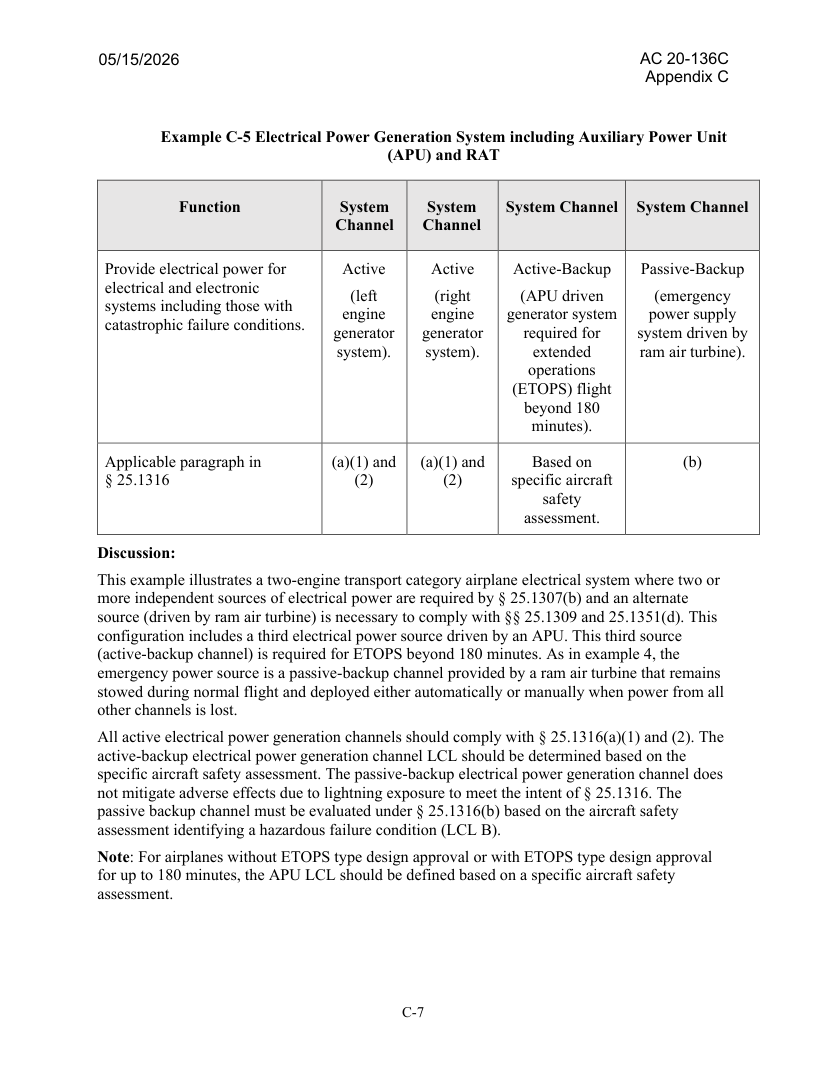
Example C-5 Electrical Power Generation System including Auxiliary Power Unit (APU) and RAT
System Channel System Channel
Function System Channel
System Channel
Passive-Backup
Active-Backup
Active
Active
Provide electrical power for electrical and electronic systems including those with catastrophic failure conditions.
(emergency power supply system driven by ram air turbine).
(right engine generator system).
(left engine generator system).
(APU driven generator system required for extended operations (ETOPS) flight beyond 180 minutes).
(b)
Applicable paragraph in § 25.1316 (a)(1) and (2) (a)(1) and (2) Based on specific aircraft safety assessment.
Discussion:
This example illustrates a two-engine transport category airplane electrical system where two or more independent sources of electrical power are required by § 25.1307(b) and an alternate source (driven by ram air turbine) is necessary to comply with §§ 25.1309 and 25.1351(d). This configuration includes a third electrical power source driven by an APU. This third source (active-backup channel) is required for ETOPS beyond 180 minutes. As in example 4, the emergency power source is a passive-backup channel provided by a ram air turbine that remains stowed during normal flight and deployed either automatically or manually when power from all other channels is lost.
All active electrical power generation channels should comply with § 25.1316(a)(1) and (2). The active-backup electrical power generation channel LCL should be determined based on the specific aircraft safety assessment. The passive-backup electrical power generation channel does not mitigate adverse effects due to lightning exposure to meet the intent of § 25.1316. The passive backup channel must be evaluated under § 25.1316(b) based on the aircraft safety assessment identifying a hazardous failure condition (LCL B).
Note: For airplanes without ETOPS type design approval or with ETOPS type design approval for up to 180 minutes, the APU LCL should be defined based on a specific aircraft safety assessment.
View figures, tables and original page layout
Connected references
Source-backed citations and subject-based engineering context are labelled separately. These links do not establish equivalence or project acceptance.
Related technical context
Engineering contextEvidence and scope
AC 20-136C and AMC 20-136A — published scope
Aerospace Consulting navigation suggestion based on the subject and stated scope of the two publications.
This connection does not establish regulatory equivalence, acceptance of a newer edition, or applicability of a project-specific precedent to another programme.
Supporting source