
AC 20-136C
Aircraft Electrical and Electronic System Lightning Protection
20-136C Source checked 2026-11-28
Scope, source and reading notes
Aircraft electrical and electronic system lightning protection for applicable Part 23, 25, 27, and 29 certification requirements.
Aerospace Consulting reference note: Describes a means of demonstrating lightning-protection compliance for aircraft systems; revision C supersedes AC 20-136B.
The complete selected publication is available in reading text and as the original PDF. Reading text is extracted from the official PDF; page layout is simplified, and figures and tables should be checked in the original page view.
Search covers extracted text. Words contained only in graphics may not be searchable. The original publication is available below.
Official source recordOriginal PDF on this siteSource: FAA. Reproduced with source acknowledgment; source edition and status are shown above. SHA-256: a97137a34f9094ac10e6fb7caba11688edf5ab0b866ddf3d5ffa40f00e327cdd
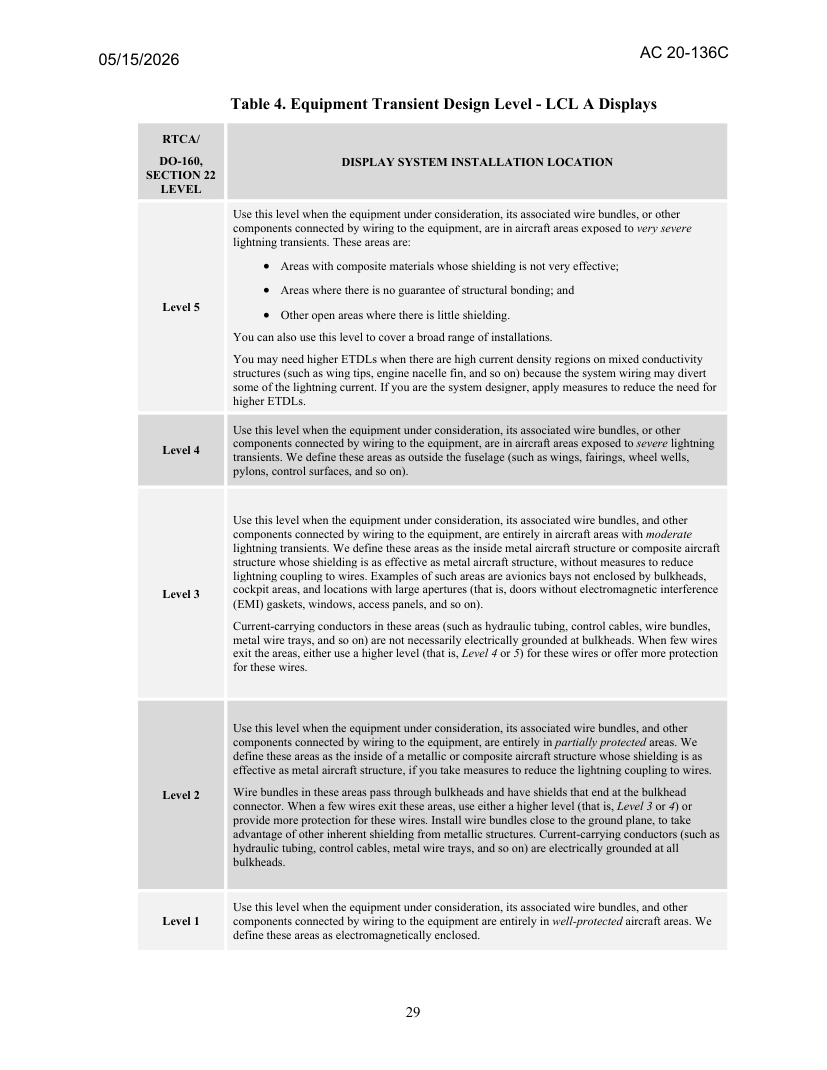
Table 4. Equipment Transient Design Level - LCL A Displays
RTCA/
DISPLAY SYSTEM INSTALLATION LOCATION
DO-160, SECTION 22
LEVEL
Use this level when the equipment under consideration, its associated wire bundles, or other components connected by wiring to the equipment, are in aircraft areas exposed to very severe lightning transients. These areas are:
• Areas with composite materials whose shielding is not very effective;
• Areas where there is no guarantee of structural bonding; and
Level 5
• Other open areas where there is little shielding.
You can also use this level to cover a broad range of installations.
You may need higher ETDLs when there are high current density regions on mixed conductivity structures (such as wing tips, engine nacelle fin, and so on) because the system wiring may divert some of the lightning current. If you are the system designer, apply measures to reduce the need for higher ETDLs.
Level 4
Use this level when the equipment under consideration, its associated wire bundles, or other components connected by wiring to the equipment, are in aircraft areas exposed to severe lightning transients. We define these areas as outside the fuselage (such as wings, fairings, wheel wells, pylons, control surfaces, and so on).
Level 3
Use this level when the equipment under consideration, its associated wire bundles, and other components connected by wiring to the equipment, are entirely in aircraft areas with moderate lightning transients. We define these areas as the inside metal aircraft structure or composite aircraft structure whose shielding is as effective as metal aircraft structure, without measures to reduce lightning coupling to wires. Examples of such areas are avionics bays not enclosed by bulkheads, cockpit areas, and locations with large apertures (that is, doors without electromagnetic interference (EMI) gaskets, windows, access panels, and so on).
Current-carrying conductors in these areas (such as hydraulic tubing, control cables, wire bundles, metal wire trays, and so on) are not necessarily electrically grounded at bulkheads. When few wires exit the areas, either use a higher level (that is, Level 4 or 5) for these wires or offer more protection for these wires.
Use this level when the equipment under consideration, its associated wire bundles, and other components connected by wiring to the equipment, are entirely in partially protected areas. We define these areas as the inside of a metallic or composite aircraft structure whose shielding is as effective as metal aircraft structure, if you take measures to reduce the lightning coupling to wires.
Level 2
Wire bundles in these areas pass through bulkheads and have shields that end at the bulkhead connector. When a few wires exit these areas, use either a higher level (that is, Level 3 or 4) or provide more protection for these wires. Install wire bundles close to the ground plane, to take advantage of other inherent shielding from metallic structures. Current-carrying conductors (such as hydraulic tubing, control cables, metal wire trays, and so on) are electrically grounded at all bulkheads.
Level 1
Use this level when the equipment under consideration, its associated wire bundles, and other components connected by wiring to the equipment are entirely in well-protected aircraft areas. We define these areas as electromagnetically enclosed.
View figures, tables and original page layout
Connected references
Source-backed citations and subject-based engineering context are labelled separately. These links do not establish equivalence or project acceptance.
Related technical context
Engineering contextEvidence and scope
AC 20-136C and AMC 20-136A — published scope
Aerospace Consulting navigation suggestion based on the subject and stated scope of the two publications.
This connection does not establish regulatory equivalence, acceptance of a newer edition, or applicability of a project-specific precedent to another programme.
Supporting source