
CS-27
Small Rotorcraft
Amendment 10; corrected 15 September 2025 Source checked 2026-11-28
Scope, source and reading notes
Complete official CS-27 Amendment 10, including AMC, GM and appendices.
Aerospace Consulting reference note: Certification specifications and related compliance guidance for small rotorcraft, using the corrected official publication.
The complete selected publication is available in reading text and as the original PDF. Reading text is extracted from the official PDF; page layout is simplified, and figures and tables should be checked in the original page view.
Search covers extracted text. Words contained only in graphics may not be searchable. The original publication is available below.
Official source recordOriginal PDF on this siteSource: EASA. Reproduced with source acknowledgment; source edition and status are shown above. SHA-256: e762c494818f5badf2cceb0a8dc04e8cf5938efa2552deeadc0f708d1ead92ae
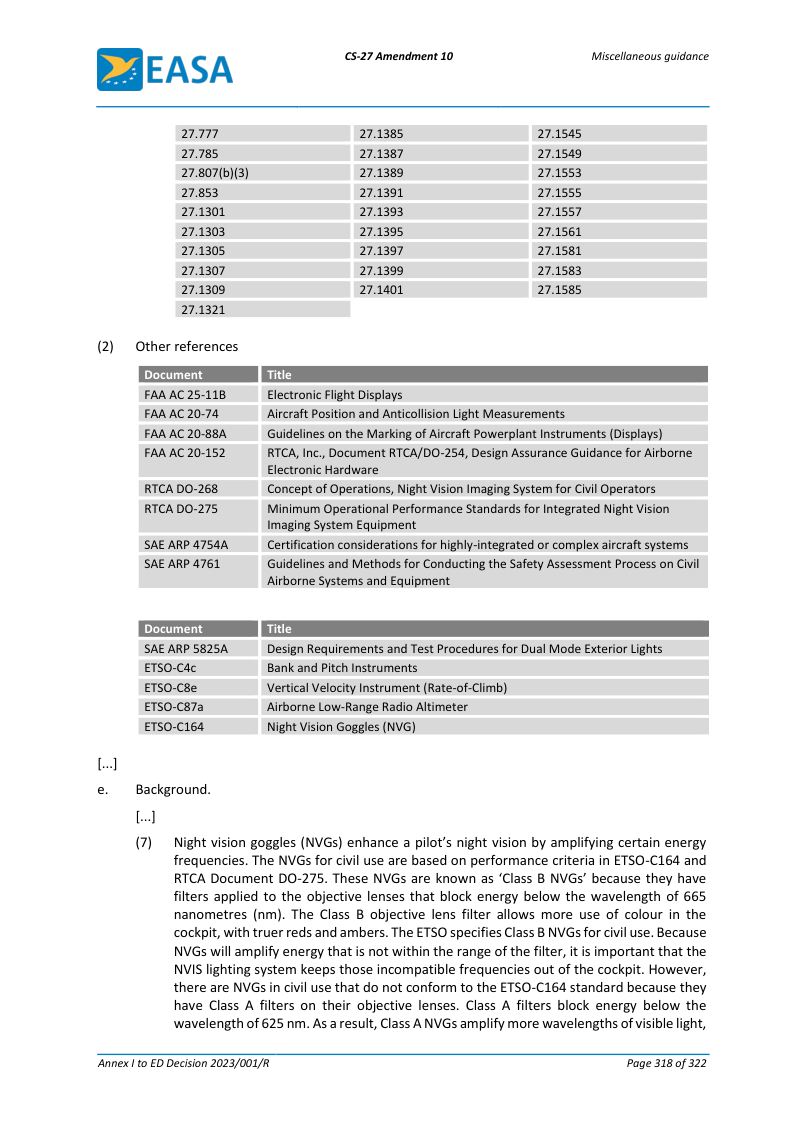
27.777 27.1385 27.1545 27.785 27.1387 27.1549 27.807(b)(3) 27.1389 27.1553 27.853 27.1391 27.1555 27.1301 27.1393 27.1557 27.1303 27.1395 27.1561 27.1305 27.1397 27.1581 27.1307 27.1399 27.1583 27.1309 27.1401 27.1585 27.1321 (2) Other references
Document Title FAA AC 25-11B Electronic Flight Displays FAA AC 20-74 Aircraft Position and Anticollision Light Measurements FAA AC 20-88A Guidelines on the Marking of Aircraft Powerplant Instruments (Displays) FAA AC 20-152 RTCA, Inc., Document RTCA/DO-254, Design Assurance Guidance for Airborne Electronic Hardware RTCA DO-268 Concept of Operations, Night Vision Imaging System for Civil Operators RTCA DO-275 Minimum Operational Performance Standards for Integrated Night Vision Imaging System Equipment SAE ARP 4754A Certification considerations for highly-integrated or complex aircraft systems SAE ARP 4761 Guidelines and Methods for Conducting the Safety Assessment Process on Civil Airborne Systems and Equipment
Document Title SAE ARP 5825A Design Requirements and Test Procedures for Dual Mode Exterior Lights ETSO-C4c Bank and Pitch Instruments ETSO-C8e Vertical Velocity Instrument (Rate-of-Climb) ETSO-C87a Airborne Low-Range Radio Altimeter ETSO-C164 Night Vision Goggles (NVG) [...]
e. Background.
[...]
(7) Night vision goggles (NVGs) enhance a pilot’s night vision by amplifying certain energy frequencies. The NVGs for civil use are based on performance criteria in ETSO-C164 and RTCA Document DO-275. These NVGs are known as ‘Class B NVGs’ because they have filters applied to the objective lenses that block energy below the wavelength of 665 nanometres (nm). The Class B objective lens filter allows more use of colour in the cockpit, with truer reds and ambers. The ETSO specifies Class B NVGs for civil use. Because NVGs will amplify energy that is not within the range of the filter, it is important that the NVIS lighting system keeps those incompatible frequencies out of the cockpit. However, there are NVGs in civil use that do not conform to the ETSO-C164 standard because they have Class A filters on their objective lenses. Class A filters block energy below the wavelength of 625 nm. As a result, Class A NVGs amplify more wavelengths of visible light,
View figures, tables and original page layout
Connected references
Source-backed citations and subject-based engineering context are labelled separately. These links do not establish equivalence or project acceptance.
Related technical context
Engineering contextEvidence and scope
CS-27 and AC 27-1B — published scope
Aerospace Consulting navigation suggestion based on the subject and stated scope of the two publications.
This connection does not establish regulatory equivalence, acceptance of a newer edition, or applicability of a project-specific precedent to another programme.
Supporting source