
CS-27
Small Rotorcraft
Amendment 10; corrected 15 September 2025 Source checked 2026-11-28
Scope, source and reading notes
Complete official CS-27 Amendment 10, including AMC, GM and appendices.
Aerospace Consulting reference note: Certification specifications and related compliance guidance for small rotorcraft, using the corrected official publication.
The complete selected publication is available in reading text and as the original PDF. Reading text is extracted from the official PDF; page layout is simplified, and figures and tables should be checked in the original page view.
Search covers extracted text. Words contained only in graphics may not be searchable. The original publication is available below.
Official source recordOriginal PDF on this siteSource: EASA. Reproduced with source acknowledgment; source edition and status are shown above. SHA-256: e762c494818f5badf2cceb0a8dc04e8cf5938efa2552deeadc0f708d1ead92ae
testing required within reasonable limits and is considered to be conservative. The justification is detailed in Appendix 2.
The applicant is at liberty to certify the rotorcraft to any significant wave height Hs. This significant wave height will be noted as performance information in the RFM.
Using reliable wave climate data for an appropriate region of the ocean for the anticipated flight operations, a Tz is selected to accompany the Hs. This Tz should be typical of those occurring at Hs as determined in the wave scatter table for the region. The mode or median of the Tz distribution at Hs should be used.
It is considered that the northern North Sea represents a conservatively ‘hostile’ region of the ocean worldwide and should be adopted as the default wave climate for certification. However, this does not preclude an applicant from certifying a rotorcraft specifically for a different region. Such a certification for a specific region would require the geographical limits of that certification region to be noted as performance information in the RFM. Certification for the default northern North Sea wave climate does not require any geographical limits.
In the case of an approval with emergency flotation provisions, operational limitations may limit flight to ‘non-hostile’ sea areas. For simplicity, the northern North Sea may still be selected as the wave climate for certification, or alternatively a wave climate derived from a non-hostile region’s data may be used. If the latter approach is chosen, and it is desired to avoid geographical limits, a ‘non-hostile’ default wave climate will need to be agreed with EASA.
Wave climate data for the northern North Sea were obtained from the United Kingdom Meteorological Office (UK Met Office) for a typical ‘hostile’ helicopter route. The route selected was from Aberdeen to Block 211/27 in the UK sector of the North Sea. Data tables were derived from a UK Met Office analysis of 34 years of 3-hourly wave data generated within an 8-km, resolved wave model hindcast for European waters. This data represents the default wave climate.
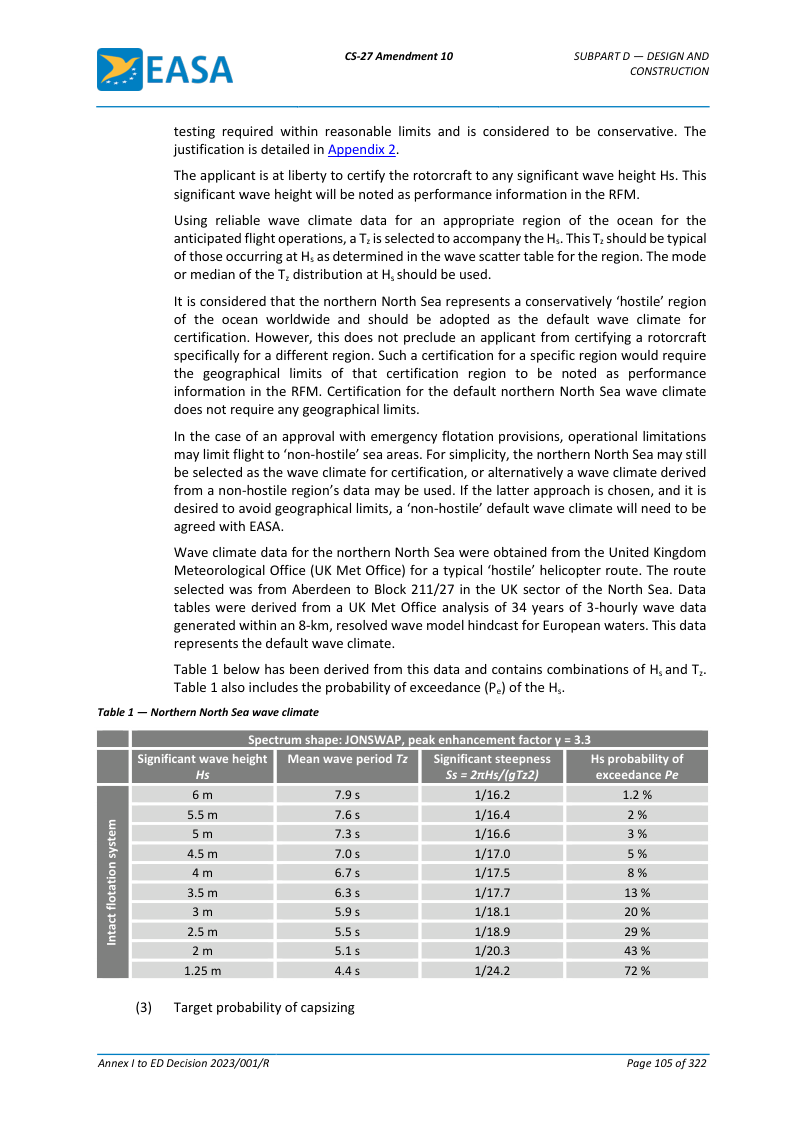
Table 1 below has been derived from this data and contains combinations of Hs and Tz. Table 1 also includes the probability of exceedance (Pe) of the Hs.
Table 1 — Northern North Sea wave climate
Spectrum shape: JONSWAP, peak enhancement factor γ = 3.3 Significant wave height
Mean wave period Tz Significant steepness
Hs probability of
Hs
Ss = 2πHs/(gTz2)
exceedance Pe
Intact flotation system
6 m 7.9 s 1/16.2 1.2 % 5.5 m 7.6 s 1/16.4 2 % 5 m 7.3 s 1/16.6 3 % 4.5 m 7.0 s 1/17.0 5 % 4 m 6.7 s 1/17.5 8 % 3.5 m 6.3 s 1/17.7 13 % 3 m 5.9 s 1/18.1 20 % 2.5 m 5.5 s 1/18.9 29 % 2 m 5.1 s 1/20.3 43 % 1.25 m 4.4 s 1/24.2 72 %
(3) Target probability of capsizing
View figures, tables and original page layout
Connected references
Source-backed citations and subject-based engineering context are labelled separately. These links do not establish equivalence or project acceptance.
Related technical context
Engineering contextEvidence and scope
CS-27 and AC 27-1B — published scope
Aerospace Consulting navigation suggestion based on the subject and stated scope of the two publications.
This connection does not establish regulatory equivalence, acceptance of a newer edition, or applicability of a project-specific precedent to another programme.
Supporting source