
AC 25.1309-1B
System Design and Analysis
25.1309-1B · 2024-08-30 Source checked 2026-11-28
Scope, source and reading notes
Guidance for showing compliance with §25.1309. Confirm the applicable amendment level and accepted means for the programme.
Aerospace Consulting reference note: A starting point for transport-airplane system-safety assessment and development-assurance connections.
The complete selected publication is available in reading text and as the original PDF. Reading text is extracted from the official PDF; page layout is simplified, and figures and tables should be checked in the original page view.
Search covers extracted text. Words contained only in graphics may not be searchable. The original publication is available below.
Official source recordOriginal PDF on this siteSource: FAA. Reproduced with source acknowledgment; source edition and status are shown above. SHA-256: 90e625593d472b74ec69fbcefe97649f97794410dbe844f7684b397121ac5a92
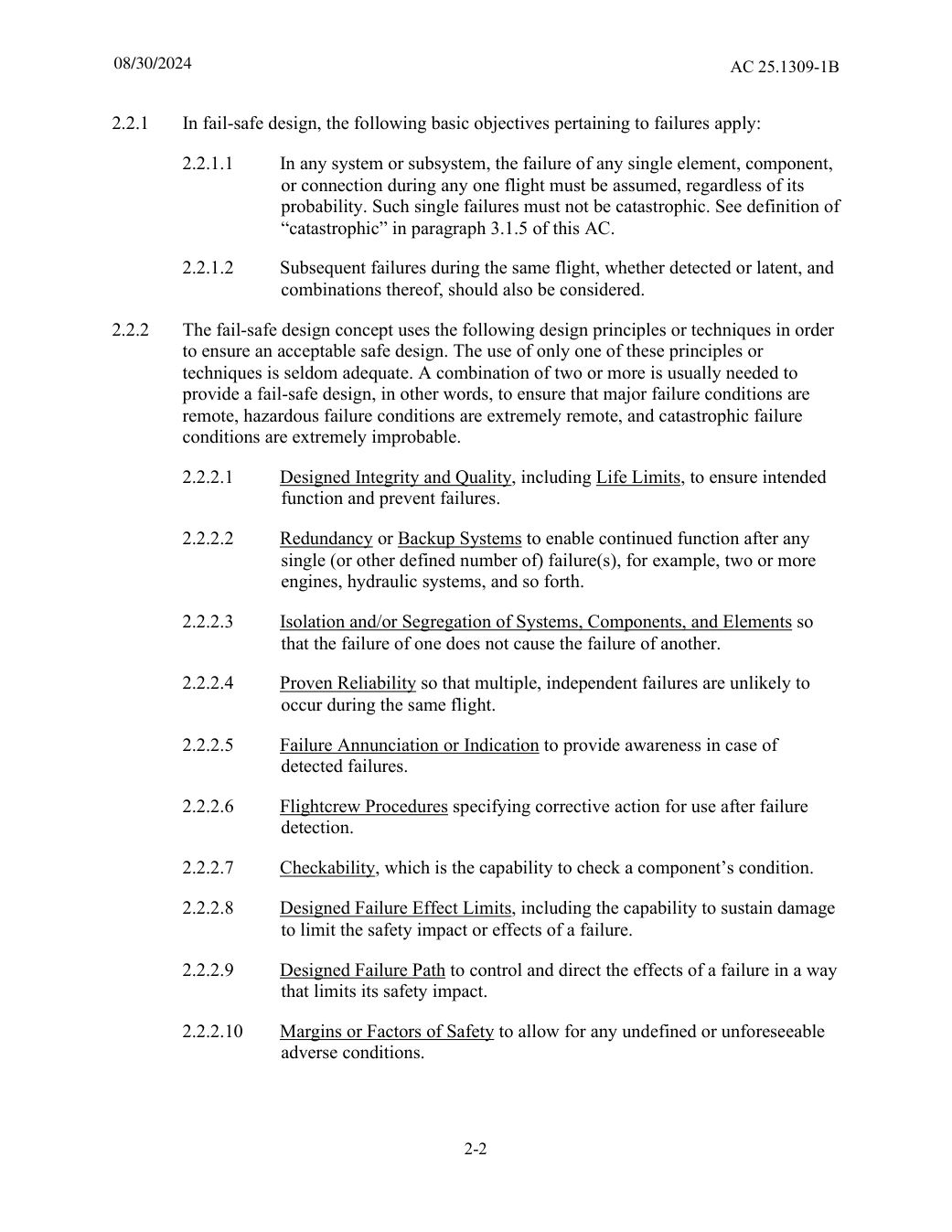
2.2.1 In fail-safe design, the following basic objectives pertaining to failures apply:
2.2.1.1 In any system or subsystem, the failure of any single element, component, or connection during any one flight must be assumed, regardless of its probability. Such single failures must not be catastrophic. See definition of “catastrophic” in paragraph 3.1.5 of this AC.
2.2.1.2 Subsequent failures during the same flight, whether detected or latent, and combinations thereof, should also be considered.
2.2.2 The fail-safe design concept uses the following design principles or techniques in order to ensure an acceptable safe design. The use of only one of these principles or techniques is seldom adequate. A combination of two or more is usually needed to provide a fail-safe design, in other words, to ensure that major failure conditions are remote, hazardous failure conditions are extremely remote, and catastrophic failure conditions are extremely improbable.
2.2.2.1 Designed Integrity and Quality, including Life Limits, to ensure intended
function and prevent failures.
2.2.2.2 Redundancy or Backup Systems to enable continued function after any
single (or other defined number of) failure(s), for example, two or more engines, hydraulic systems, and so forth.
2.2.2.3 Isolation and/or Segregation of Systems, Components, and Elements so
that the failure of one does not cause the failure of another.
2.2.2.4 Proven Reliability so that multiple, independent failures are unlikely to
occur during the same flight.
2.2.2.5 Failure Annunciation or Indication to provide awareness in case of
detected failures.
2.2.2.6 Flightcrew Procedures specifying corrective action for use after failure
detection.
2.2.2.7 Checkability, which is the capability to check a component’s condition.
2.2.2.8 Designed Failure Effect Limits, including the capability to sustain damage
to limit the safety impact or effects of a failure.
2.2.2.9 Designed Failure Path to control and direct the effects of a failure in a way
that limits its safety impact.
2.2.2.10 Margins or Factors of Safety to allow for any undefined or unforeseeable
adverse conditions.
View figures, tables and original page layout
Connected references
Source-backed citations and subject-based engineering context are labelled separately. These links do not establish equivalence or project acceptance.
Provides compliance guidance for
Source-backedEvidence and scope
FAA AC 25.1309-1B Cover and §1.1, printed p1-1 / PDF p6; FAA AC 25.1309-1B Appendix A §A.5, printed pA-3 / PDF p53
Provides acceptable means for compliance with 14 CFR 25.1309. Connects the rule change to amendment25-152 and notes harmonisation of failure-condition/probability terms with AMC 25.1309; this is not whole-document equivalence.
Assess against the applicable project amendment; current source and certification basis are distinct.
Supporting sourceReferences latest version
Source-backedEvidence and scope
FAA AC 25.1309-1B §1.4.5, printed pp1-7–1-8 / PDF pp12–13
Lists ARP4754 and ARP4761 without revision suffixes and explicitly instructs use of the latest referenced version. Preserve this revision policy rather than pinning the reference to legacy editions.
Do not display this as an explicit suffix-B citation; preserve family reference and latest-version instruction.
Supporting sourceReferences latest version
Source-backedEvidence and scope
FAA AC 25.1309-1B §1.4.5, printed pp1-7–1-8 / PDF pp12–13
Lists ARP4754 and ARP4761 without revision suffixes and explicitly instructs use of the latest referenced version. Preserve this revision policy rather than pinning the reference to legacy editions.
Do not display this as an explicit suffix-A citation; preserve family reference and latest-version instruction.
Supporting sourceReferences development-assurance guidance
Source-backedEvidence and scope
FAA AC 25.1309-1B §5.3.4, printed p5-4 / PDF p30
References AC 20-174 for aircraft/system assurance, AC 20-115D for software and AC 20-152A for hardware.
Read the cited document’s applicability and the project certification basis.
Supporting sourceRelated EASA safety guidance
Engineering contextEvidence and scope
FAA AC 25.1309-1B Appendix A §A.5, printed pA-3 / PDF p53
Connects the rule change to amendment25-152 and notes harmonisation of failure-condition/probability terms with AMC 25.1309; this is not whole-document equivalence.
Harmonised terms do not establish whole-document equivalence.
Supporting sourceReferences hardware guidance
Source-backedEvidence and scope
AC 25.1309-1B §5.3.4.2, printed p5-4 / PDF p30
Identifies AC 20-152A as hardware development-assurance guidance.
Read the source scope and applicable project basis.
Supporting sourceRelated technical context
Engineering contextEvidence and scope
AC 23.1309-1E and AC 25.1309-1B — published scope
Aerospace Consulting navigation suggestion based on the subject and stated scope of the two publications.
This connection does not establish regulatory equivalence, acceptance of a newer edition, or applicability of a project-specific precedent to another programme.
Supporting source