
AC 29-2C
Certification of Transport Category Rotorcraft
29-2C — Changes 1–9 incorporated (2023-06-23) Source checked 2026-11-28
Scope, source and reading notes
Transport category rotorcraft certification guidance under Part 29; consolidated FAA publication incorporating Changes 1 through 9. Base publication catalog date: 2008-09-30; latest included change: 2023-06-23.
Aerospace Consulting reference note: Broad Part 29 guidance covering transport rotorcraft design, flight, equipment, systems, and certification, including system safety and flight guidance.
The complete selected publication is available in reading text and as the original PDF. Reading text is extracted from the official PDF; page layout is simplified, and figures and tables should be checked in the original page view.
Search covers extracted text. Words contained only in graphics may not be searchable. The original publication is available below.
Official source recordOriginal PDF on this siteSource: FAA. Reproduced with source acknowledgment; source edition and status are shown above. SHA-256: c57691386dd1e59263633bd8fdaabb842a958061a9b6a82d30dad18358977013
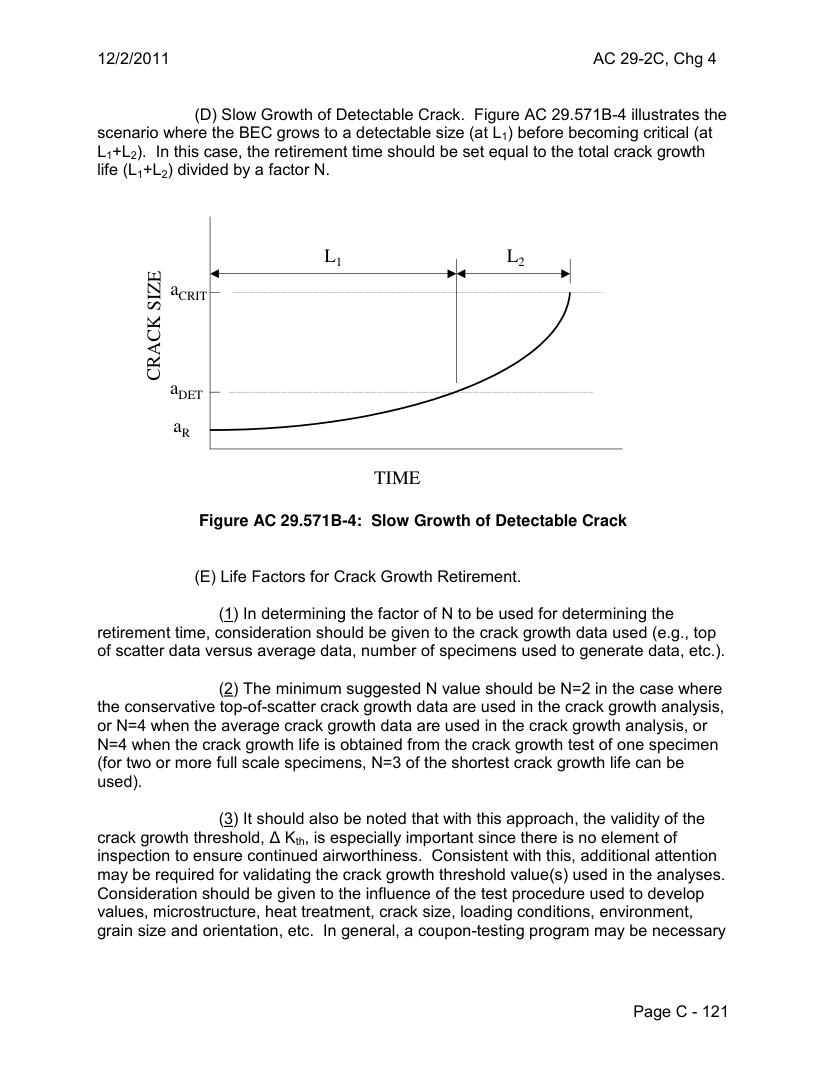
(D) Slow Growth of Detectable Crack. Figure AC 29.571B-4 illustrates the scenario where the BEC grows to a detectable size (at L1) before becoming critical (at L1+L2). In this case, the retirement time should be set equal to the total crack growth life (L1+L2) divided by a factor N.
L 1 L 2
a CRIT
CRA CK S IZ E
a DET
a R
TIME
Figure AC 29.571B-4: Slow Growth of Detectable Crack
(E) Life Factors for Crack Growth Retirement.
(1) In determining the factor of N to be used for determining the retirement time, consideration should be given to the crack growth data used (e.g., top of scatter data versus average data, number of specimens used to generate data, etc.).
(2) The minimum suggested N value should be N=2 in the case where the conservative top-of-scatter crack growth data are used in the crack growth analysis, or N=4 when the average crack growth data are used in the crack growth analysis, or N=4 when the crack growth life is obtained from the crack growth test of one specimen (for two or more full scale specimens, N=3 of the shortest crack growth life can be used).
(3) It should also be noted that with this approach, the validity of the crack growth threshold, Δ Kth, is especially important since there is no element of inspection to ensure continued airworthiness. Consistent with this, additional attention may be required for validating the crack growth threshold value(s) used in the analyses. Consideration should be given to the influence of the test procedure used to develop values, microstructure, heat treatment, crack size, loading conditions, environment, grain size and orientation, etc. In general, a coupon-testing program may be necessary
View figures, tables and original page layout
Connected references
Source-backed citations and subject-based engineering context are labelled separately. These links do not establish equivalence or project acceptance.
Related technical context
Engineering contextEvidence and scope
AC 27-1B and AC 29-2C — published scope
Aerospace Consulting navigation suggestion based on the subject and stated scope of the two publications.
This connection does not establish regulatory equivalence, acceptance of a newer edition, or applicability of a project-specific precedent to another programme.
Supporting sourceRelated technical context
Engineering contextEvidence and scope
CS-29 and AC 29-2C — published scope
Aerospace Consulting navigation suggestion based on the subject and stated scope of the two publications.
This connection does not establish regulatory equivalence, acceptance of a newer edition, or applicability of a project-specific precedent to another programme.
Supporting source