
AC 29-2C
Certification of Transport Category Rotorcraft
29-2C — Changes 1–9 incorporated (2023-06-23) Source checked 2026-11-28
Scope, source and reading notes
Transport category rotorcraft certification guidance under Part 29; consolidated FAA publication incorporating Changes 1 through 9. Base publication catalog date: 2008-09-30; latest included change: 2023-06-23.
Aerospace Consulting reference note: Broad Part 29 guidance covering transport rotorcraft design, flight, equipment, systems, and certification, including system safety and flight guidance.
The complete selected publication is available in reading text and as the original PDF. Reading text is extracted from the official PDF; page layout is simplified, and figures and tables should be checked in the original page view.
Search covers extracted text. Words contained only in graphics may not be searchable. The original publication is available below.
Official source recordOriginal PDF on this siteSource: FAA. Reproduced with source acknowledgment; source edition and status are shown above. SHA-256: c57691386dd1e59263633bd8fdaabb842a958061a9b6a82d30dad18358977013
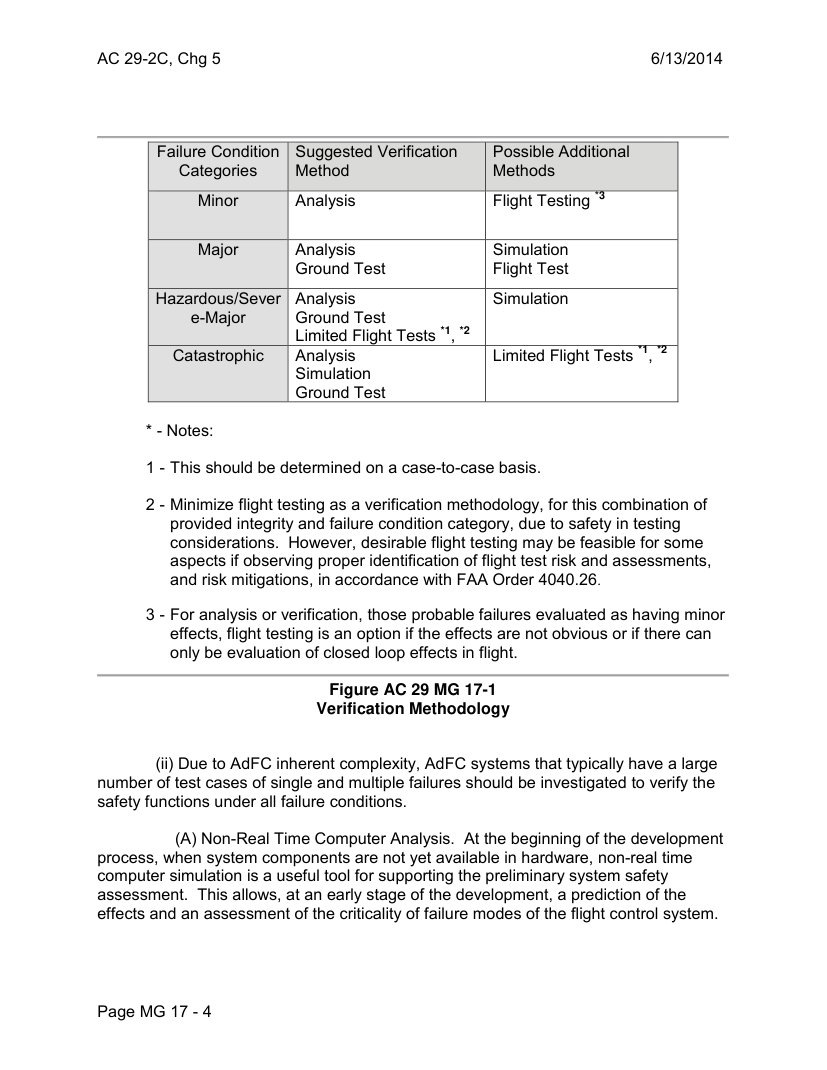
Failure Condition
Categories
Suggested Verification Method
Possible Additional Methods
Minor Analysis Flight Testing *3
Major Analysis Ground Test
Simulation Flight Test
Hazardous/Sever
Simulation
e-Major
Analysis Ground Test Limited Flight Tests *1 , *2
Limited Flight Tests *1 , *2
Catastrophic Analysis Simulation Ground Test
* - Notes:
1 - This should be determined on a case-to-case basis.
2 - Minimize flight testing as a verification methodology, for this combination of provided integrity and failure condition category, due to safety in testing considerations. However, desirable flight testing may be feasible for some aspects if observing proper identification of flight test risk and assessments, and risk mitigations, in accordance with FAA Order 4040.26.
3 - For analysis or verification, those probable failures evaluated as having minor effects, flight testing is an option if the effects are not obvious or if there can only be evaluation of closed loop effects in flight.
Figure AC 29 MG 17-1 Verification Methodology
(ii) Due to AdFC inherent complexity, AdFC systems that typically have a large number of test cases of single and multiple failures should be investigated to verify the safety functions under all failure conditions.
(A) Non-Real Time Computer Analysis. At the beginning of the development process, when system components are not yet available in hardware, non-real time computer simulation is a useful tool for supporting the preliminary system safety assessment. This allows, at an early stage of the development, a prediction of the effects and an assessment of the criticality of failure modes of the flight control system.
View figures, tables and original page layout
Connected references
Source-backed citations and subject-based engineering context are labelled separately. These links do not establish equivalence or project acceptance.
Related technical context
Engineering contextEvidence and scope
AC 27-1B and AC 29-2C — published scope
Aerospace Consulting navigation suggestion based on the subject and stated scope of the two publications.
This connection does not establish regulatory equivalence, acceptance of a newer edition, or applicability of a project-specific precedent to another programme.
Supporting sourceRelated technical context
Engineering contextEvidence and scope
CS-29 and AC 29-2C — published scope
Aerospace Consulting navigation suggestion based on the subject and stated scope of the two publications.
This connection does not establish regulatory equivalence, acceptance of a newer edition, or applicability of a project-specific precedent to another programme.
Supporting source