
AC 29-2C
Certification of Transport Category Rotorcraft
29-2C — Changes 1–9 incorporated (2023-06-23) Source checked 2026-11-28
Scope, source and reading notes
Transport category rotorcraft certification guidance under Part 29; consolidated FAA publication incorporating Changes 1 through 9. Base publication catalog date: 2008-09-30; latest included change: 2023-06-23.
Aerospace Consulting reference note: Broad Part 29 guidance covering transport rotorcraft design, flight, equipment, systems, and certification, including system safety and flight guidance.
The complete selected publication is available in reading text and as the original PDF. Reading text is extracted from the official PDF; page layout is simplified, and figures and tables should be checked in the original page view.
Search covers extracted text. Words contained only in graphics may not be searchable. The original publication is available below.
Official source recordOriginal PDF on this siteSource: FAA. Reproduced with source acknowledgment; source edition and status are shown above. SHA-256: c57691386dd1e59263633bd8fdaabb842a958061a9b6a82d30dad18358977013
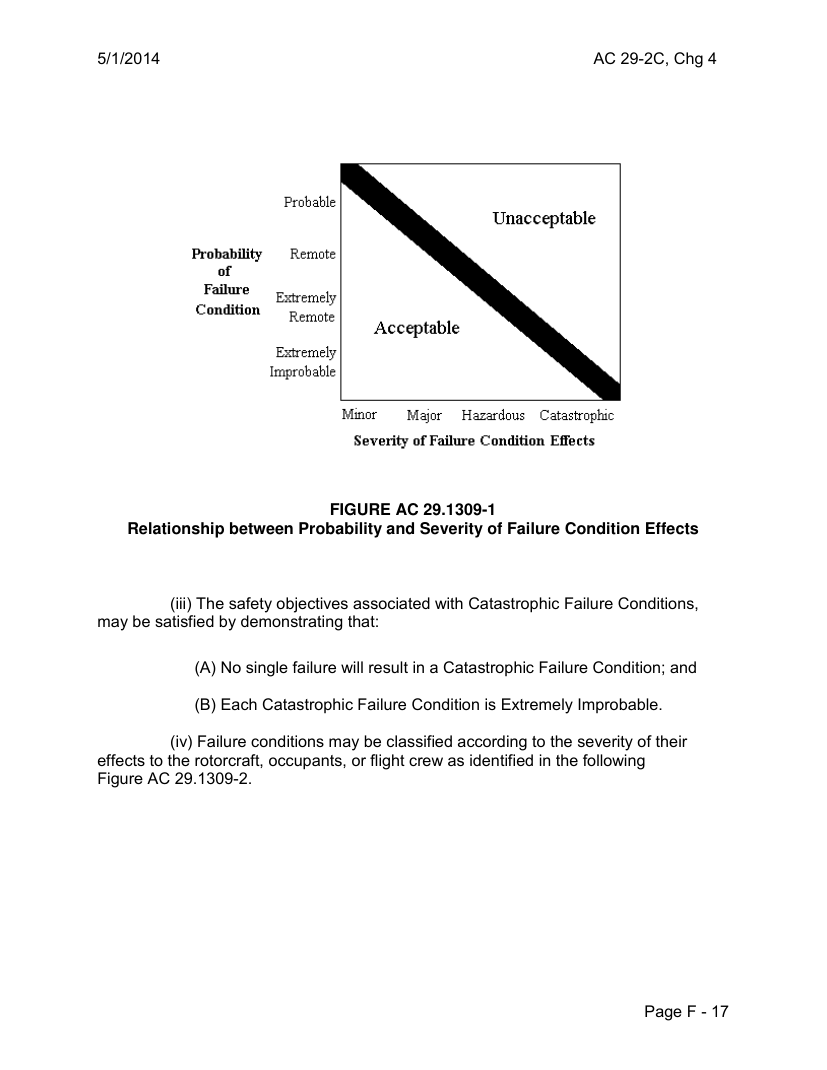
Probable
Unacceptable
Remote
Probability of Failure Condition
Extremely Remote
Acceptable
Extremely Improbable
Minor Major Hazardous Catastrophic
Severity of Failure Condition Elfects
FIGURE AC 29.1309-1 Relationship between Probability and Severity of Failure Condition Effects
(iii) The safety objectives associated with Catastrophic Failure Conditions, may be satisfied by demonstrating that:
(A) No single failure will result in a Catastrophic Failure Condition; and
(B) Each Catastrophic Failure Condition is Extremely Improbable.
(iv) Failure conditions may be classified according to the severity of their effects to the rotorcraft, occupants, or flight crew as identified in the following Figure AC 29.1309-2.
View figures, tables and original page layout
Connected references
Source-backed citations and subject-based engineering context are labelled separately. These links do not establish equivalence or project acceptance.
Related technical context
Engineering contextEvidence and scope
AC 27-1B and AC 29-2C — published scope
Aerospace Consulting navigation suggestion based on the subject and stated scope of the two publications.
This connection does not establish regulatory equivalence, acceptance of a newer edition, or applicability of a project-specific precedent to another programme.
Supporting sourceRelated technical context
Engineering contextEvidence and scope
CS-29 and AC 29-2C — published scope
Aerospace Consulting navigation suggestion based on the subject and stated scope of the two publications.
This connection does not establish regulatory equivalence, acceptance of a newer edition, or applicability of a project-specific precedent to another programme.
Supporting source