
MOC-5 SC-VTOL
Means of Compliance with SC-VTOL — Batch 5
Issue 2 — FINAL Source checked 2026-11-28
Scope, source and reading notes
Complete final batch 5 of SC-VTOL means of compliance. Later batches may amend individual provisions in earlier batches.
Aerospace Consulting reference note: Fifth final batch, introducing additional means of compliance and amendments to earlier MoC batches. This is the final Issue 2, not the consultation draft or tracked copy.
The complete selected publication is available in reading text and as the original PDF. Reading text is extracted from the official PDF; page layout is simplified, and figures and tables should be checked in the original page view.
Search covers extracted text. Words contained only in graphics may not be searchable. The original publication is available below.
Official source recordOriginal PDF on this siteSource: EASA. Reproduced with source acknowledgment; source edition and status are shown above. SHA-256: 5e91110d91378ed3836aafe2cb30871f5b2d3802a92b97a28acf42913467a949
Doc. No: MOC-5 SC-VTOL Issue: 2 Date: 5 November 2026
Special Condition VTOL
MOC – SUBPART C – STRUCTURES
MOC VTOL.2205 Interaction of systems and structures
Note:
Section 1. (c)(4) of MOC.VTOL.2205 in Doc. No. MOC-2 SC-VTOL Issue 3, dated 22 Dec 2022 is updated as follows. Changes are highlighted in blue colour for the reader’s convenience.
This change is introduced to align with MOC 2510 where the term improbable is not used.
(4) Probabilistic terms: the probabilistic terms (probable, remote, extremely remote, extremely improbable) used in this MOC are the same as those used in MOC VTOL.2510.
MOC VTOL.2215 Flight load conditions
Note:
Section (f) of MOC.VTOL.2215 in Doc. No. MOC SC-VTOL Issue 3, dated 12 May 2021 is updated as follows. Changes are highlighted in blue colour for the reader’s convenience.
The changes to this MOC are considered minor and therefore are published without consultation.
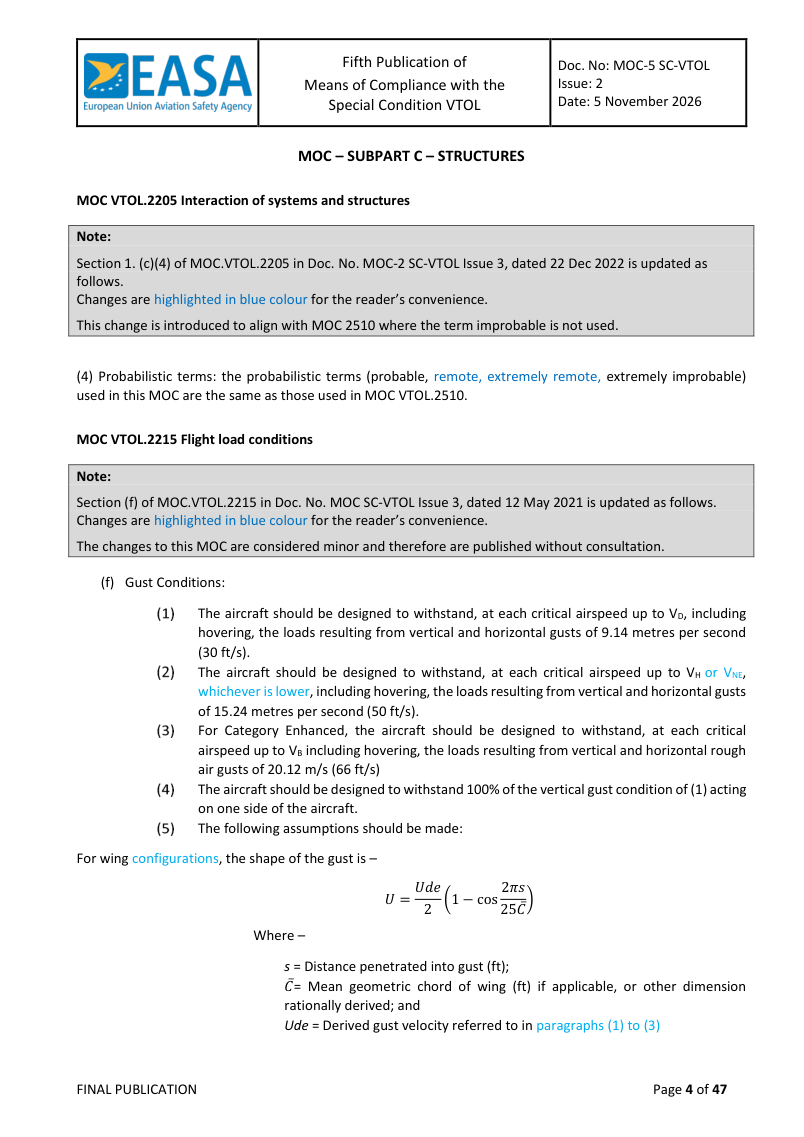
(f) Gust Conditions:
The aircraft should be designed to withstand, at each critical airspeed up to VD, including hovering, the loads resulting from vertical and horizontal gusts of 9.14 metres per second (30 ft/s). The aircraft should be designed to withstand, at each critical airspeed up to VH or VNE, whichever is lower, including hovering, the loads resulting from vertical and horizontal gusts of 15.24 metres per second (50 ft/s). For Category Enhanced, the aircraft should be designed to withstand, at each critical airspeed up to VB including hovering, the loads resulting from vertical and horizontal rough air gusts of 20.12 m/s (66 ft/s) The aircraft should be designed to withstand 100% of the vertical gust condition of (1) acting on one side of the aircraft. The following assumptions should be made:
For wing configurations, the shape of the gust is –
𝑈= 𝑈𝑑𝑒
2 (1 −cos 2𝜋𝑠
25𝐶̅)
Where –
s = Distance penetrated into gust (ft); 𝐶̅= Mean geometric chord of wing (ft) if applicable, or other dimension rationally derived; and Ude = Derived gust velocity referred to in paragraphs (1) to (3)
View figures, tables and original page layout
Connected references
Source-backed citations and subject-based engineering context are labelled separately. These links do not establish equivalence or project acceptance.
Related technical context
Engineering contextEvidence and scope
SC-VTOL-02 and MOC-5 SC-VTOL — published scope
Aerospace Consulting navigation suggestion based on the subject and stated scope of the two publications.
This connection does not establish regulatory equivalence, acceptance of a newer edition, or applicability of a project-specific precedent to another programme.
Supporting source