
MOC-5 SC-VTOL
Means of Compliance with SC-VTOL — Batch 5
Issue 2 — FINAL Source checked 2026-11-28
Scope, source and reading notes
Complete final batch 5 of SC-VTOL means of compliance. Later batches may amend individual provisions in earlier batches.
Aerospace Consulting reference note: Fifth final batch, introducing additional means of compliance and amendments to earlier MoC batches. This is the final Issue 2, not the consultation draft or tracked copy.
The complete selected publication is available in reading text and as the original PDF. Reading text is extracted from the official PDF; page layout is simplified, and figures and tables should be checked in the original page view.
Search covers extracted text. Words contained only in graphics may not be searchable. The original publication is available below.
Official source recordOriginal PDF on this siteSource: EASA. Reproduced with source acknowledgment; source edition and status are shown above. SHA-256: 5e91110d91378ed3836aafe2cb30871f5b2d3802a92b97a28acf42913467a949
Doc. No: MOC-5 SC-VTOL Issue: 2 Date: 5 November 2026
Special Condition VTOL
MOC – SUBPART E – LIFT/THRUST SYSTEM INSTALLATION
MOC VTOL.2400(c)(3) Lift/thrust system installation -likely hazards in operation
Note:
MOC VTOL.2400(c)(3) in Doc. No. MOC 2 SC-VTOL, Issue 3, dated 22 December 2022 is updated by replacing the part of the table corresponding to the “Measuring equipment” for downwash testing with the table below. Footnote (3) is updated as shown below and the explanatory note is added. Changes are highlighted in blue for reader’s convenience.
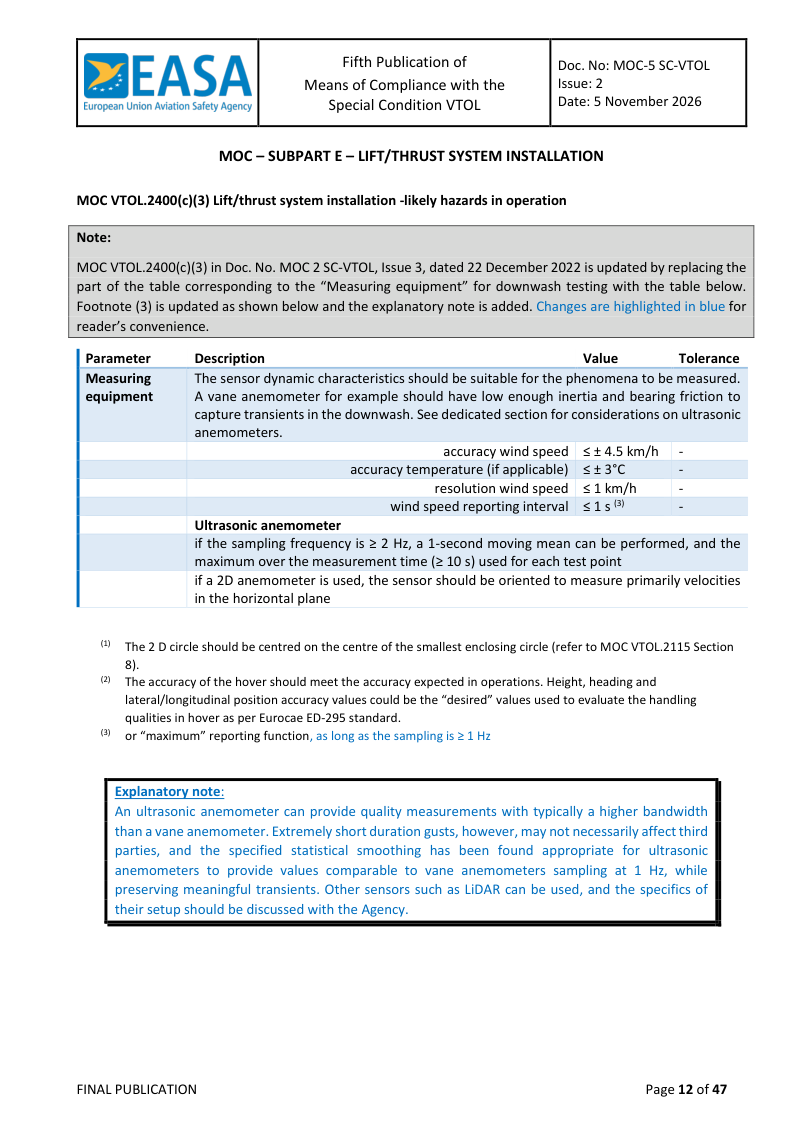
Parameter Description Value Tolerance Measuring equipment
The sensor dynamic characteristics should be suitable for the phenomena to be measured. A vane anemometer for example should have low enough inertia and bearing friction to capture transients in the downwash. See dedicated section for considerations on ultrasonic anemometers. accuracy wind speed ≤ ± 4.5 km/h - accuracy temperature (if applicable) ≤ ± 3°C - resolution wind speed ≤ 1 km/h - wind speed reporting interval ≤ 1 s (3) - Ultrasonic anemometer if the sampling frequency is ≥ 2 Hz, a 1-second moving mean can be performed, and the maximum over the measurement time (≥ 10 s) used for each test point if a 2D anemometer is used, the sensor should be oriented to measure primarily velocities in the horizontal plane
(1) The 2 D circle should be centred on the centre of the smallest enclosing circle (refer to MOC VTOL.2115 Section 8).
(2) The accuracy of the hover should meet the accuracy expected in operations. Height, heading and lateral/longitudinal position accuracy values could be the “desired” values used to evaluate the handling qualities in hover as per Eurocae ED-295 standard. (3) or “maximum” reporting function, as long as the sampling is ≥ 1 Hz
Explanatory note: An ultrasonic anemometer can provide quality measurements with typically a higher bandwidth than a vane anemometer. Extremely short duration gusts, however, may not necessarily affect third parties, and the specified statistical smoothing has been found appropriate for ultrasonic anemometers to provide values comparable to vane anemometers sampling at 1 Hz, while preserving meaningful transients. Other sensors such as LiDAR can be used, and the specifics of their setup should be discussed with the Agency.
View figures, tables and original page layout
Connected references
Source-backed citations and subject-based engineering context are labelled separately. These links do not establish equivalence or project acceptance.
Related technical context
Engineering contextEvidence and scope
SC-VTOL-02 and MOC-5 SC-VTOL — published scope
Aerospace Consulting navigation suggestion based on the subject and stated scope of the two publications.
This connection does not establish regulatory equivalence, acceptance of a newer edition, or applicability of a project-specific precedent to another programme.
Supporting source