
CS-23
Normal-Category Aeroplanes
CS Amendment 6; AMC/GM Issue 5 Source checked 2026-11-28
Scope, source and reading notes
Complete Easy Access Rules consolidation of CS-23 Amendment 6 and related AMC/GM Issue 5.
Aerospace Consulting reference note: Current consolidated certification specifications and related compliance guidance for normal-category aeroplanes.
The complete selected publication is available in reading text and as the original PDF. Reading text is extracted from the official PDF; page layout is simplified, and figures and tables should be checked in the original page view.
Search covers extracted text. Words contained only in graphics may not be searchable. The original publication is available below.
Official source recordOriginal PDF on this siteSource: EASA. Reproduced with source acknowledgment; source edition and status are shown above. SHA-256: 86ad4923e633b90fc84b90ff5ab4b1caade703896da2ee03657437e1cde181b1
AMC3 23.2315 Means of egress and emergency exits
ED Decision 2017/025/R
CS VLA Amdt 1
VLA.783 Exits
VLA.787 Baggage compartments
VLA.807 Emergency exits
CS 23.2320 Occupant physical environment
ED Decision 2017/013/R
(a) The applicant must design the aeroplane to:
(1) allow clear communication between the flight crew and passengers;
(2) protect the pilot against serious injury due to hazards originating from high energy, associated with systems and equipment; and
(3) protect the occupants from serious injury due to breakage of windshields, windows, and canopies.
(b) For Level-4 aeroplanes, each windshield and its supporting structure directly in front of the pilot must withstand, without penetration, the impact equivalent to a two-pound bird when the velocity of the aeroplane is equal to the aeroplane’s maximum approach flap speed.
(c) The aeroplane must provide each occupant with air at a breathable pressure, free of hazardous concentrations of gases, vapours and smoke during normal operations and likely failures.
(d) If a pressurisation system is installed in the aeroplane, it must be designed to protect against:
(1) decompression to an unsafe level; and
(2) excessive differential pressure.
(e) If an oxygen system is installed in the aeroplane, it must:
(1) effectively provide oxygen to each user to prevent the effects of hypoxia; and
(2) be free from hazards in itself, in its method of operation, and its effect upon other components.
AMC1 23.2320 Occupant physical environment
ED Decision 2026/003/R
ASTM F44 F3264 Standard Specification for Normal Category Aeroplanes Certification
7.5 Occupant Physical Environment
F3061/F3061M-24a Standard Specification for Systems and Equipment in Small Aircraft
F3083/F3083M-20a Standard Specification for Emergency Conditions, Occupant Safety and Accommodations
F3114-21 Standard Specification for Structures
F3117/F3117M-24a Standard Specification for Crew Interface in Aircraft
Remarks
F3227/F3227M-25 Standard Specification for Environmental Systems in Aircraft
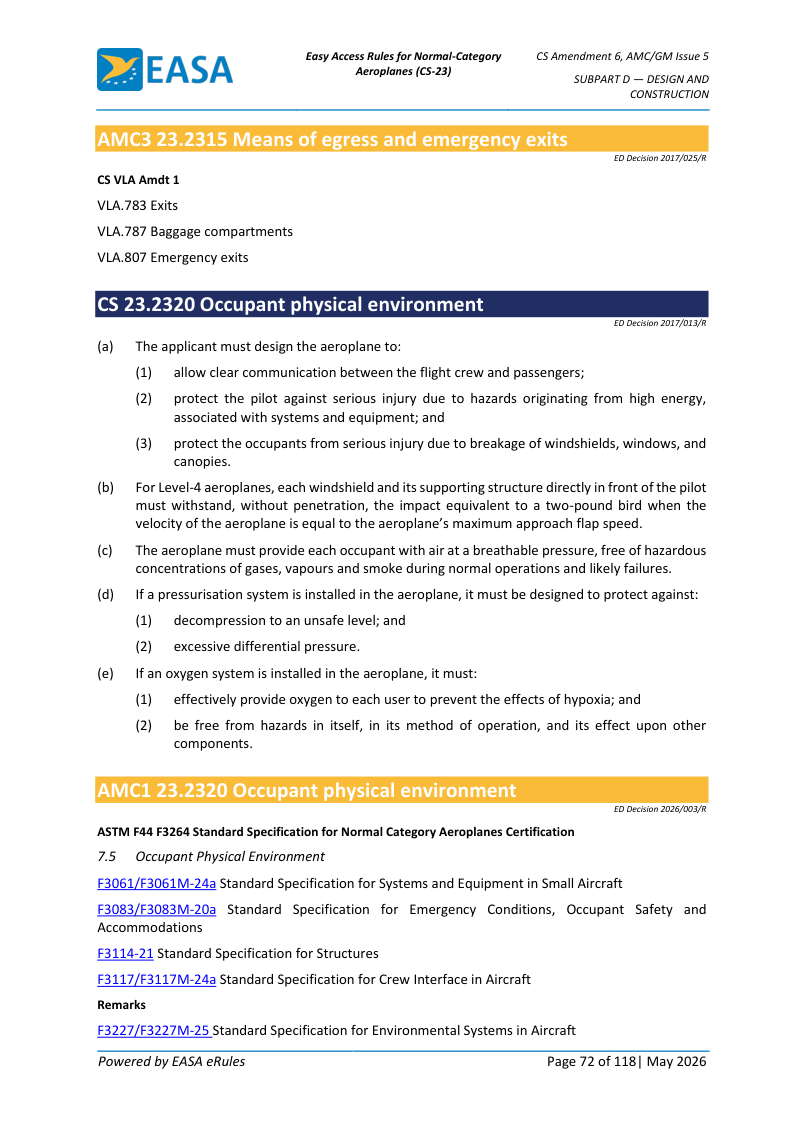
View figures, tables and original page layout
Connected references
Source-backed citations and subject-based engineering context are labelled separately. These links do not establish equivalence or project acceptance.
Related technical context
Engineering contextEvidence and scope
AC 23.2010-1 and CS-23 — published scope
Aerospace Consulting navigation suggestion based on the subject and stated scope of the two publications.
This connection does not establish regulatory equivalence, acceptance of a newer edition, or applicability of a project-specific precedent to another programme.
Supporting source