
CS-23
Normal-Category Aeroplanes
CS Amendment 6; AMC/GM Issue 5 Source checked 2026-11-28
Scope, source and reading notes
Complete Easy Access Rules consolidation of CS-23 Amendment 6 and related AMC/GM Issue 5.
Aerospace Consulting reference note: Current consolidated certification specifications and related compliance guidance for normal-category aeroplanes.
The complete selected publication is available in reading text and as the original PDF. Reading text is extracted from the official PDF; page layout is simplified, and figures and tables should be checked in the original page view.
Search covers extracted text. Words contained only in graphics may not be searchable. The original publication is available below.
Official source recordOriginal PDF on this siteSource: EASA. Reproduced with source acknowledgment; source edition and status are shown above. SHA-256: 86ad4923e633b90fc84b90ff5ab4b1caade703896da2ee03657437e1cde181b1
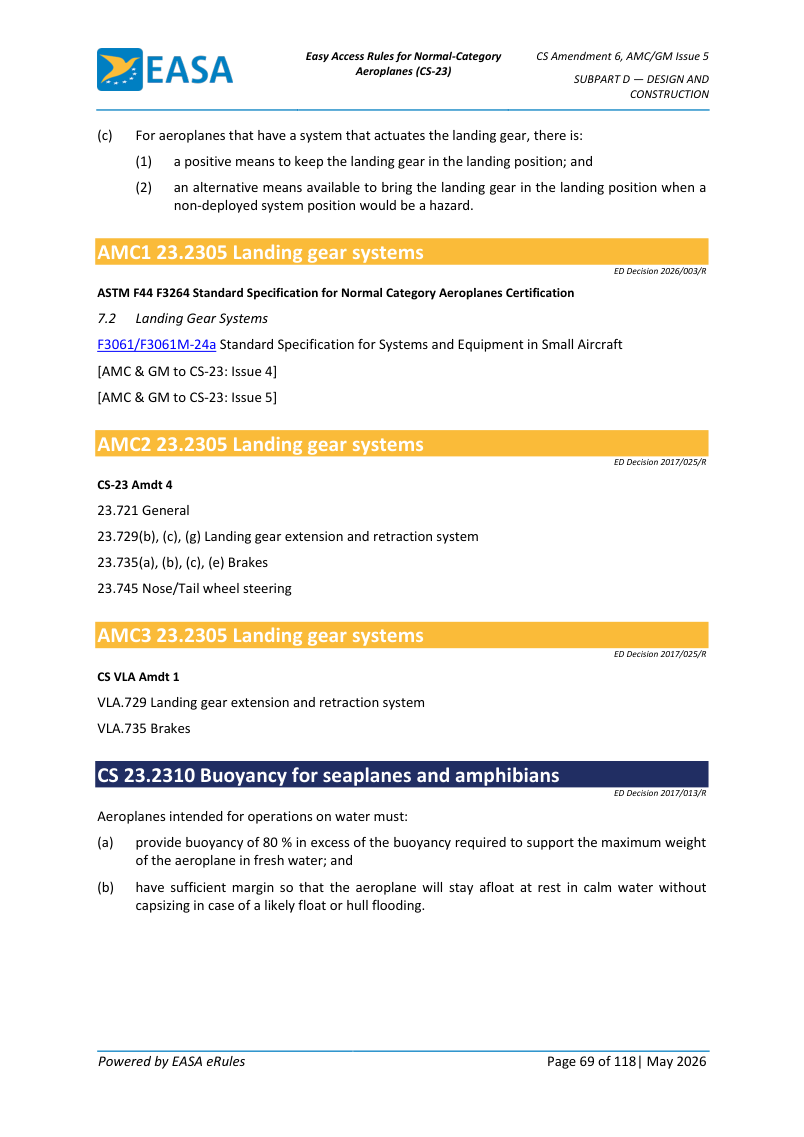
(c) For aeroplanes that have a system that actuates the landing gear, there is:
(1) a positive means to keep the landing gear in the landing position; and
(2) an alternative means available to bring the landing gear in the landing position when a non-deployed system position would be a hazard.
AMC1 23.2305 Landing gear systems
ED Decision 2026/003/R
ASTM F44 F3264 Standard Specification for Normal Category Aeroplanes Certification
7.2 Landing Gear Systems
F3061/F3061M-24a Standard Specification for Systems and Equipment in Small Aircraft
[AMC & GM to CS-23: Issue 4]
[AMC & GM to CS-23: Issue 5]
AMC2 23.2305 Landing gear systems
ED Decision 2017/025/R
CS-23 Amdt 4
23.721 General
23.729(b), (c), (g) Landing gear extension and retraction system
23.735(a), (b), (c), (e) Brakes
23.745 Nose/Tail wheel steering
AMC3 23.2305 Landing gear systems
ED Decision 2017/025/R
CS VLA Amdt 1
VLA.729 Landing gear extension and retraction system
VLA.735 Brakes
CS 23.2310 Buoyancy for seaplanes and amphibians
ED Decision 2017/013/R
Aeroplanes intended for operations on water must:
(a) provide buoyancy of 80 % in excess of the buoyancy required to support the maximum weight of the aeroplane in fresh water; and
(b) have sufficient margin so that the aeroplane will stay afloat at rest in calm water without capsizing in case of a likely float or hull flooding.
View figures, tables and original page layout
Connected references
Source-backed citations and subject-based engineering context are labelled separately. These links do not establish equivalence or project acceptance.
Related technical context
Engineering contextEvidence and scope
AC 23.2010-1 and CS-23 — published scope
Aerospace Consulting navigation suggestion based on the subject and stated scope of the two publications.
This connection does not establish regulatory equivalence, acceptance of a newer edition, or applicability of a project-specific precedent to another programme.
Supporting source