
CS-23
Normal-Category Aeroplanes
CS Amendment 6; AMC/GM Issue 5 Source checked 2026-11-28
Scope, source and reading notes
Complete Easy Access Rules consolidation of CS-23 Amendment 6 and related AMC/GM Issue 5.
Aerospace Consulting reference note: Current consolidated certification specifications and related compliance guidance for normal-category aeroplanes.
The complete selected publication is available in reading text and as the original PDF. Reading text is extracted from the official PDF; page layout is simplified, and figures and tables should be checked in the original page view.
Search covers extracted text. Words contained only in graphics may not be searchable. The original publication is available below.
Official source recordOriginal PDF on this siteSource: EASA. Reproduced with source acknowledgment; source edition and status are shown above. SHA-256: 86ad4923e633b90fc84b90ff5ab4b1caade703896da2ee03657437e1cde181b1
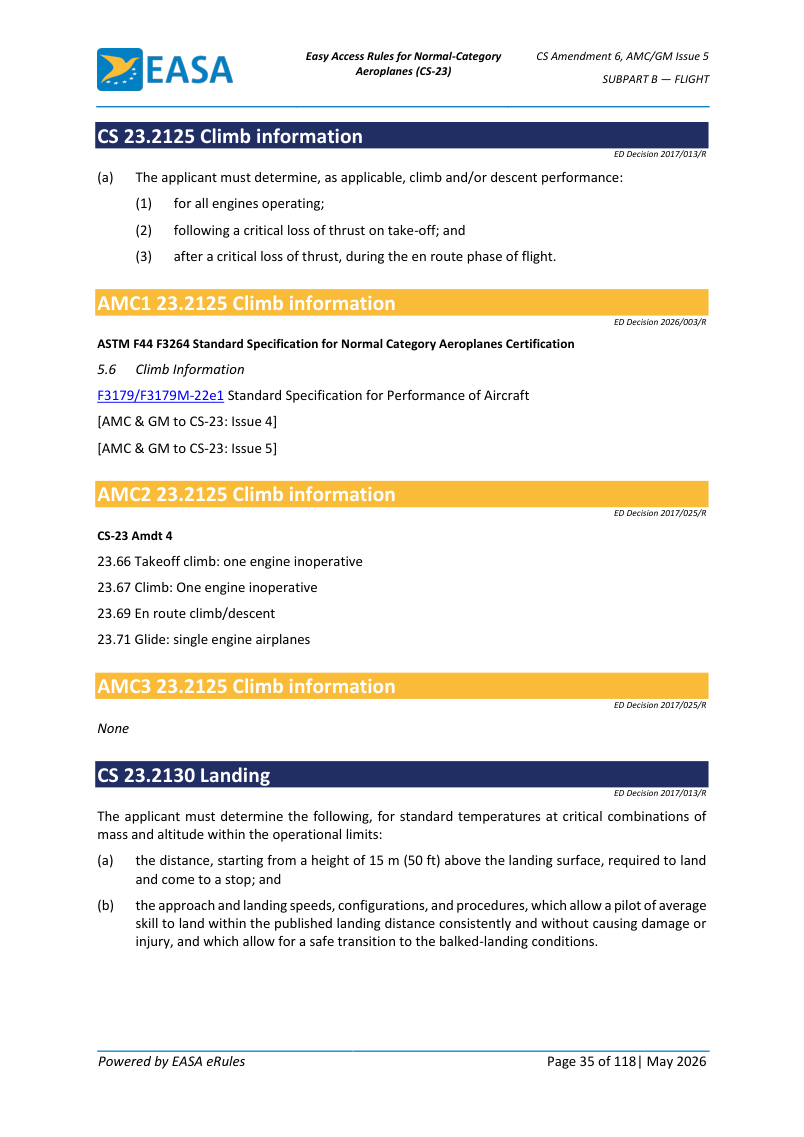
CS 23.2125 Climb information
ED Decision 2017/013/R
(a) The applicant must determine, as applicable, climb and/or descent performance:
(1) for all engines operating;
(2) following a critical loss of thrust on take-off; and
(3) after a critical loss of thrust, during the en route phase of flight.
AMC1 23.2125 Climb information
ED Decision 2026/003/R
ASTM F44 F3264 Standard Specification for Normal Category Aeroplanes Certification
5.6 Climb Information
F3179/F3179M-22e1 Standard Specification for Performance of Aircraft
[AMC & GM to CS-23: Issue 4]
[AMC & GM to CS-23: Issue 5]
AMC2 23.2125 Climb information
ED Decision 2017/025/R
CS-23 Amdt 4
23.66 Takeoff climb: one engine inoperative
23.67 Climb: One engine inoperative
23.69 En route climb/descent
23.71 Glide: single engine airplanes
AMC3 23.2125 Climb information
ED Decision 2017/025/R
None
CS 23.2130 Landing
ED Decision 2017/013/R
The applicant must determine the following, for standard temperatures at critical combinations of mass and altitude within the operational limits:
(a) the distance, starting from a height of 15 m (50 ft) above the landing surface, required to land and come to a stop; and
(b) the approach and landing speeds, configurations, and procedures, which allow a pilot of average skill to land within the published landing distance consistently and without causing damage or injury, and which allow for a safe transition to the balked-landing conditions.
View figures, tables and original page layout
Connected references
Source-backed citations and subject-based engineering context are labelled separately. These links do not establish equivalence or project acceptance.
Related technical context
Engineering contextEvidence and scope
AC 23.2010-1 and CS-23 — published scope
Aerospace Consulting navigation suggestion based on the subject and stated scope of the two publications.
This connection does not establish regulatory equivalence, acceptance of a newer edition, or applicability of a project-specific precedent to another programme.
Supporting source