
AC 21.17-4
Type Certification—Powered-lift
21.17-4 · 2025-07-18 Source checked 2026-11-28
Scope, source and reading notes
Appendix A gives an acceptable means for certain powered-lift under §21.17(b). These criteria are not universally applicable CFR requirements; establish the basis for the particular aircraft.
Aerospace Consulting reference note: FAA guidance for the type certification of powered-lift, including the development of project airworthiness criteria.
The complete selected publication is available in reading text and as the original PDF. Reading text is extracted from the official PDF; page layout is simplified, and figures and tables should be checked in the original page view.
Search covers extracted text. Words contained only in graphics may not be searchable. The original publication is available below.
Official source recordOriginal PDF on this siteSource: FAA. Reproduced with source acknowledgment; source edition and status are shown above. SHA-256: e1a60e5f5ed4f34764beb0866a0a1b65471832a1cf169ef670a6dd6bf434297e
AC 21.17-4 Appendix A
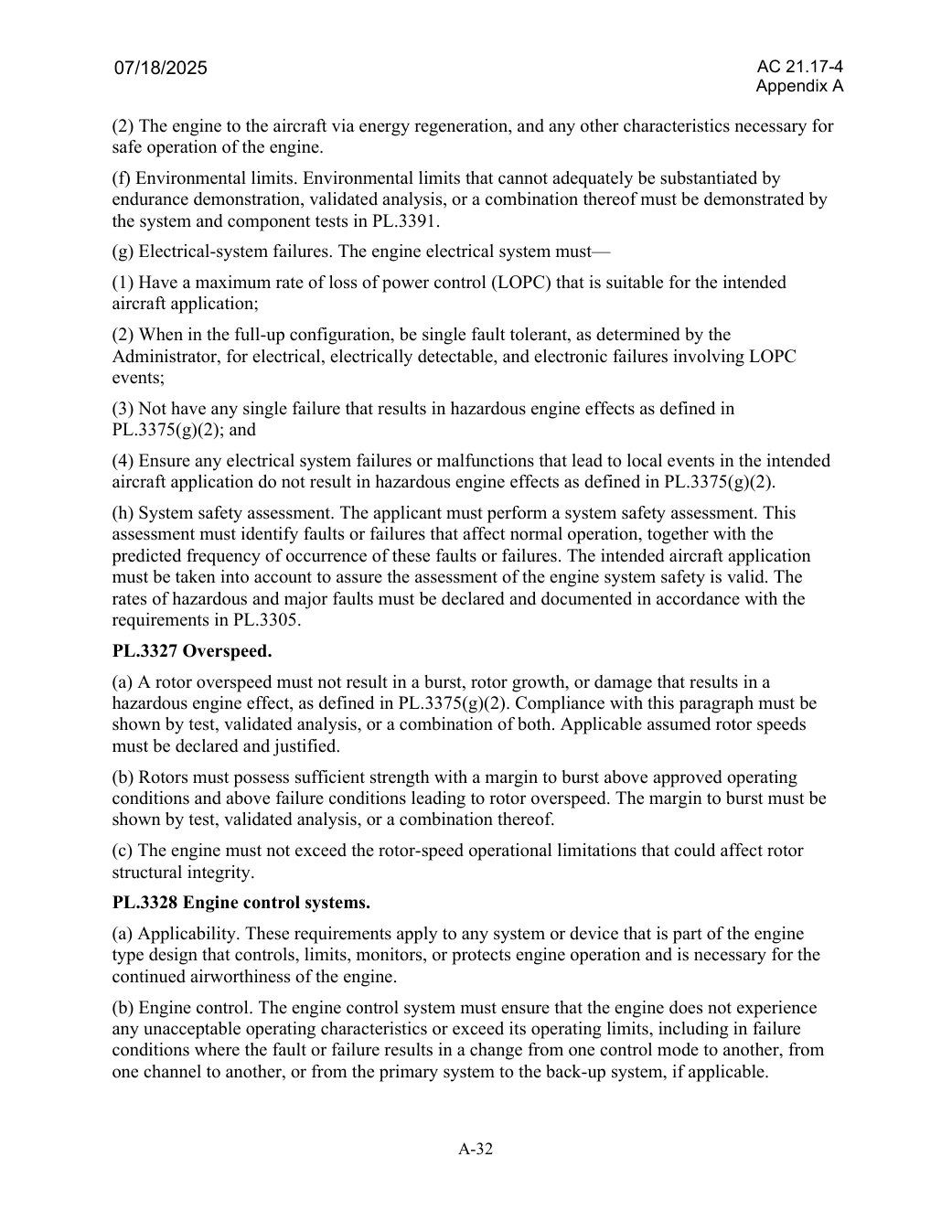
(2) The engine to the aircraft via energy regeneration, and any other characteristics necessary for safe operation of the engine.
(f) Environmental limits. Environmental limits that cannot adequately be substantiated by endurance demonstration, validated analysis, or a combination thereof must be demonstrated by the system and component tests in PL.3391.
(g) Electrical-system failures. The engine electrical system must—
(1) Have a maximum rate of loss of power control (LOPC) that is suitable for the intended aircraft application;
(2) When in the full-up configuration, be single fault tolerant, as determined by the Administrator, for electrical, electrically detectable, and electronic failures involving LOPC events;
(3) Not have any single failure that results in hazardous engine effects as defined in PL.3375(g)(2); and
(4) Ensure any electrical system failures or malfunctions that lead to local events in the intended aircraft application do not result in hazardous engine effects as defined in PL.3375(g)(2).
(h) System safety assessment. The applicant must perform a system safety assessment. This assessment must identify faults or failures that affect normal operation, together with the predicted frequency of occurrence of these faults or failures. The intended aircraft application must be taken into account to assure the assessment of the engine system safety is valid. The rates of hazardous and major faults must be declared and documented in accordance with the requirements in PL.3305.
PL.3327 Overspeed.
(a) A rotor overspeed must not result in a burst, rotor growth, or damage that results in a hazardous engine effect, as defined in PL.3375(g)(2). Compliance with this paragraph must be shown by test, validated analysis, or a combination of both. Applicable assumed rotor speeds must be declared and justified.
(b) Rotors must possess sufficient strength with a margin to burst above approved operating conditions and above failure conditions leading to rotor overspeed. The margin to burst must be shown by test, validated analysis, or a combination thereof.
(c) The engine must not exceed the rotor-speed operational limitations that could affect rotor structural integrity.
PL.3328 Engine control systems.
(a) Applicability. These requirements apply to any system or device that is part of the engine type design that controls, limits, monitors, or protects engine operation and is necessary for the continued airworthiness of the engine.
(b) Engine control. The engine control system must ensure that the engine does not experience any unacceptable operating characteristics or exceed its operating limits, including in failure conditions where the fault or failure results in a change from one control mode to another, from one channel to another, or from the primary system to the back-up system, if applicable.
View figures, tables and original page layout
Connected references
Source-backed citations and subject-based engineering context are labelled separately. These links do not establish equivalence or project acceptance.
Related technical context
Engineering contextEvidence and scope
AC 21.17-4 and Joby JAS4-1 criteria — published scope
Aerospace Consulting navigation suggestion based on the subject and stated scope of the two publications.
This connection does not establish regulatory equivalence, acceptance of a newer edition, or applicability of a project-specific precedent to another programme.
Supporting sourceRelated technical context
Engineering contextEvidence and scope
AC 21.17-4 and Archer M001 criteria — published scope
Aerospace Consulting navigation suggestion based on the subject and stated scope of the two publications.
This connection does not establish regulatory equivalence, acceptance of a newer edition, or applicability of a project-specific precedent to another programme.
Supporting sourceRelated technical context
Engineering contextEvidence and scope
AC 21.17-4 and SC-VTOL-02 — published scope
Aerospace Consulting navigation suggestion based on the subject and stated scope of the two publications.
This connection does not establish regulatory equivalence, acceptance of a newer edition, or applicability of a project-specific precedent to another programme.
Supporting source