
AC 21.17-4
Type Certification—Powered-lift
21.17-4 · 2025-07-18 Source checked 2026-11-28
Scope, source and reading notes
Appendix A gives an acceptable means for certain powered-lift under §21.17(b). These criteria are not universally applicable CFR requirements; establish the basis for the particular aircraft.
Aerospace Consulting reference note: FAA guidance for the type certification of powered-lift, including the development of project airworthiness criteria.
The complete selected publication is available in reading text and as the original PDF. Reading text is extracted from the official PDF; page layout is simplified, and figures and tables should be checked in the original page view.
Search covers extracted text. Words contained only in graphics may not be searchable. The original publication is available below.
Official source recordOriginal PDF on this siteSource: FAA. Reproduced with source acknowledgment; source edition and status are shown above. SHA-256: e1a60e5f5ed4f34764beb0866a0a1b65471832a1cf169ef670a6dd6bf434297e
AC 21.17-4 Appendix A
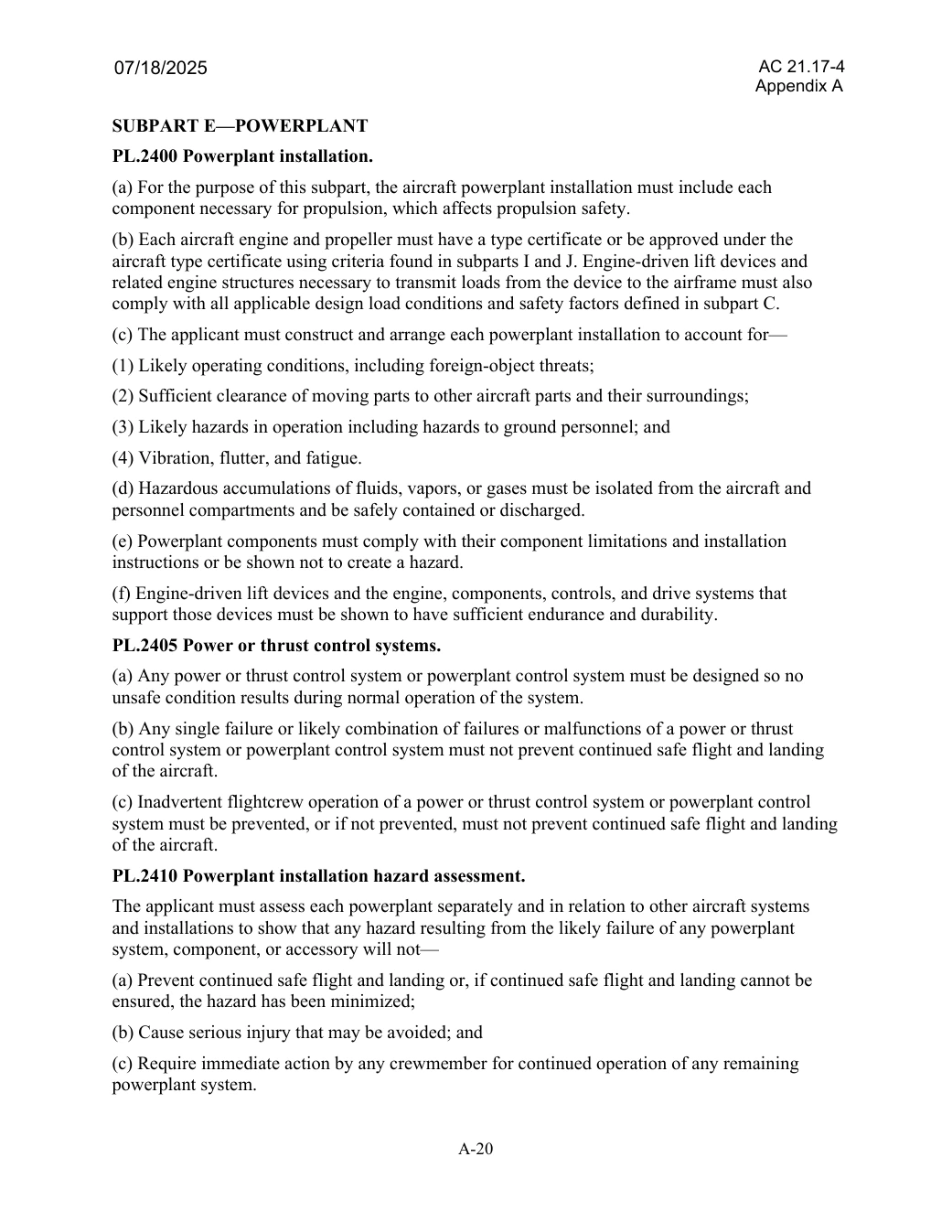
SUBPART E—POWERPLANT
PL.2400 Powerplant installation.
(a) For the purpose of this subpart, the aircraft powerplant installation must include each component necessary for propulsion, which affects propulsion safety.
(b) Each aircraft engine and propeller must have a type certificate or be approved under the aircraft type certificate using criteria found in subparts I and J. Engine-driven lift devices and related engine structures necessary to transmit loads from the device to the airframe must also comply with all applicable design load conditions and safety factors defined in subpart C.
(c) The applicant must construct and arrange each powerplant installation to account for—
(1) Likely operating conditions, including foreign-object threats;
(2) Sufficient clearance of moving parts to other aircraft parts and their surroundings;
(3) Likely hazards in operation including hazards to ground personnel; and
(4) Vibration, flutter, and fatigue.
(d) Hazardous accumulations of fluids, vapors, or gases must be isolated from the aircraft and personnel compartments and be safely contained or discharged.
(e) Powerplant components must comply with their component limitations and installation instructions or be shown not to create a hazard.
(f) Engine-driven lift devices and the engine, components, controls, and drive systems that support those devices must be shown to have sufficient endurance and durability.
PL.2405 Power or thrust control systems.
(a) Any power or thrust control system or powerplant control system must be designed so no unsafe condition results during normal operation of the system.
(b) Any single failure or likely combination of failures or malfunctions of a power or thrust control system or powerplant control system must not prevent continued safe flight and landing of the aircraft.
(c) Inadvertent flightcrew operation of a power or thrust control system or powerplant control system must be prevented, or if not prevented, must not prevent continued safe flight and landing of the aircraft.
PL.2410 Powerplant installation hazard assessment.
The applicant must assess each powerplant separately and in relation to other aircraft systems and installations to show that any hazard resulting from the likely failure of any powerplant system, component, or accessory will not—
(a) Prevent continued safe flight and landing or, if continued safe flight and landing cannot be ensured, the hazard has been minimized;
(b) Cause serious injury that may be avoided; and
(c) Require immediate action by any crewmember for continued operation of any remaining powerplant system.
View figures, tables and original page layout
Connected references
Source-backed citations and subject-based engineering context are labelled separately. These links do not establish equivalence or project acceptance.
Related technical context
Engineering contextEvidence and scope
AC 21.17-4 and Joby JAS4-1 criteria — published scope
Aerospace Consulting navigation suggestion based on the subject and stated scope of the two publications.
This connection does not establish regulatory equivalence, acceptance of a newer edition, or applicability of a project-specific precedent to another programme.
Supporting sourceRelated technical context
Engineering contextEvidence and scope
AC 21.17-4 and Archer M001 criteria — published scope
Aerospace Consulting navigation suggestion based on the subject and stated scope of the two publications.
This connection does not establish regulatory equivalence, acceptance of a newer edition, or applicability of a project-specific precedent to another programme.
Supporting sourceRelated technical context
Engineering contextEvidence and scope
AC 21.17-4 and SC-VTOL-02 — published scope
Aerospace Consulting navigation suggestion based on the subject and stated scope of the two publications.
This connection does not establish regulatory equivalence, acceptance of a newer edition, or applicability of a project-specific precedent to another programme.
Supporting source