
AC 21.17-4
Type Certification—Powered-lift
21.17-4 · 2025-07-18 Source checked 2026-11-28
Scope, source and reading notes
Appendix A gives an acceptable means for certain powered-lift under §21.17(b). These criteria are not universally applicable CFR requirements; establish the basis for the particular aircraft.
Aerospace Consulting reference note: FAA guidance for the type certification of powered-lift, including the development of project airworthiness criteria.
The complete selected publication is available in reading text and as the original PDF. Reading text is extracted from the official PDF; page layout is simplified, and figures and tables should be checked in the original page view.
Search covers extracted text. Words contained only in graphics may not be searchable. The original publication is available below.
Official source recordOriginal PDF on this siteSource: FAA. Reproduced with source acknowledgment; source edition and status are shown above. SHA-256: e1a60e5f5ed4f34764beb0866a0a1b65471832a1cf169ef670a6dd6bf434297e
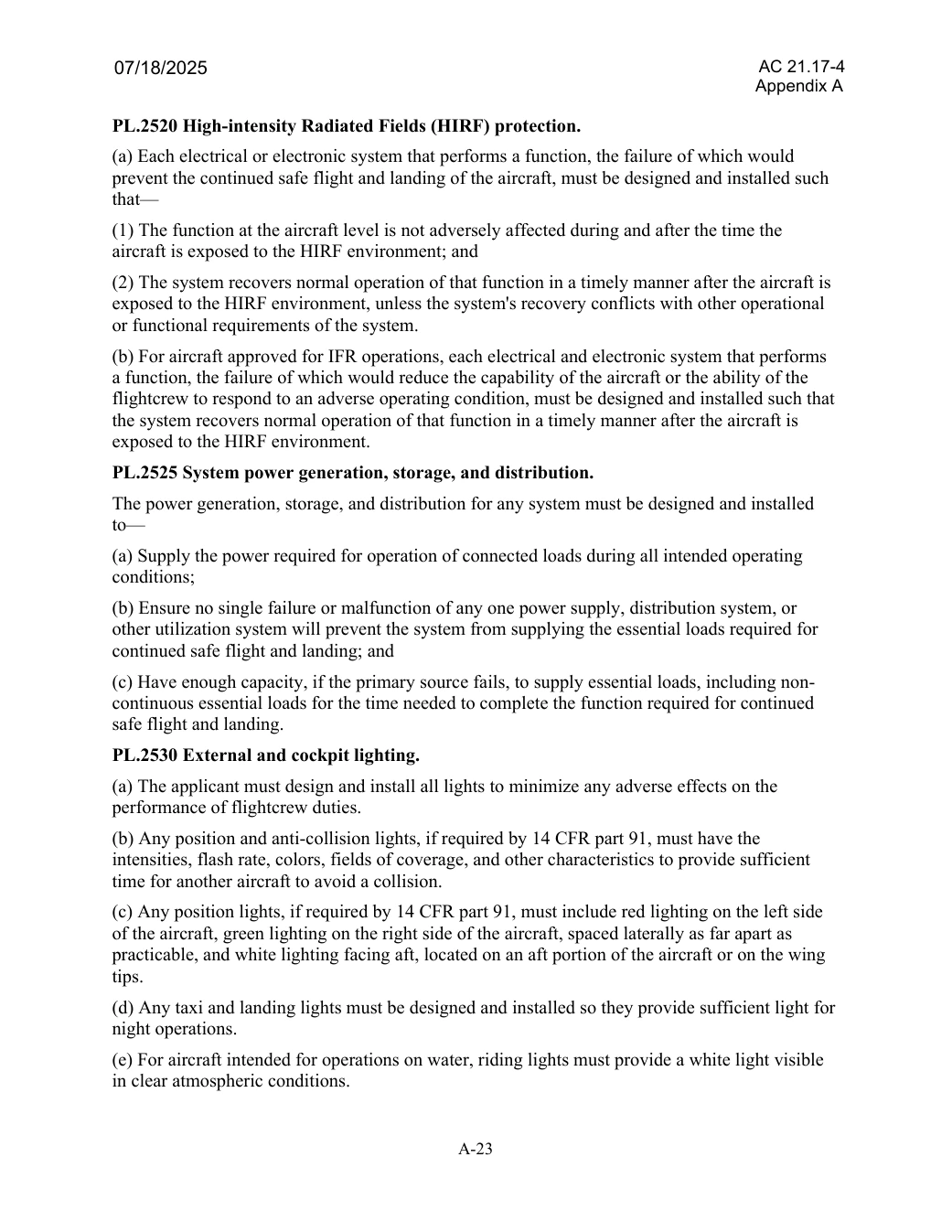
AC 21.17-4 Appendix A
PL.2520 High-intensity Radiated Fields (HIRF) protection.
(a) Each electrical or electronic system that performs a function, the failure of which would prevent the continued safe flight and landing of the aircraft, must be designed and installed such that—
(1) The function at the aircraft level is not adversely affected during and after the time the aircraft is exposed to the HIRF environment; and
(2) The system recovers normal operation of that function in a timely manner after the aircraft is exposed to the HIRF environment, unless the system's recovery conflicts with other operational or functional requirements of the system.
(b) For aircraft approved for IFR operations, each electrical and electronic system that performs a function, the failure of which would reduce the capability of the aircraft or the ability of the flightcrew to respond to an adverse operating condition, must be designed and installed such that the system recovers normal operation of that function in a timely manner after the aircraft is exposed to the HIRF environment.
PL.2525 System power generation, storage, and distribution.
The power generation, storage, and distribution for any system must be designed and installed to—
(a) Supply the power required for operation of connected loads during all intended operating conditions;
(b) Ensure no single failure or malfunction of any one power supply, distribution system, or other utilization system will prevent the system from supplying the essential loads required for continued safe flight and landing; and
(c) Have enough capacity, if the primary source fails, to supply essential loads, including non- continuous essential loads for the time needed to complete the function required for continued safe flight and landing.
PL.2530 External and cockpit lighting.
(a) The applicant must design and install all lights to minimize any adverse effects on the performance of flightcrew duties.
(b) Any position and anti-collision lights, if required by 14 CFR part 91, must have the intensities, flash rate, colors, fields of coverage, and other characteristics to provide sufficient time for another aircraft to avoid a collision.
(c) Any position lights, if required by 14 CFR part 91, must include red lighting on the left side of the aircraft, green lighting on the right side of the aircraft, spaced laterally as far apart as practicable, and white lighting facing aft, located on an aft portion of the aircraft or on the wing tips.
(d) Any taxi and landing lights must be designed and installed so they provide sufficient light for night operations.
(e) For aircraft intended for operations on water, riding lights must provide a white light visible in clear atmospheric conditions.
View figures, tables and original page layout
Connected references
Source-backed citations and subject-based engineering context are labelled separately. These links do not establish equivalence or project acceptance.
Related technical context
Engineering contextEvidence and scope
AC 21.17-4 and Joby JAS4-1 criteria — published scope
Aerospace Consulting navigation suggestion based on the subject and stated scope of the two publications.
This connection does not establish regulatory equivalence, acceptance of a newer edition, or applicability of a project-specific precedent to another programme.
Supporting sourceRelated technical context
Engineering contextEvidence and scope
AC 21.17-4 and Archer M001 criteria — published scope
Aerospace Consulting navigation suggestion based on the subject and stated scope of the two publications.
This connection does not establish regulatory equivalence, acceptance of a newer edition, or applicability of a project-specific precedent to another programme.
Supporting sourceRelated technical context
Engineering contextEvidence and scope
AC 21.17-4 and SC-VTOL-02 — published scope
Aerospace Consulting navigation suggestion based on the subject and stated scope of the two publications.
This connection does not establish regulatory equivalence, acceptance of a newer edition, or applicability of a project-specific precedent to another programme.
Supporting source