
AC 21.17-4
Type Certification—Powered-lift
21.17-4 · 2025-07-18 Source checked 2026-11-28
Scope, source and reading notes
Appendix A gives an acceptable means for certain powered-lift under §21.17(b). These criteria are not universally applicable CFR requirements; establish the basis for the particular aircraft.
Aerospace Consulting reference note: FAA guidance for the type certification of powered-lift, including the development of project airworthiness criteria.
The complete selected publication is available in reading text and as the original PDF. Reading text is extracted from the official PDF; page layout is simplified, and figures and tables should be checked in the original page view.
Search covers extracted text. Words contained only in graphics may not be searchable. The original publication is available below.
Official source recordOriginal PDF on this siteSource: FAA. Reproduced with source acknowledgment; source edition and status are shown above. SHA-256: e1a60e5f5ed4f34764beb0866a0a1b65471832a1cf169ef670a6dd6bf434297e
AC 21.17-4 Appendix A
(3) Structural test requirement;
(4) Sampling percentage; and
(5) Process and material control.
(c) The applicant must multiply the highest pertinent special factor of safety in the design for each part of the structure by each limit and ultimate load, or ultimate load only, if there is no corresponding limit load, such as occurs with emergency condition loading.
Structural Occupant Protection
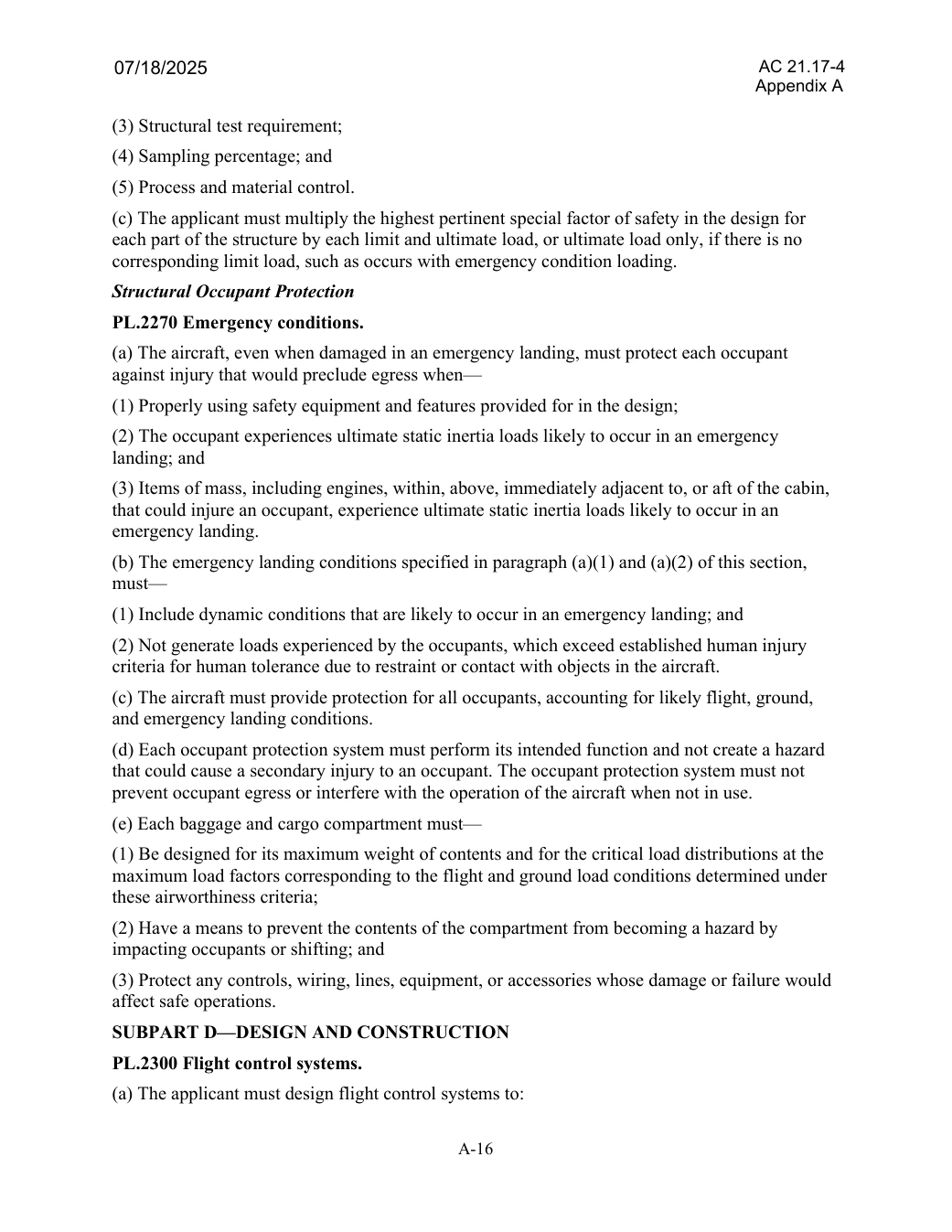
PL.2270 Emergency conditions.
(a) The aircraft, even when damaged in an emergency landing, must protect each occupant against injury that would preclude egress when—
(1) Properly using safety equipment and features provided for in the design;
(2) The occupant experiences ultimate static inertia loads likely to occur in an emergency landing; and
(3) Items of mass, including engines, within, a bove, immediately adjacent to, or aft of the cabin, that could injure an occupant, experience ultimate static inertia loads likely to occur in an emergency landing.
(b) The emergency landing conditions specified in paragraph (a)(1) and (a)(2) of this section, must—
(1) Include dynamic conditions that are likely to occur in an emergency landing; and
(2) Not generate loads experienced by the occupants, which exceed established human injury criteria for human tolerance due to restraint or contact with objects in the aircraft.
(c) The aircraft must provide protection for all occupants, accounting for likely flight, ground, and emergency landing conditions.
(d) Each occupant protection system must perform its intended function and not create a hazard that could cause a secondary injury to an occupant. The occupant protection system must not prevent occupant egress or interfere with the operation of the aircraft when not in use.
(e) Each baggage and cargo compartment must—
(1) Be designed for its maximum weight of contents and for the critical load distributions at the maximum load factors corresponding to the flight and ground load conditions determined under these airworthiness criteria;
(2) Have a means to prevent the contents of the compartment from becoming a hazard by impacting occupants or shifting; and
(3) Protect any controls, wiring, lines, equipment, or accessories whose damage or failure would affect safe operations.
SUBPART D—DESIGN AND CONSTRUCTION
PL.2300 Flight control systems.
(a) The applicant must design flight control systems to:
View figures, tables and original page layout
Connected references
Source-backed citations and subject-based engineering context are labelled separately. These links do not establish equivalence or project acceptance.
Related technical context
Engineering contextEvidence and scope
AC 21.17-4 and Joby JAS4-1 criteria — published scope
Aerospace Consulting navigation suggestion based on the subject and stated scope of the two publications.
This connection does not establish regulatory equivalence, acceptance of a newer edition, or applicability of a project-specific precedent to another programme.
Supporting sourceRelated technical context
Engineering contextEvidence and scope
AC 21.17-4 and Archer M001 criteria — published scope
Aerospace Consulting navigation suggestion based on the subject and stated scope of the two publications.
This connection does not establish regulatory equivalence, acceptance of a newer edition, or applicability of a project-specific precedent to another programme.
Supporting sourceRelated technical context
Engineering contextEvidence and scope
AC 21.17-4 and SC-VTOL-02 — published scope
Aerospace Consulting navigation suggestion based on the subject and stated scope of the two publications.
This connection does not establish regulatory equivalence, acceptance of a newer edition, or applicability of a project-specific precedent to another programme.
Supporting source