
AC 21.17-4
Type Certification—Powered-lift
21.17-4 · 2025-07-18 Source checked 2026-11-28
Scope, source and reading notes
Appendix A gives an acceptable means for certain powered-lift under §21.17(b). These criteria are not universally applicable CFR requirements; establish the basis for the particular aircraft.
Aerospace Consulting reference note: FAA guidance for the type certification of powered-lift, including the development of project airworthiness criteria.
The complete selected publication is available in reading text and as the original PDF. Reading text is extracted from the official PDF; page layout is simplified, and figures and tables should be checked in the original page view.
Search covers extracted text. Words contained only in graphics may not be searchable. The original publication is available below.
Official source recordOriginal PDF on this siteSource: FAA. Reproduced with source acknowledgment; source edition and status are shown above. SHA-256: e1a60e5f5ed4f34764beb0866a0a1b65471832a1cf169ef670a6dd6bf434297e
AC 21.17-4 Appendix A
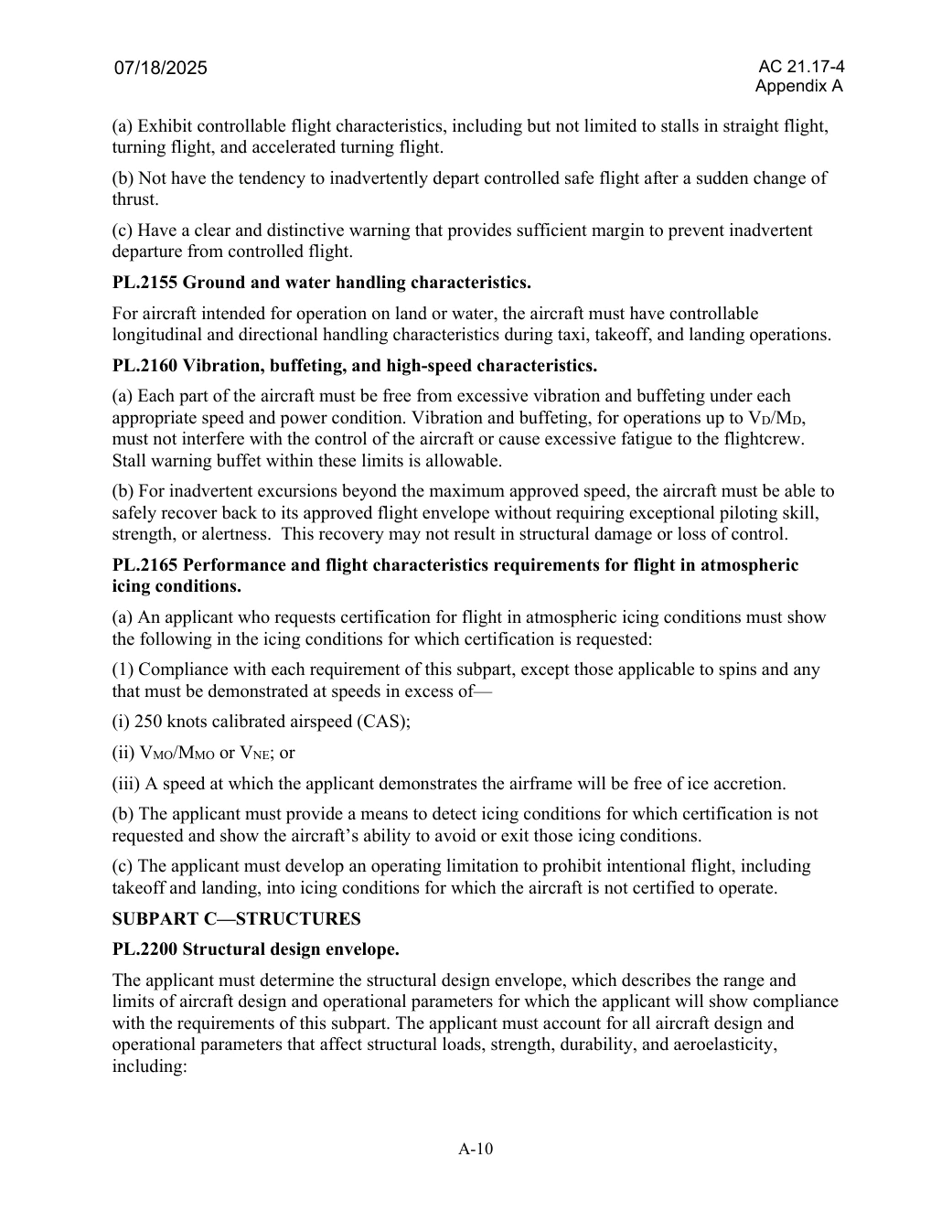
(a) Exhibit controllable flight characteristics, including but not limited to stalls in straight flight, turning flight, and accelerated turning flight.
(b) Not have the tendency to inadvertently depart controlled safe flight after a sudden change of thrust.
(c) Have a clear and distinctive warning that provides sufficient margin to prevent inadvertent departure from controlled flight.
PL.2155 Ground and water handling characteristics.
For aircraft intended for operation on land or water, the aircraft must have controllable longitudinal and directional handling characteristics during taxi, takeoff, and landing operations.
PL.2160 Vibration, buffeting, and high-speed characteristics.
(a) Each part of the aircraft must be free from excessive vibration and buffeting under each appropriate speed and power condition. Vibration and buffeting, for operations up to VD/MD, must not interfere with the control of the aircraft or cause excessive fatigue to the flightcrew. Stall warning buffet within these limits is allowable.
(b) For inadvertent excursions beyond the maximum approved speed, the aircraft must be able to safely recover back to its approved flight envelope without requiring exceptional piloting skill, strength, or alertness. This recovery may not result in structural damage or loss of control.
PL.2165 Performance and flight characteristics requirements for flight in atmospheric icing conditions.
(a) An applicant who requests certification for flight in atmospheric icing conditions must show the following in the icing conditions for which certification is requested:
(1) Compliance with each requirement of this subpart, except those applicable to spins and any that must be demonstrated at speeds in excess of—
(i) 250 knots calibrated airspeed (CAS);
(ii) VMO/MMO or VNE; or
(iii) A speed at which the applicant demonstrates the airframe will be free of ice accretion.
(b) The applicant must provide a means to detect icing conditions for which certification is not requested and show the aircraft’s ability to avoid or exit those icing conditions.
(c) The applicant must develop an operating limitation to prohibit intentional flight, including takeoff and landing, into icing conditions for which the aircraft is not certified to operate.
SUBPART C—STRUCTURES
PL.2200 Structural design envelope.
The applicant must determine the structural design envelope, which describes the range and limits of aircraft design and operational parameters for which the applicant will show compliance with the requirements of this subpart. The applicant must account for all aircraft design and operational parameters that affect structural loads, strength, durability, and aeroelasticity, including:
View figures, tables and original page layout
Connected references
Source-backed citations and subject-based engineering context are labelled separately. These links do not establish equivalence or project acceptance.
Related technical context
Engineering contextEvidence and scope
AC 21.17-4 and Joby JAS4-1 criteria — published scope
Aerospace Consulting navigation suggestion based on the subject and stated scope of the two publications.
This connection does not establish regulatory equivalence, acceptance of a newer edition, or applicability of a project-specific precedent to another programme.
Supporting sourceRelated technical context
Engineering contextEvidence and scope
AC 21.17-4 and Archer M001 criteria — published scope
Aerospace Consulting navigation suggestion based on the subject and stated scope of the two publications.
This connection does not establish regulatory equivalence, acceptance of a newer edition, or applicability of a project-specific precedent to another programme.
Supporting sourceRelated technical context
Engineering contextEvidence and scope
AC 21.17-4 and SC-VTOL-02 — published scope
Aerospace Consulting navigation suggestion based on the subject and stated scope of the two publications.
This connection does not establish regulatory equivalence, acceptance of a newer edition, or applicability of a project-specific precedent to another programme.
Supporting source