The Certification of Aircraft Electrical and Electronic Systems for Operation in the High-Intensity Radiated Fields (HIRF) Environment
20-158B Source checked 2026-11-28
Scope, source and reading notes
HIRF protection for aircraft electrical and electronic systems where the certification basis includes the specified Part 23, 25, 27, or 29 requirements.
Aerospace Consulting reference note: Guidance for demonstrating that aircraft electrical and electronic systems are protected against the high-intensity radiated fields environment.
The complete selected publication is available in reading text and as the original PDF. Reading text is extracted from the official PDF; page layout is simplified, and figures and tables should be checked in the original page view.
Search covers extracted text. Words contained only in graphics may not be searchable. The original publication is available below.
Source: FAA. Reproduced with source acknowledgment; source edition and status are shown above. SHA-256: c3be1c8b9e84592a978a2be6c3b8f89abfa59a6430af80afdacee892c3c917d3
Source page 50 · PDF page 50
05/20/24 AC 20-158B Appendix A
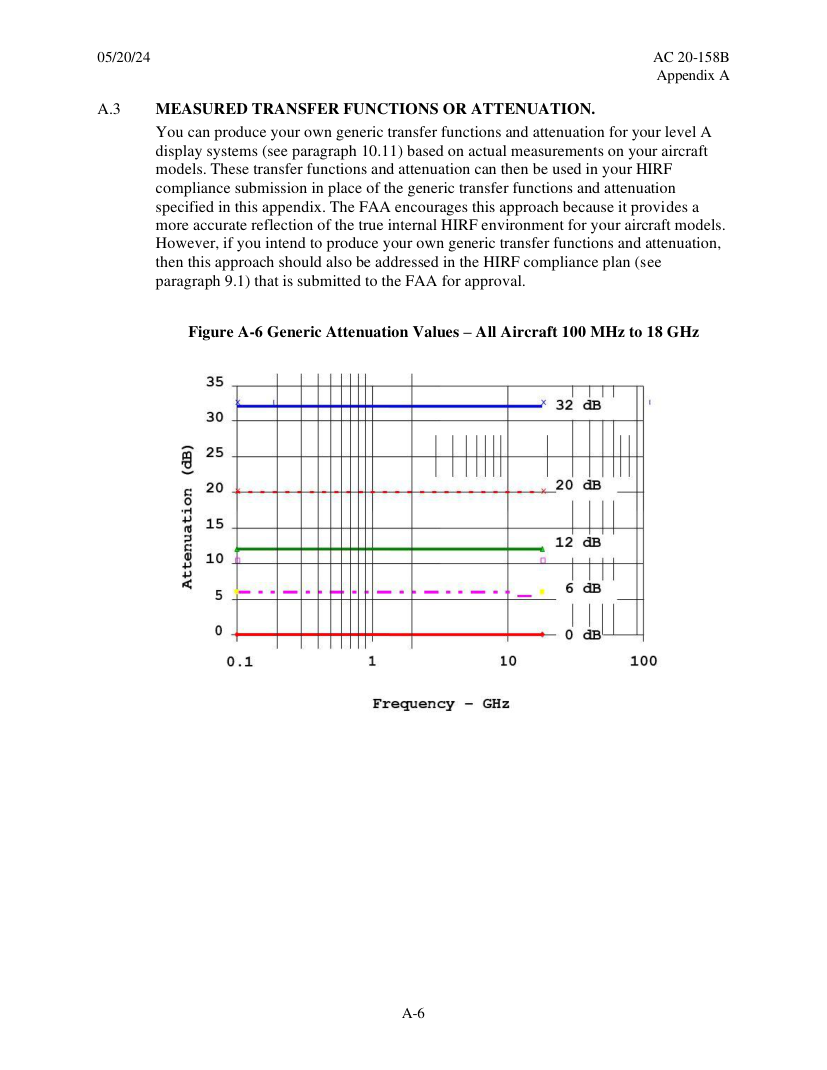
A.3 MEASURED TRANSFER FUNCTIONS OR ATTENUATION. You can produce your own generic transfer functions and attenuation for your level A display systems (see paragraph 10.11) based on actual measurements on your aircraft models. These transfer functions and attenuation can then be used in your HIRF compliance submission in place of the generic transfer functions and attenuation specified in this appendix. The FAA encourages this approach because it provides a more accurate reflection of the true internal HIRF environment for your aircraft models. However, if you intend to produce your own generic transfer functions and attenuation, then this approach should also be addressed in the HIRF compliance plan (see paragraph 9.1) that is submitted to the FAA for approval.
Figure A-6 Generic Attenuation Values – All Aircraft 100 MHz to 18 GHz
View figures, tables and original page layout
Connected references
Source-backed citations and subject-based engineering context are labelled separately. These links do not establish equivalence or project acceptance.
Aerospace Consulting navigation suggestion based on the subject and stated scope of the two publications.
This connection does not establish regulatory equivalence, acceptance of a newer edition, or applicability of a project-specific precedent to another programme.
A focused review, an agreed assessment package or ongoing support alongside your team. We can agree the relevant inputs and scope in the initial conversation.
This opens your email application.
Start a conversation
Tell us about your programme, the system you are developing and the support you need.
We can agree a focused use-case review, a defined evidence package or ongoing programme support.
This opens your email application.
Specialist aerospace expertise
Aerospace Consulting is led by Hussein Khimji, an FAA Designated Engineering Representative in systems and equipment, with a focus on system safety, flight controls and avionics.
We work with aircraft developers and systems suppliers to connect technical decisions, safety assessments and certification evidence.
This is the proposed introduction. The full About page will add your approved biography and associate expertise.
Systems engineering & development assurance
Tell us about the aircraft or system, its intended function, stage of development and the support you need.