FAA AI Safety Assurance Roadmap
Roadmap for Artificial Intelligence Safety Assurance
Version I · July 2024 Source checked 2026-11-28
Scope, source and reading notes
Strategic roadmap for safety assurance of AI and use of AI for safety. It is not an advisory circular, accepted project means of compliance, or regulatory requirement.
Aerospace Consulting reference note: FAA strategy, guiding principles and research priorities for AI safety assurance.
The complete selected publication is available in reading text and as the original PDF. Reading text is extracted from the official PDF; page layout is simplified, and figures and tables should be checked in the original page view.
Search covers extracted text. Words contained only in graphics may not be searchable. The original publication is available below.
Official source recordOriginal PDF on this siteSource: FAA. Reproduced with source acknowledgment; source edition and status are shown above. SHA-256: b8683625358a9f624aaf1567c0b083ad22235d3b518684f499b1e9c588fc4908
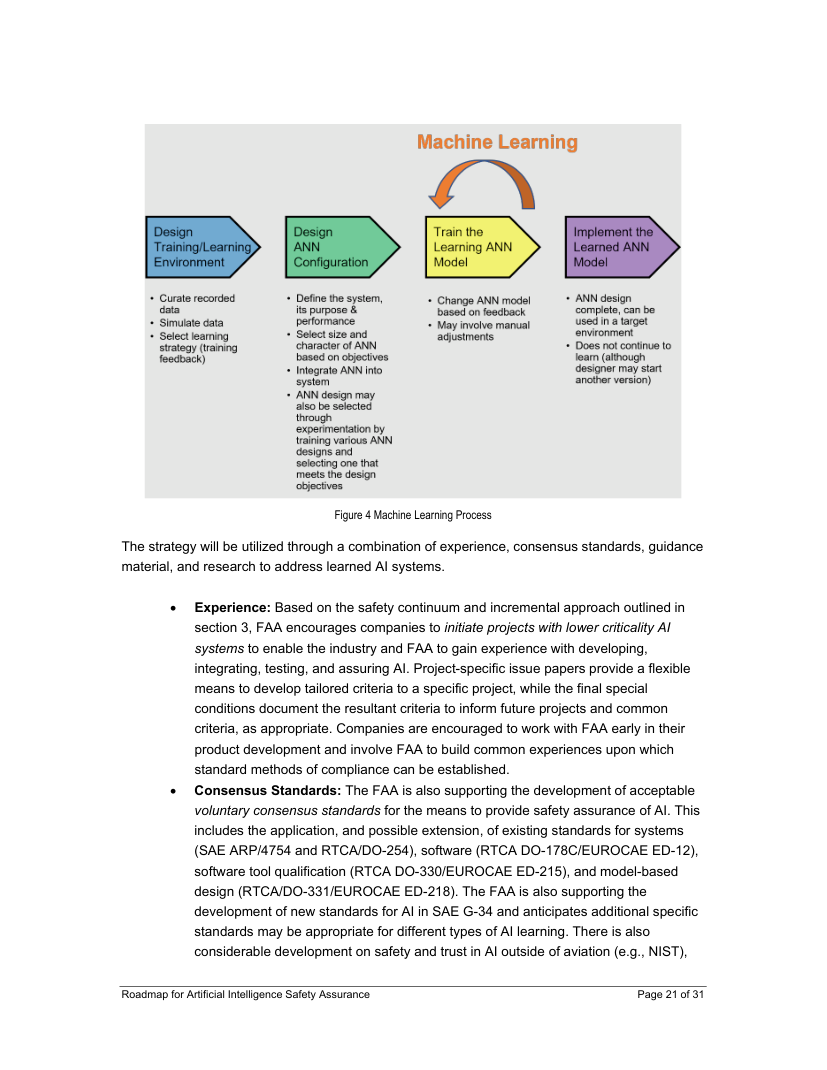
Figure 4 Machine Learning Process
The strategy will be utilized through a combination of experience, consensus standards, guidance material, and research to address learned AI systems.
• Experience: Based on the safety continuum and incremental approach outlined in section 3, FAA encourages companies to initiate projects with lower criticality AI systems to enable the industry and FAA to gain experience with developing, integrating, testing, and assuring AI. Project-specific issue papers provide a flexible means to develop tailored criteria to a specific project, while the final special conditions document the resultant criteria to inform future projects and common criteria, as appropriate. Companies are encouraged to work with FAA early in their product development and involve FAA to build common experiences upon which standard methods of compliance can be established.
• Consensus Standards: The FAA is also supporting the development of acceptable voluntary consensus standards for the means to provide safety assurance of AI. This includes the application, and possible extension, of existing standards for systems (SAE ARP/4754 and RTCA/DO-254), software (RTCA DO-178C/EUROCAE ED-12), software tool qualification (RTCA DO-330/EUROCAE ED-215), and model-based design (RTCA/DO-331/EUROCAE ED-218). The FAA is also supporting the development of new standards for AI in SAE G-34 and anticipates additional specific standards may be appropriate for different types of AI learning. There is also considerable development on safety and trust in AI outside of aviation (e.g., NIST),
View figures, tables and original page layout