FAA AI Safety Assurance Roadmap
Roadmap for Artificial Intelligence Safety Assurance
Version I · July 2024 Source checked 2026-11-28
Scope, source and reading notes
Strategic roadmap for safety assurance of AI and use of AI for safety. It is not an advisory circular, accepted project means of compliance, or regulatory requirement.
Aerospace Consulting reference note: FAA strategy, guiding principles and research priorities for AI safety assurance.
The complete selected publication is available in reading text and as the original PDF. Reading text is extracted from the official PDF; page layout is simplified, and figures and tables should be checked in the original page view.
Search covers extracted text. Words contained only in graphics may not be searchable. The original publication is available below.
Official source recordOriginal PDF on this siteSource: FAA. Reproduced with source acknowledgment; source edition and status are shown above. SHA-256: b8683625358a9f624aaf1567c0b083ad22235d3b518684f499b1e9c588fc4908
AI for Safety
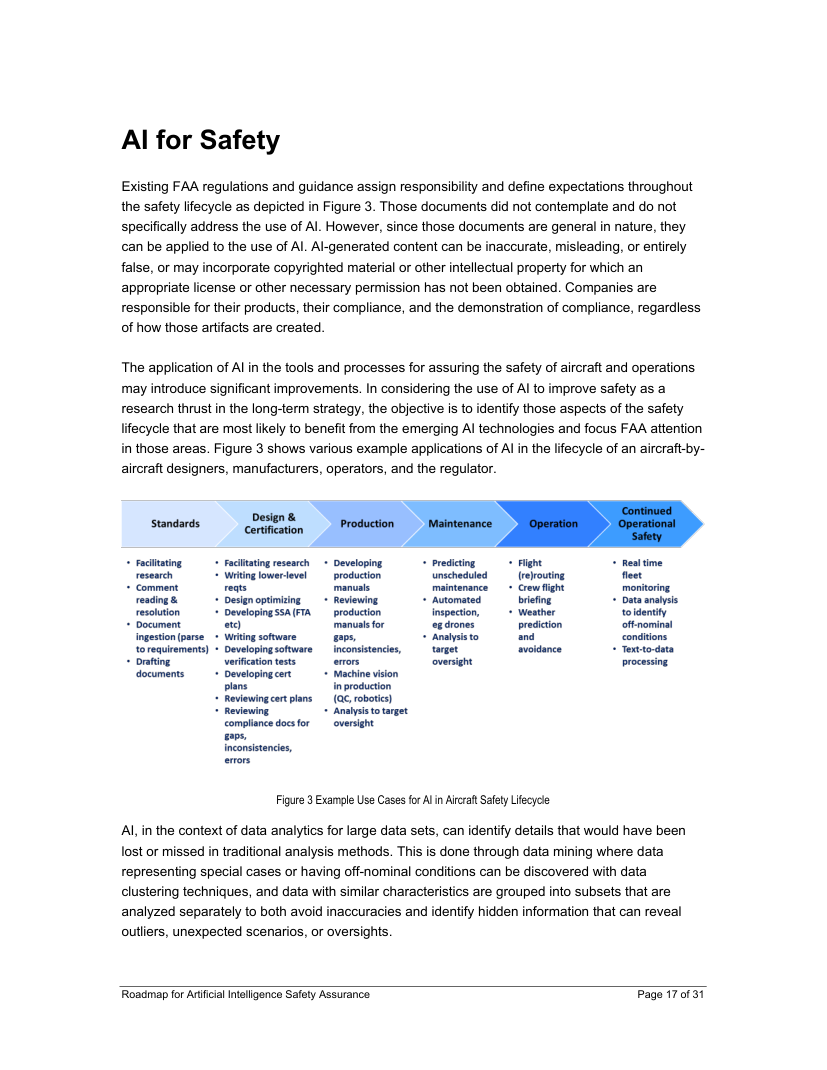
Existing FAA regulations and guidance assign responsibility and define expectations throughout the safety lifecycle as depicted in Figure 3. Those documents did not contemplate and do not specifically address the use of AI. However, since those documents are general in nature, they can be applied to the use of AI. AI-generated content can be inaccurate, misleading, or entirely false, or may incorporate copyrighted material or other intellectual property for which an appropriate license or other necessary permission has not been obtained. Companies are responsible for their products, their compliance, and the demonstration of compliance, regardless of how those artifacts are created.
The application of AI in the tools and processes for assuring the safety of aircraft and operations may introduce significant improvements. In considering the use of AI to improve safety as a research thrust in the long-term strategy, the objective is to identify those aspects of the safety lifecycle that are most likely to benefit from the emerging AI technologies and focus FAA attention in those areas. Figure 3 shows various example applications of AI in the lifecycle of an aircraft-by aircraft designers, manufacturers, operators, and the regulator.
Figure 3 Example Use Cases for AI in Aircraft Safety Lifecycle
AI, in the context of data analytics for large data sets, can identify details that would have been lost or missed in traditional analysis methods. This is done through data mining where data representing special cases or having off-nominal conditions can be discovered with data clustering techniques, and data with similar characteristics are grouped into subsets that are analyzed separately to both avoid inaccuracies and identify hidden information that can reveal outliers, unexpected scenarios, or oversights.
View figures, tables and original page layout