FAA AI Safety Assurance Roadmap
Roadmap for Artificial Intelligence Safety Assurance
Version I · July 2024 Source checked 2026-11-28
Scope, source and reading notes
Strategic roadmap for safety assurance of AI and use of AI for safety. It is not an advisory circular, accepted project means of compliance, or regulatory requirement.
Aerospace Consulting reference note: FAA strategy, guiding principles and research priorities for AI safety assurance.
The complete selected publication is available in reading text and as the original PDF. Reading text is extracted from the official PDF; page layout is simplified, and figures and tables should be checked in the original page view.
Search covers extracted text. Words contained only in graphics may not be searchable. The original publication is available below.
Official source recordOriginal PDF on this siteSource: FAA. Reproduced with source acknowledgment; source edition and status are shown above. SHA-256: b8683625358a9f624aaf1567c0b083ad22235d3b518684f499b1e9c588fc4908
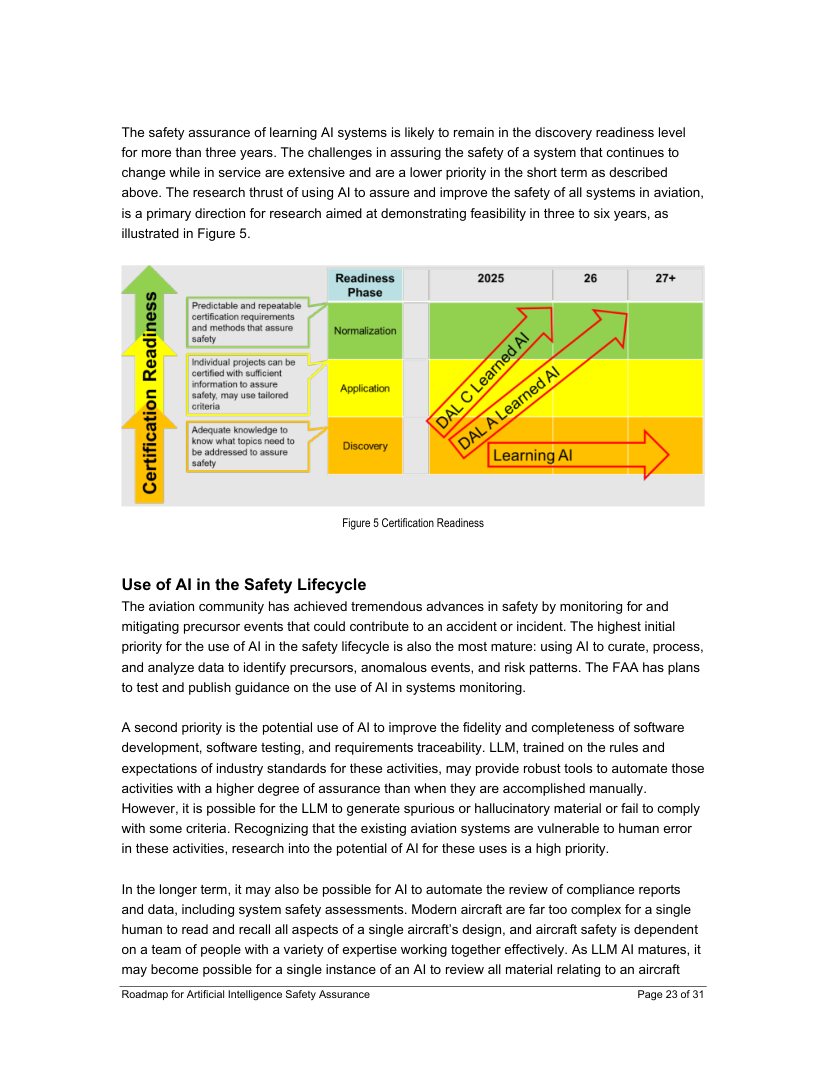
The safety assurance of learning AI systems is likely to remain in the discovery readiness level for more than three years. The challenges in assuring the safety of a system that continues to change while in service are extensive and are a lower priority in the short term as described above. The research thrust of using AI to assure and improve the safety of all systems in aviation, is a primary direction for research aimed at demonstrating feasibility in three to six years, as illustrated in Figure 5.
Figure 5 Certification Readiness
Use of AI in the Safety Lifecycle
The aviation community has achieved tremendous advances in safety by monitoring for and mitigating precursor events that could contribute to an accident or incident. The highest initial priority for the use of AI in the safety lifecycle is also the most mature: using AI to curate, process, and analyze data to identify precursors, anomalous events, and risk patterns. The FAA has plans to test and publish guidance on the use of AI in systems monitoring.
A second priority is the potential use of AI to improve the fidelity and completeness of software development, software testing, and requirements traceability. LLM, trained on the rules and expectations of industry standards for these activities, may provide robust tools to automate those activities with a higher degree of assurance than when they are accomplished manually. However, it is possible for the LLM to generate spurious or hallucinatory material or fail to comply with some criteria. Recognizing that the existing aviation systems are vulnerable to human error in these activities, research into the potential of AI for these uses is a high priority.
In the longer term, it may also be possible for AI to automate the review of compliance reports and data, including system safety assessments. Modern aircraft are far too complex for a single human to read and recall all aspects of a single aircraft’s design, and aircraft safety is dependent on a team of people with a variety of expertise working together effectively. As LLM AI matures, it may become possible for a single instance of an AI to review all material relating to an aircraft
View figures, tables and original page layout