
AMC 20-158A
Aircraft electrical and electronic system high-intensity radiated fields (HIRF) protection
Current AMC; incorporated in AMC-20 Amendment 23 Source checked 2026-11-28
Scope, source and reading notes
HIRF protection for aircraft electrical and electronic systems, including all three appendices.
Aerospace Consulting reference note: Provides the HIRF protection framework and supporting environmental, transfer-function and safety-assessment guidance.
Complete selected AMC and associated material, from PDF pages 518–559 of the AMC-20 consolidation. The original PDF contains the whole consolidation. Reading text is extracted; original figures and layout remain available.
Search covers extracted text. Words contained only in graphics may not be searchable. The original publication is available below.
Official source recordOriginal PDF on this siteSource: EASA. Reproduced with source acknowledgment; source edition and status are shown above. SHA-256: b3d02d6ad4cd2833f79be85634221f52ea8bd90a84c733257193e4a60a2d536a
3. Level B systems. The internal RF environments for Level B systems are defined in CS-23 Appendix K, in CS-25 Appendix R, in CS-27 Appendix D, and in CS-29 Appendix E, as applicable, as equipment HIRF test Levels 1 or 2. The steps for showing Level B HIRF compliance are presented in Section 9 of this AMC.
4. Level C systems. The internal RF environment for Level C systems is defined in CS- 23 Appendix K, in CS-25 Appendix R, in CS-27 Appendix D, and in CS-29 Appendix E, as applicable, as equipment HIRF test Level 3. The steps for showing Level C HIRF compliance are also presented in Section 9 of this AMC.
e. Apply the appropriate method of HIRF compliance verification
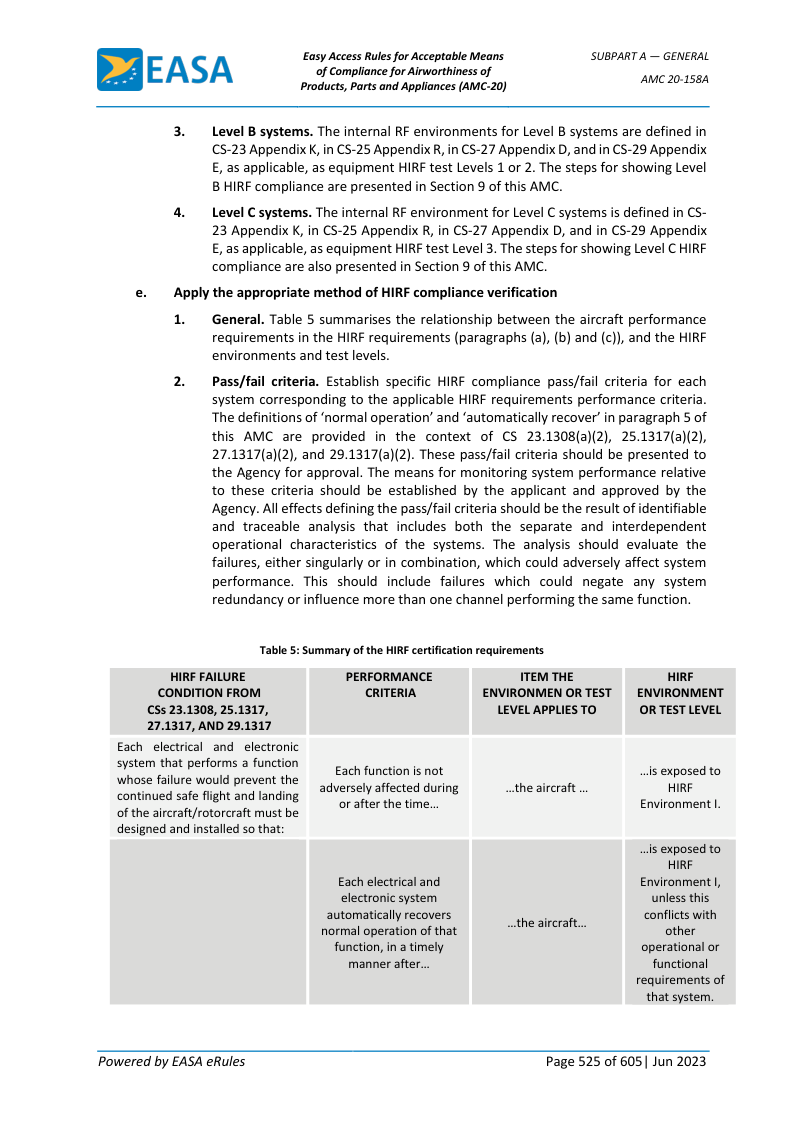
1. General. Table 5 summarises the relationship between the aircraft performance requirements in the HIRF requirements (paragraphs (a), (b) and (c)), and the HIRF environments and test levels.
2. Pass/fail criteria. Establish specific HIRF compliance pass/fail criteria for each system corresponding to the applicable HIRF requirements performance criteria. The definitions of ‘normal operation’ and ‘automatically recover’ in paragraph 5 of this AMC are provided in the context of CS 23.1308(a)(2), 25.1317(a)(2), 27.1317(a)(2), and 29.1317(a)(2). These pass/fail criteria should be presented to the Agency for approval. The means for monitoring system performance relative to these criteria should be established by the applicant and approved by the Agency. All effects defining the pass/fail criteria should be the result of identifiable and traceable analysis that includes both the separate and interdependent operational characteristics of the systems. The analysis should evaluate the failures, either singularly or in combination, which could adversely affect system performance. This should include failures which could negate any system redundancy or influence more than one channel performing the same function.
Table 5: Summary of the HIRF certification requirements
PERFORMANCE
CRITERIA
ITEM THE ENVIRONMEN OR TEST
HIRF ENVIRONMENT
LEVEL APPLIES TO
OR TEST LEVEL
HIRF FAILURE CONDITION FROM CSs 23.1308, 25.1317, 27.1317, AND 29.1317
…is exposed to
Each function is not adversely affected during
…the aircraft …
or after the time…
HIRF Environment I.
Each electrical and electronic system that performs a function whose failure would prevent the continued safe flight and landing of the aircraft/rotorcraft must be designed and installed so that:
…is exposed to
Each electrical and
HIRF Environment I,
unless this conflicts with
…the aircraft…
electronic system automatically recovers normal operation of that
function, in a timely
other operational or
manner after…
functional requirements of
that system.
View figures, tables and original page layout
Connected references
Source-backed citations and subject-based engineering context are labelled separately. These links do not establish equivalence or project acceptance.
Related technical context
Engineering contextEvidence and scope
AC 20-158B and AMC 20-158A — published scope
Aerospace Consulting navigation suggestion based on the subject and stated scope of the two publications.
This connection does not establish regulatory equivalence, acceptance of a newer edition, or applicability of a project-specific precedent to another programme.
Supporting source