
AMC 20-158A
Aircraft electrical and electronic system high-intensity radiated fields (HIRF) protection
Current AMC; incorporated in AMC-20 Amendment 23 Source checked 2026-11-28
Scope, source and reading notes
HIRF protection for aircraft electrical and electronic systems, including all three appendices.
Aerospace Consulting reference note: Provides the HIRF protection framework and supporting environmental, transfer-function and safety-assessment guidance.
Complete selected AMC and associated material, from PDF pages 518–559 of the AMC-20 consolidation. The original PDF contains the whole consolidation. Reading text is extracted; original figures and layout remain available.
Search covers extracted text. Words contained only in graphics may not be searchable. The original publication is available below.
Official source recordOriginal PDF on this siteSource: EASA. Reproduced with source acknowledgment; source edition and status are shown above. SHA-256: b3d02d6ad4cd2833f79be85634221f52ea8bd90a84c733257193e4a60a2d536a
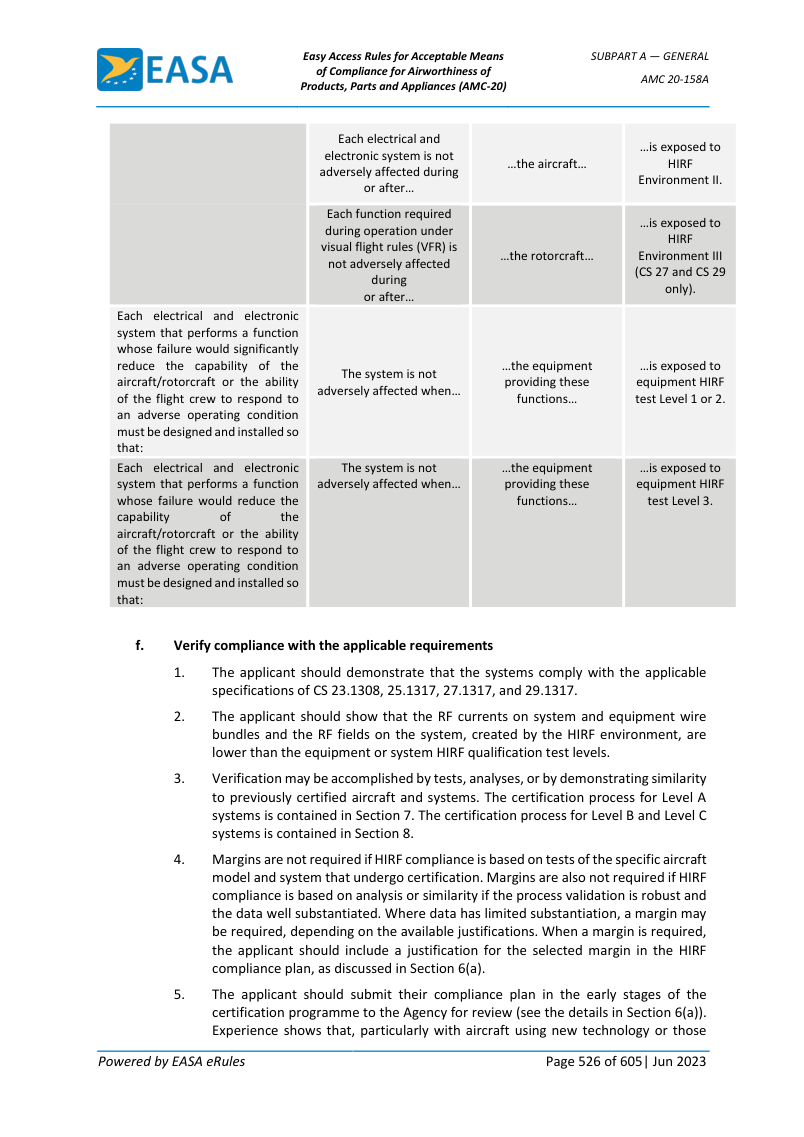
…is exposed to
…the aircraft…
Each electrical and electronic system is not adversely affected during
HIRF Environment II.
or after…
…is exposed to
Each function required during operation under visual flight rules (VFR) is
…the rotorcraft…
not adversely affected
HIRF Environment III (CS 27 and CS 29
only).
during or after…
…the equipment
providing these
The system is not adversely affected when…
functions…
…is exposed to equipment HIRF test Level 1 or 2.
Each electrical and electronic system that performs a function whose failure would significantly reduce the capability of the aircraft/rotorcraft or the ability of the flight crew to respond to an adverse operating condition must be designed and installed so that:
…the equipment
The system is not adversely affected when…
providing these
…is exposed to equipment HIRF
functions…
test Level 3.
Each electrical and electronic system that performs a function whose failure would reduce the capability of the aircraft/rotorcraft or the ability of the flight crew to respond to an adverse operating condition must be designed and installed so that:
f. Verify compliance with the applicable requirements
1. The applicant should demonstrate that the systems comply with the applicable specifications of CS 23.1308, 25.1317, 27.1317, and 29.1317.
2. The applicant should show that the RF currents on system and equipment wire bundles and the RF fields on the system, created by the HIRF environment, are lower than the equipment or system HIRF qualification test levels.
3. Verification may be accomplished by tests, analyses, or by demonstrating similarity to previously certified aircraft and systems. The certification process for Level A systems is contained in Section 7. The certification process for Level B and Level C systems is contained in Section 8.
4. Margins are not required if HIRF compliance is based on tests of the specific aircraft model and system that undergo certification. Margins are also not required if HIRF compliance is based on analysis or similarity if the process validation is robust and the data well substantiated. Where data has limited substantiation, a margin may be required, depending on the available justifications. When a margin is required, the applicant should include a justification for the selected margin in the HIRF compliance plan, as discussed in Section 6(a).
5. The applicant should submit their compliance plan in the early stages of the certification programme to the Agency for review (see the details in Section 6(a)). Experience shows that, particularly with aircraft using new technology or those
View figures, tables and original page layout
Connected references
Source-backed citations and subject-based engineering context are labelled separately. These links do not establish equivalence or project acceptance.
Related technical context
Engineering contextEvidence and scope
AC 20-158B and AMC 20-158A — published scope
Aerospace Consulting navigation suggestion based on the subject and stated scope of the two publications.
This connection does not establish regulatory equivalence, acceptance of a newer edition, or applicability of a project-specific precedent to another programme.
Supporting source