
AC 20-158B
The Certification of Aircraft Electrical and Electronic Systems for Operation in the High-Intensity Radiated Fields (HIRF) Environment
20-158B Source checked 2026-11-28
Scope, source and reading notes
HIRF protection for aircraft electrical and electronic systems where the certification basis includes the specified Part 23, 25, 27, or 29 requirements.
Aerospace Consulting reference note: Guidance for demonstrating that aircraft electrical and electronic systems are protected against the high-intensity radiated fields environment.
The complete selected publication is available in reading text and as the original PDF. Reading text is extracted from the official PDF; page layout is simplified, and figures and tables should be checked in the original page view.
Search covers extracted text. Words contained only in graphics may not be searchable. The original publication is available below.
Official source recordOriginal PDF on this siteSource: FAA. Reproduced with source acknowledgment; source edition and status are shown above. SHA-256: c3be1c8b9e84592a978a2be6c3b8f89abfa59a6430af80afdacee892c3c917d3
05/20/24
AC 20-158B Appendix B
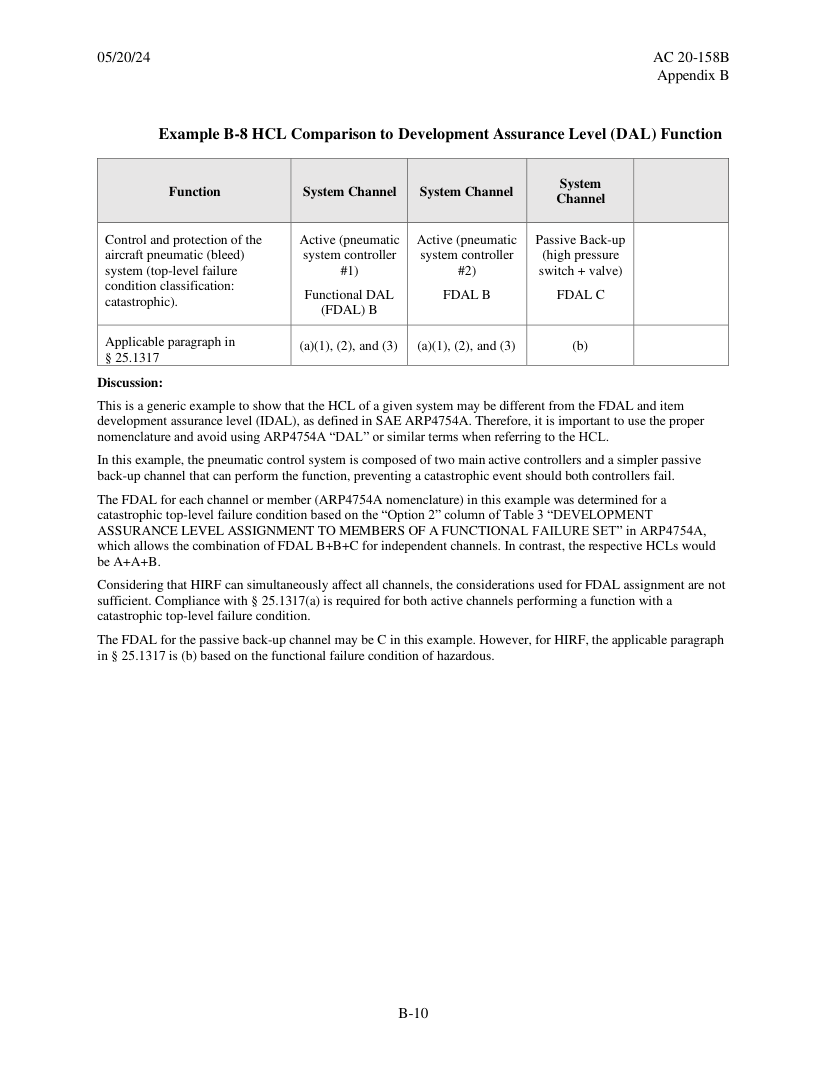
Example B-8 HCL Comparison to Development Assurance Level (DAL) Function
Function System Channel System Channel System Channel
Active (pneumatic
Active (pneumatic
Passive Back-up
system controller
system controller
#1)
#2)
(high pressure switch + valve)
Functional DAL
FDAL B
FDAL C
Control and protection of the aircraft pneumatic (bleed) system (top-level failure condition classification: catastrophic).
(FDAL) B
(a)(1), (2), and (3) (a)(1), (2), and (3) (b)
Applicable paragraph in § 25.1317
Discussion:
This is a generic example to show that the HCL of a given system may be different from the FDAL and item development assurance level (IDAL), as defined in SAE ARP4754A. Therefore, it is important to use the proper nomenclature and avoid using ARP4754A “DAL” or similar terms when referring to the HCL.
In this example, the pneumatic control system is composed of two main active controllers and a simpler passive back-up channel that can perform the function, preventing a catastrophic event should both controllers fail.
The FDAL for each channel or member (ARP4754A nomenclature) in this example was determined for a catastrophic top-level failure condition based on the “Option 2” column of Table 3 “DEVELOPMENT ASSURANCE LEVEL ASSIGNMENT TO MEMBERS OF A FUNCTIONAL FAILURE SET” in ARP4754A, which allows the combination of FDAL B+B+C for independent channels. In contrast, the respective HCLs would be A+A+B.
Considering that HIRF can simultaneously affect all channels, the considerations used for FDAL assignment are not sufficient. Compliance with § 25.1317(a) is required for both active channels performing a function with a catastrophic top-level failure condition.
The FDAL for the passive back-up channel may be C in this example. However, for HIRF, the applicable paragraph in § 25.1317 is (b) based on the functional failure condition of hazardous.
View figures, tables and original page layout
Connected references
Source-backed citations and subject-based engineering context are labelled separately. These links do not establish equivalence or project acceptance.
Related technical context
Engineering contextEvidence and scope
AC 20-158B and AMC 20-158A — published scope
Aerospace Consulting navigation suggestion based on the subject and stated scope of the two publications.
This connection does not establish regulatory equivalence, acceptance of a newer edition, or applicability of a project-specific precedent to another programme.
Supporting source