
AC 20-158B
The Certification of Aircraft Electrical and Electronic Systems for Operation in the High-Intensity Radiated Fields (HIRF) Environment
20-158B Source checked 2026-11-28
Scope, source and reading notes
HIRF protection for aircraft electrical and electronic systems where the certification basis includes the specified Part 23, 25, 27, or 29 requirements.
Aerospace Consulting reference note: Guidance for demonstrating that aircraft electrical and electronic systems are protected against the high-intensity radiated fields environment.
The complete selected publication is available in reading text and as the original PDF. Reading text is extracted from the official PDF; page layout is simplified, and figures and tables should be checked in the original page view.
Search covers extracted text. Words contained only in graphics may not be searchable. The original publication is available below.
Official source recordOriginal PDF on this siteSource: FAA. Reproduced with source acknowledgment; source edition and status are shown above. SHA-256: c3be1c8b9e84592a978a2be6c3b8f89abfa59a6430af80afdacee892c3c917d3
05/20/24 AC 20-158B Appendix B
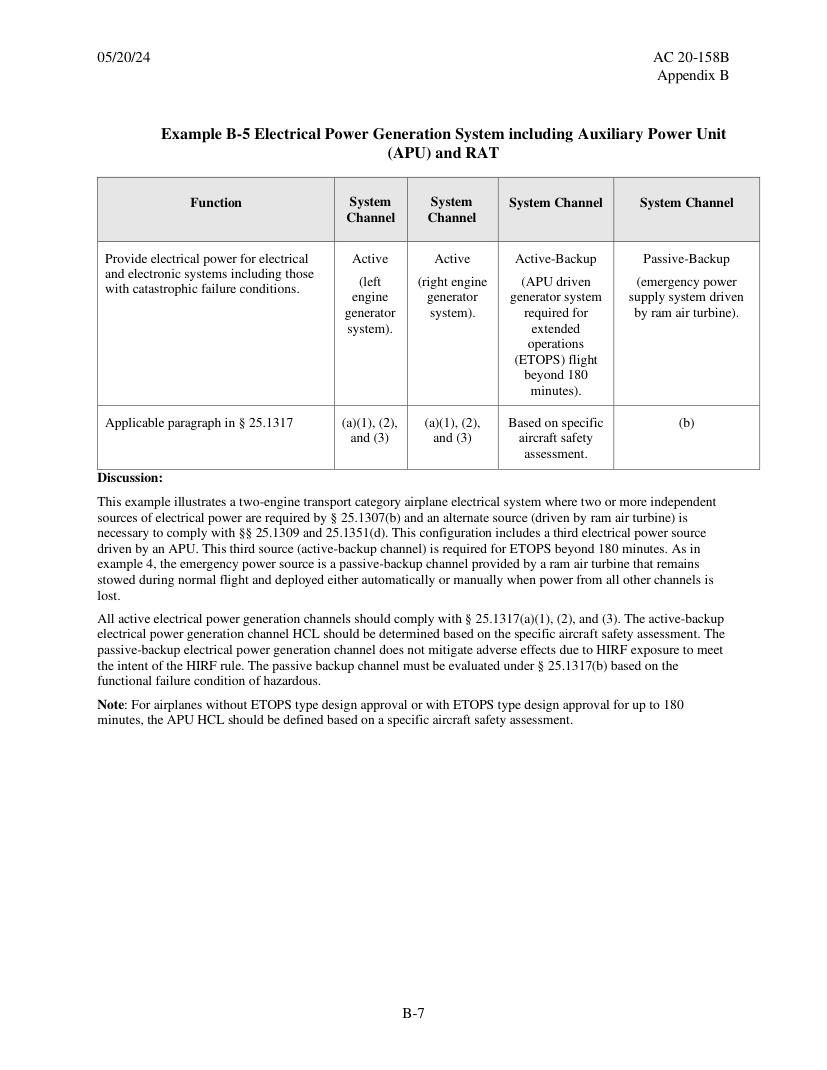
Example B-5 Electrical Power Generation System including Auxiliary Power Unit
(APU) and RAT
System Channel System Channel
Function System Channel
System Channel
Active
Active
Active-Backup
Passive-Backup
(right engine
Provide electrical power for electrical and electronic systems including those with catastrophic failure conditions.
generator
(APU driven generator system
(emergency power supply system driven
(left engine generator
system).
required for
by ram air turbine).
system).
extended operations (ETOPS) flight
beyond 180
minutes).
Applicable paragraph in § 25.1317 (a)(1), (2),
(a)(1), (2),
Based on specific
(b)
and (3)
and (3)
aircraft safety
assessment.
Discussion:
This example illustrates a two-engine transport category airplane electrical system where two or more independent sources of electrical power are required by § 25.1307(b) and an alternate source (driven by ram air turbine) is necessary to comply with §§ 25.1309 and 25.1351(d). This configuration includes a third electrical power source driven by an APU. This third source (active-backup channel) is required for ETOPS beyond 180 minutes. As in example 4, the emergency power source is a passive-backup channel provided by a ram air turbine that remains stowed during normal flight and deployed either automatically or manually when power from all other channels is lost.
All active electrical power generation channels should comply with § 25.1317(a)(1), (2), and (3). The active-backup electrical power generation channel HCL should be determined based on the specific aircraft safety assessment. The passive-backup electrical power generation channel does not mitigate adverse effects due to HIRF exposure to meet the intent of the HIRF rule. The passive backup channel must be evaluated under § 25.1317(b) based on the functional failure condition of hazardous.
Note: For airplanes without ETOPS type design approval or with ETOPS type design approval for up to 180 minutes, the APU HCL should be defined based on a specific aircraft safety assessment.
View figures, tables and original page layout
Connected references
Source-backed citations and subject-based engineering context are labelled separately. These links do not establish equivalence or project acceptance.
Related technical context
Engineering contextEvidence and scope
AC 20-158B and AMC 20-158A — published scope
Aerospace Consulting navigation suggestion based on the subject and stated scope of the two publications.
This connection does not establish regulatory equivalence, acceptance of a newer edition, or applicability of a project-specific precedent to another programme.
Supporting source