FAA Small Airplanes Issues List
Small Airplanes Product Issues List
Q3 2026 · 30 September 2026 Source checked 2026-11-28
Scope, source and reading notes
Certification planning issues for domestic projects. Consult the applicable bilateral agreement for validation projects. Entries summarize issues and do not reproduce the underlying project issue papers. Public issue summaries only; complete project issue papers are not reproduced.
Aerospace Consulting reference note: Public certification topics that may require special conditions, agreed means of compliance or FAA coordination.
The complete selected publication is available in reading text and as the original PDF. Reading text is extracted from the official PDF; page layout is simplified, and figures and tables should be checked in the original page view. This is the FAA’s public summary of certification issues, not the full project issue papers.
Search covers extracted text. Words contained only in graphics may not be searchable. The original publication is available below.
Official source recordOriginal PDF on this siteSource: FAA. Reproduced with source acknowledgment; source edition and status are shown above. SHA-256: 62751f1b8c1bedde2c69ffaeb2a9164653f8b95bb1349c12e16e00532257ddcc
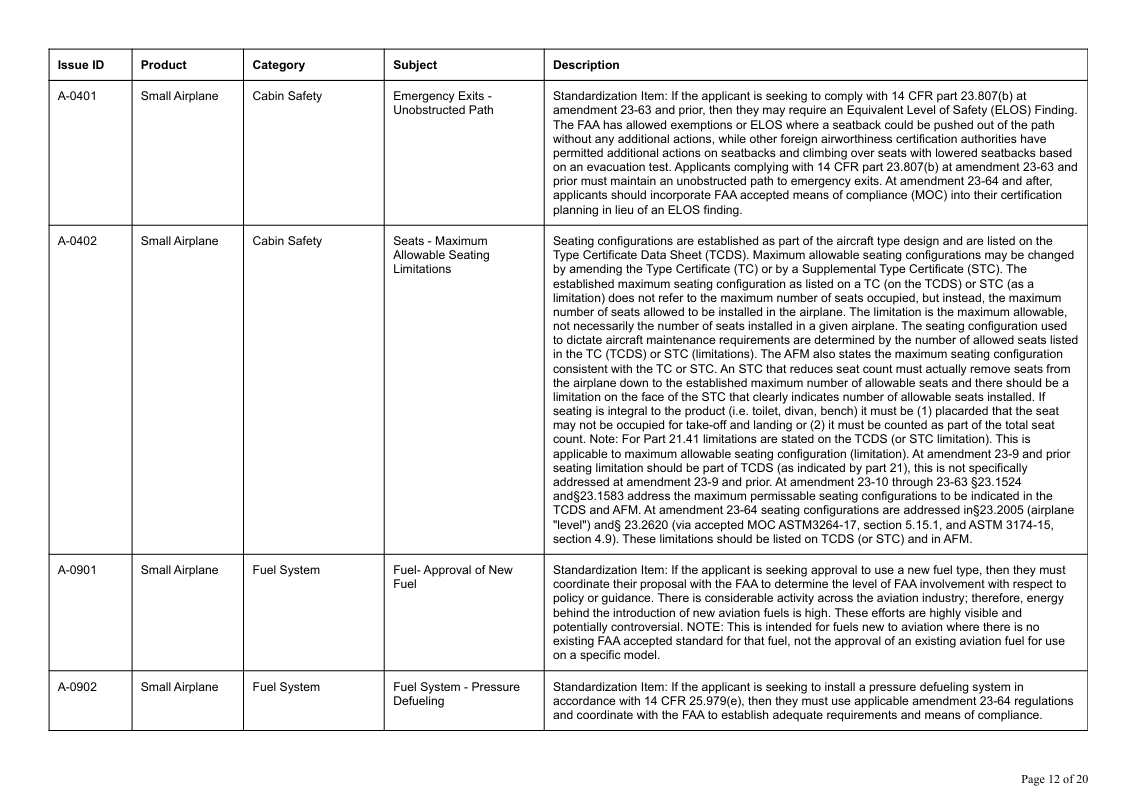
A-0401 Small Airplane Cabin Safety Emergency Exits - Unobstructed Path
Standardization Item: If the applicant is seeking to comply with 14 CFR part 23.807(b) at amendment 23-63 and prior, then they may require an Equivalent Level of Safety (ELOS) Finding. The FAA has allowed exemptions or ELOS where a seatback could be pushed out of the path without any additional actions, while other foreign airworthiness certification authorities have permitted additional actions on seatbacks and climbing over seats with lowered seatbacks based on an evacuation test. Applicants complying with 14 CFR part 23.807(b) at amendment 23-63 and prior must maintain an unobstructed path to emergency exits. At amendment 23-64 and after, applicants should incorporate FAA accepted means of compliance (MOC) into their certification planning in lieu of an ELOS finding.
A-0402 Small Airplane Cabin Safety Seats - Maximum Allowable Seating Limitations
Seating configurations are established as part of the aircraft type design and are listed on the Type Certificate Data Sheet (TCDS). Maximum allowable seating configurations may be changed by amending the Type Certificate (TC) or by a Supplemental Type Certificate (STC). The established maximum seating configuration as listed on a TC (on the TCDS) or STC (as a limitation) does not refer to the maximum number of seats occupied, but instead, the maximum number of seats allowed to be installed in the airplane. The limitation is the maximum allowable, not necessarily the number of seats installed in a given airplane. The seating configuration used to dictate aircraft maintenance requirements are determined by the number of allowed seats listed in the TC (TCDS) or STC (limitations). The AFM also states the maximum seating configuration consistent with the TC or STC. An STC that reduces seat count must actually remove seats from the airplane down to the established maximum number of allowable seats and there should be a limitation on the face of the STC that clearly indicates number of allowable seats installed. If seating is integral to the product (i.e. toilet, divan, bench) it must be (1) placarded that the seat may not be occupied for take-off and landing or (2) it must be counted as part of the total seat count. Note: For Part 21.41 limitations are stated on the TCDS (or STC limitation). This is applicable to maximum allowable seating configuration (limitation). At amendment 23-9 and prior seating limitation should be part of TCDS (as indicated by part 21), this is not specifically addressed at amendment 23-9 and prior. At amendment 23-10 through 23-63 §23.1524 and§23.1583 address the maximum permissable seating configurations to be indicated in the TCDS and AFM. At amendment 23-64 seating configurations are addressed in§23.2005 (airplane "level") and§ 23.2620 (via accepted MOC ASTM3264-17, section 5.15.1, and ASTM 3174-15, section 4.9). These limitations should be listed on TCDS (or STC) and in AFM.
A-0901 Small Airplane Fuel System Fuel- Approval of New Fuel
Standardization Item: If the applicant is seeking approval to use a new fuel type, then they must coordinate their proposal with the FAA to determine the level of FAA involvement with respect to policy or guidance. There is considerable activity across the aviation industry; therefore, energy behind the introduction of new aviation fuels is high. These efforts are highly visible and potentially controversial. NOTE: This is intended for fuels new to aviation where there is no existing FAA accepted standard for that fuel, not the approval of an existing aviation fuel for use on a specific model.
A-0902 Small Airplane Fuel System Fuel System - Pressure Defueling
Standardization Item: If the applicant is seeking to install a pressure defueling system in accordance with 14 CFR 25.979(e), then they must use applicable amendment 23-64 regulations and coordinate with the FAA to establish adequate requirements and means of compliance.
View figures, tables and original page layout