FAA Small Airplanes Issues List
Small Airplanes Product Issues List
Q3 2026 · 30 September 2026 Source checked 2026-11-28
Scope, source and reading notes
Certification planning issues for domestic projects. Consult the applicable bilateral agreement for validation projects. Entries summarize issues and do not reproduce the underlying project issue papers. Public issue summaries only; complete project issue papers are not reproduced.
Aerospace Consulting reference note: Public certification topics that may require special conditions, agreed means of compliance or FAA coordination.
The complete selected publication is available in reading text and as the original PDF. Reading text is extracted from the official PDF; page layout is simplified, and figures and tables should be checked in the original page view. This is the FAA’s public summary of certification issues, not the full project issue papers.
Search covers extracted text. Words contained only in graphics may not be searchable. The original publication is available below.
Official source recordOriginal PDF on this siteSource: FAA. Reproduced with source acknowledgment; source edition and status are shown above. SHA-256: 62751f1b8c1bedde2c69ffaeb2a9164653f8b95bb1349c12e16e00532257ddcc
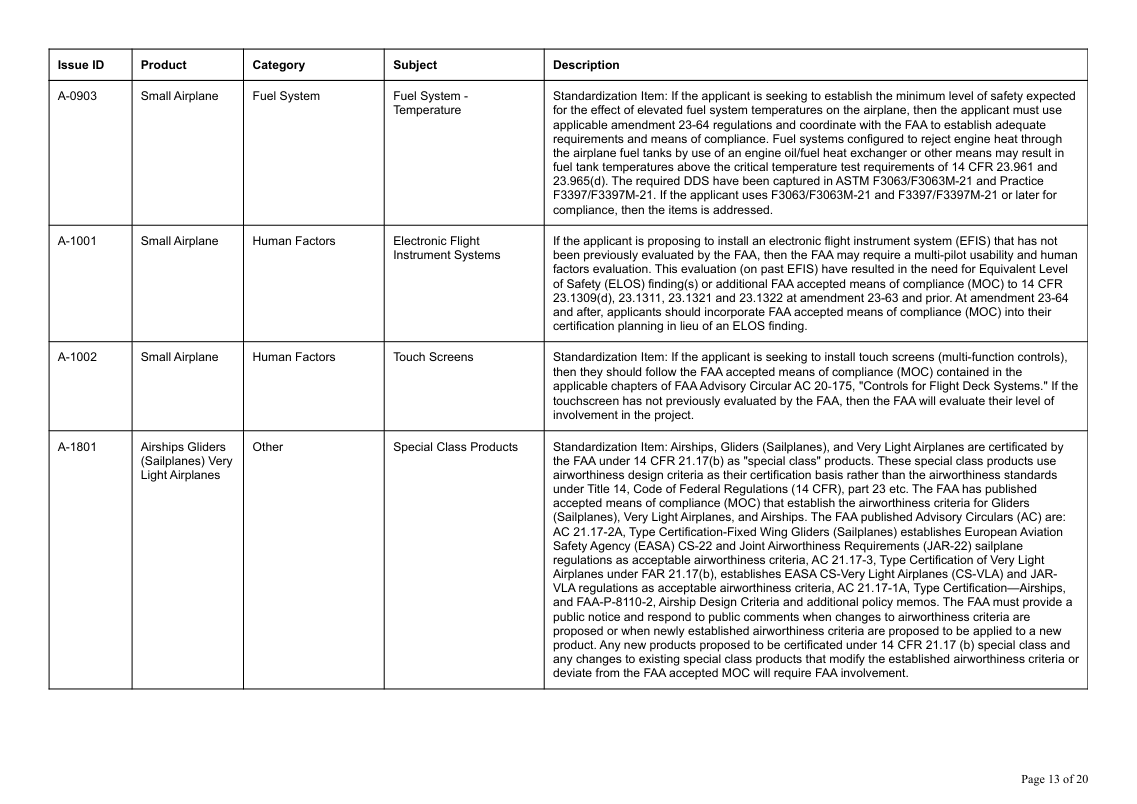
A-0903 Small Airplane Fuel System Fuel System - Temperature
Standardization Item: If the applicant is seeking to establish the minimum level of safety expected for the effect of elevated fuel system temperatures on the airplane, then the applicant must use applicable amendment 23-64 regulations and coordinate with the FAA to establish adequate requirements and means of compliance. Fuel systems configured to reject engine heat through the airplane fuel tanks by use of an engine oil/fuel heat exchanger or other means may result in fuel tank temperatures above the critical temperature test requirements of 14 CFR 23.961 and 23.965(d). The required DDS have been captured in ASTM F3063/F3063M-21 and Practice F3397/F3397M-21. If the applicant uses F3063/F3063M-21 and F3397/F3397M-21 or later for compliance, then the items is addressed.
A-1001 Small Airplane Human Factors Electronic Flight Instrument Systems
If the applicant is proposing to install an electronic flight instrument system (EFIS) that has not been previously evaluated by the FAA, then the FAA may require a multi-pilot usability and human factors evaluation. This evaluation (on past EFIS) have resulted in the need for Equivalent Level of Safety (ELOS) finding(s) or additional FAA accepted means of compliance (MOC) to 14 CFR 23.1309(d), 23.1311, 23.1321 and 23.1322 at amendment 23-63 and prior. At amendment 23-64 and after, applicants should incorporate FAA accepted means of compliance (MOC) into their certification planning in lieu of an ELOS finding.
A-1002 Small Airplane Human Factors Touch Screens Standardization Item: If the applicant is seeking to install touch screens (multi-function controls), then they should follow the FAA accepted means of compliance (MOC) contained in the applicable chapters of FAA Advisory Circular AC 20‐175, "Controls for Flight Deck Systems." If the touchscreen has not previously evaluated by the FAA, then the FAA will evaluate their level of involvement in the project.
A-1801 Airships Gliders (Sailplanes) Very Light Airplanes
Other Special Class Products Standardization Item: Airships, Gliders (Sailplanes), and Very Light Airplanes are certificated by the FAA under 14 CFR 21.17(b) as "special class" products. These special class products use airworthiness design criteria as their certification basis rather than the airworthiness standards under Title 14, Code of Federal Regulations (14 CFR), part 23 etc. The FAA has published accepted means of compliance (MOC) that establish the airworthiness criteria for Gliders (Sailplanes), Very Light Airplanes, and Airships. The FAA published Advisory Circulars (AC) are: AC 21.17-2A, Type Certification-Fixed Wing Gliders (Sailplanes) establishes European Aviation Safety Agency (EASA) CS-22 and Joint Airworthiness Requirements (JAR-22) sailplane regulations as acceptable airworthiness criteria, AC 21.17-3, Type Certification of Very Light Airplanes under FAR 21.17(b), establishes EASA CS-Very Light Airplanes (CS-VLA) and JAR- VLA regulations as acceptable airworthiness criteria, AC 21.17-1A, Type Certification—Airships, and FAA-P-8110-2, Airship Design Criteria and additional policy memos. The FAA must provide a public notice and respond to public comments when changes to airworthiness criteria are proposed or when newly established airworthiness criteria are proposed to be applied to a new product. Any new products proposed to be certificated under 14 CFR 21.17 (b) special class and any changes to existing special class products that modify the established airworthiness criteria or deviate from the FAA accepted MOC will require FAA involvement.
View figures, tables and original page layout